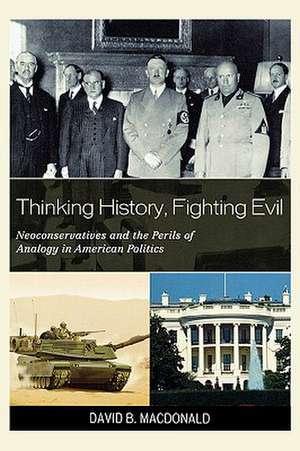
Thinking History, Fighting Evil
Autor David B. MacDonalden Limba Engleză Hardback – mai 2009
Preț: 676.21 lei
Preț vechi: 795.54 lei
-15%
Puncte Express: 1014
Carte tipărită la comandă
Livrare economică 06-20 iunie
Specificații
ISBN-13: 9780739125021
ISBN-10: 0739125028
Pagini: 220
Dimensiuni: 152 x 229 x 18 mm
Greutate: 0.52 kg
Ediția:New.
Editura: Bloomsbury Publishing
ISBN-10: 0739125028
Pagini: 220
Dimensiuni: 152 x 229 x 18 mm
Greutate: 0.52 kg
Ediția:New.
Editura: Bloomsbury Publishing
Descriere
Descriere de la o altă ediție sau format:
Thinking History, Fighting Evil presents the most thorough exploration to date of how World War II analogies, particularly those focused on the Holocaust, have colored American foreign policy-making after 9/11. In particular, this book highlights how influential neoconservatives inside and outside the Bush administration used analogies of the "Good War" to reinterpret domestic and international events, often with disastrous consequences. On the surface, World War II promotes a simple but compelling range of images and symbols: valiant Roosevelts and Churchills, appeasing Chamberlains, evil Hitlers, Jewish victims, European bystanders, and American liberators. However, the simplistic use of analogies was precisely what doomed the neoconservative project to failure. This book explores the misuse of ten key analogies arising from World War II and charts their problematic deployment after the 9/11 attacks.
Divided into eight chapters, Thinking History, Fighting Evil engages with timely issues such as the moral legacies of the civil rights era, identity politics movements, the representation of the Holocaust in American life, the rise of victim politics on the neoconservative right, the instrumentalization of anti-American and anti-Semitic discourses, the trans-Atlantic rift between Europe and the United States, and the war on terror. While the book focuses on the post-9/11 security environment, it also explores the history of negative exceptionalism in U.S. history and politics, tracing back Manichean conceptions of good and evil to the foundation of the early colonies.
Thinking History, Fighting Evil presents the most thorough exploration to date of how World War II analogies, particularly those focused on the Holocaust, have colored American foreign policy-making after 9/11. In particular, this book highlights how influential neoconservatives inside and outside the Bush administration used analogies of the "Good War" to reinterpret domestic and international events, often with disastrous consequences. On the surface, World War II promotes a simple but compelling range of images and symbols: valiant Roosevelts and Churchills, appeasing Chamberlains, evil Hitlers, Jewish victims, European bystanders, and American liberators. However, the simplistic use of analogies was precisely what doomed the neoconservative project to failure. This book explores the misuse of ten key analogies arising from World War II and charts their problematic deployment after the 9/11 attacks.
Divided into eight chapters, Thinking History, Fighting Evil engages with timely issues such as the moral legacies of the civil rights era, identity politics movements, the representation of the Holocaust in American life, the rise of victim politics on the neoconservative right, the instrumentalization of anti-American and anti-Semitic discourses, the trans-Atlantic rift between Europe and the United States, and the war on terror. While the book focuses on the post-9/11 security environment, it also explores the history of negative exceptionalism in U.S. history and politics, tracing back Manichean conceptions of good and evil to the foundation of the early colonies.
Cuprins
Chapter 1 Introduction
Part 2 Part 1. Analogies in U.S. Foreign Policy
Chapter 3 Chapter 1. Thinking History: Analogies and Schemas in International Politics
Chapter 4 Chapter 2. Fighting Evil: The Hebrew Shema and the Munich Analogy
Chapter 5 Chapter 3. World War II Analogies in American Politics
Part 6 Part 2. Neoconservatives and Historical Analogies
Chapter 7 Chapter 4. Neoconservatives and the American Weimar
Chapter 8 Chapter 5. Islam, the Holocaust, and the New Cold War
Chapter 9 Chapter 6. Swastikas in the Sand?: Neoconservatives and the War in Iraq
Part 10 Part 3. Anti-Americanism and the War on Terror
Chapter 11 Chapter 7. Righteous Victims: The Pathologies of Anti-Americanism
Chapter 12 Chapter 8. Near Enemies: The European Collaborators
Chapter 13 Conclusions
Part 2 Part 1. Analogies in U.S. Foreign Policy
Chapter 3 Chapter 1. Thinking History: Analogies and Schemas in International Politics
Chapter 4 Chapter 2. Fighting Evil: The Hebrew Shema and the Munich Analogy
Chapter 5 Chapter 3. World War II Analogies in American Politics
Part 6 Part 2. Neoconservatives and Historical Analogies
Chapter 7 Chapter 4. Neoconservatives and the American Weimar
Chapter 8 Chapter 5. Islam, the Holocaust, and the New Cold War
Chapter 9 Chapter 6. Swastikas in the Sand?: Neoconservatives and the War in Iraq
Part 10 Part 3. Anti-Americanism and the War on Terror
Chapter 11 Chapter 7. Righteous Victims: The Pathologies of Anti-Americanism
Chapter 12 Chapter 8. Near Enemies: The European Collaborators
Chapter 13 Conclusions
Recenzii
Combining conceptual rigor and detailed empirical application, this outstanding book shows how the 'lessons of history' continue to shape the perceptions of policies of American decision-makers. In particular, Thinking History, Fighting Evil provides some timely insight into the strategic miscalculations of the American neo-Conservatives during the Bush era.