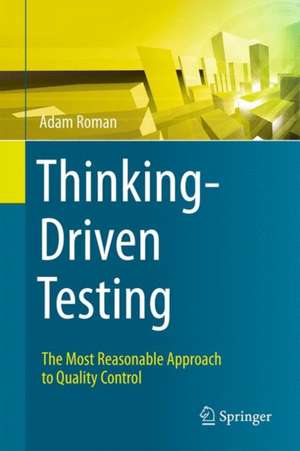
Thinking-Driven Testing
Autor Adam Romanen Limba Engleză Hardback – 27 mar 2018
This book presents a new paradigm of software testing by emphasizing the role of critical thinking, system thinking and rationality as the most important skills for the tester. It thus approaches software testing from a different perspective than in past literature, as the vast majority of books describe testing in the context of specific tools, automation, documentation, particular test design techniques or test management. In addition, the book proposes a novel meta-approach for designing effective test strategies, which is based on recent advances in psychology, economics, system sciences and logic.
Chapter 1 starts by introducing the fundamental ideas underlying software testing. Chapter 2 then describes meta-strategies in software testing, i.e. general approaches that can be adapted to many different situations that a software tester encounters. Next, Chapter 3 presents the concept of Thinking-Driven Testing (TDT). This approach utilizes the conceptsdiscussed in the two previous chapters and introduces the main ideas that underlie a reasonable and optimal approach to software testing. Chapter 4 builds on this basis and proposes a specific approach to testing, called TQED, that makes it possible to increase creativity in the context of delivering effective, optimal test ideas. Chapter 5 provides an overview of different types of testing techniques in order to understand the fundamental concepts of test design, while Chapter 6 details various pitfalls a tester may encounter and that can originate from a wide range of testing process areas. Lastly, Chapter 7 puts all this into practice, as it contains several exercises that will help testers develop a number of crucial skills: logical thinking and reasoning, thinking out of the box, creativity, counting and estimating, and analytical thinking.
By promoting critical, rational and creative thinking, this book invites readers to re-examine common assumptions regarding software testing and shows them how to become professional testers who bring added value to their company.
Preț: 499.78 lei
Preț vechi: 624.72 lei
-20%
Puncte Express: 750
Carte tipărită la comandă
Livrare economică 28 noiembrie-12 decembrie
Livrare prin curier în România Termenul estimat este afișat lângă disponibilitate.
Transport gratuit pentru acest produs Plată online sau ramburs, în funcție de opțiunile comenzii.
Retur gratuit în 14 zile Comandă securizată și suport în română.
Specificații
ISBN-13: 9783319731940
ISBN-10: 3319731947
Pagini: 332
Ilustrații: XXV, 305 p. 84 illus., 7 illus. in color.
Dimensiuni: 160 x 241 x 24 mm
Greutate: 0.61 kg
Ediția:1st ed. 2018
Editura: Springer
Locul publicării:Cham, Switzerland
ISBN-10: 3319731947
Pagini: 332
Ilustrații: XXV, 305 p. 84 illus., 7 illus. in color.
Dimensiuni: 160 x 241 x 24 mm
Greutate: 0.61 kg
Ediția:1st ed. 2018
Editura: Springer
Locul publicării:Cham, Switzerland
V-ar putea interesa
-
 Test Requirement Driven DevelopmentMichael O'Reilly-20%Preț: 100.71 lei125.89 lei
 -
 Agile SoftwareJoseph Bergin-20%Preț: 188.56 lei235.70 lei
 -
 Software Engineering Essentials, Volume IRichard Hall Thayer-20%Preț: 287.02 lei358.79 lei
 -
 Software Engineering Essentials, Volume IIRichard Hall Thayer-20%Preț: 286.67 lei358.33 lei
 -
 Software Engineering Essentials, Volume IIIRichard Hall Thayer-20%Preț: 226.11 lei282.63 lei
 -
 -20%Preț: 188.64 lei235.81 lei
 -
 Effective Project Management for Software DevelopmentJonathan Cook-20%Preț: 51.43 lei64.28 lei
 -
 World Class SoftwareJonathan Cook-20%Preț: 54.63 lei68.29 lei
 -
 HackingGary Hall-20%Preț: 65.20 lei81.51 lei
 -
 -20%Preț: 293.16 lei366.46 lei
 -
 Software Reuse, Second EditionRonald J. Leach-20%Preț: 158.26 lei197.84 lei
 -
 Predicting the UnpredictableJohanna RothmanPreț: 153.95 lei
 -
 Maschinelle Übersetzung: Ein Überblick über Theorie und PraxisMartina Reimann-20%Preț: 359.63 lei449.54 lei
 -
 Parallel Image ProcessingT. Bräunl-20%Preț: 319.37 lei399.21 lei
 -
 Analysis and Design of AdviceIvan Jureta-20%Preț: 351.20 lei439.01 lei
 -
 -20%Preț: 115.77 lei144.71 lei
Cuprins
1 Fundamentals of Software Testing.- 2 Testing strategies – how to become a better tester?.- 3 Thinking-Driven Testing: a universal testing framework.- 4 TQED model.- 5 Testing techniques.- 6 Testing pitfalls and how to avoid them.- 7 Kata and exercises for testers.
Notă biografică
Prof. Adam Roman, PhD, DSc is professor of computer science, research and teaching fellow at the Institute of Computer Science and Computer Mathematics at Jagiellonian University in Krakow, Poland, where he has been giving lectures and seminars on software testing and quality assurance for many years. He is the head of the Software Engineering Department and co-founder of the "Software Testing" and "Business Analysis" postgraduate studies at Jagiellonian University. His research interests include software measurement, defect prediction models, and effective test design techniques. Member of many ISTQB® working groups, co-author of several ISTQB® syllabi, including the Advanced Level – Test Analyst v4.0 syllabus. ISTQB® accredited trainer.
Matthias Hamburg, PhD was Managing Consultant at Sogeti (part of Capgemini) until his retirement in September 2019. His professional focus is on test analysis, test management, and test process improvement. He continues his involvement in the German Testing Board (GTB) and in the International Software Testing Qualifications Board (ISTQB®) voluntarily. As Chair of the ISTQB® Glossary Working Group, he publishes the ISTQB® Standard Glossary of Testing Terms and is the product owner of the Glossary app. In this role, he continues to be an active practitioner of testing and enjoys piloting innovative methods. In addition, he leads the task force for the ISTQB® Advanced Level Test Analyst Syllabus.
Textul de pe ultima copertă
This book presents a new paradigm of software testing by emphasizing the role of critical thinking, system thinking and rationality as the most important skills for the tester. It thus approaches software testing from a different perspective than in past literature, as the vast majority of books describe testing in the context of specific tools, automation, documentation, particular test design techniques or test management. In addition, the book proposes a novel meta-approach for designing effective test strategies, which is based on recent advances in psychology, economics, system sciences and logic.
Chapter 1 starts by introducing the fundamental ideas underlying software testing. Chapter 2 then describes meta-strategies in software testing, i.e. general approaches that can be adapted to many different situations that a software tester encounters. Next, Chapter 3 presents the concept of Thinking-Driven Testing (TDT). This approach utilizes the conceptsdiscussed in the two previous chapters and introduces the main ideas that underlie a reasonable and optimal approach to software testing. Chapter 4 builds on this basis and proposes a specific approach to testing, called TQED, that makes it possible to increase creativity in the context of delivering effective, optimal test ideas. Chapter 5 provides an overview of different types of testing techniques in order to understand the fundamental concepts of test design, while Chapter 6 details various pitfalls a tester may encounter and that can originate from a wide range of testing process areas. Lastly, Chapter 7 puts all this into practice, as it contains several exercises that will help testers develop a number of crucial skills: logical thinking and reasoning, thinking out of the box, creativity, counting and estimating, and analytical thinking.
By promoting critical, rational and creative thinking, this book invites readers to re-examine common assumptions regarding software testing and shows them how to become professional testers who bring added value to their company.