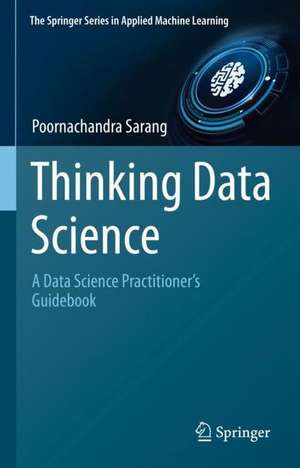
Thinking Data Science: The Springer Series in Applied Machine Learning
Autor Poornachandra Sarangen Limba Engleză Hardback – 2 mar 2023
The challenge for a data scientist is to extract meaningful information from huge datasets that will help to create better strategies for businesses. Many Machine Learning algorithms and Neural Networks are designed to do analytics on such datasets. For a data scientist, it is a daunting decision as to which algorithm to use for a given dataset. Although there is no single answer to this question, a systematic approach to problem solving is necessary. This book describes the various ML algorithms conceptually and defines/discusses a process in the selection of ML/DL models. The consolidation of available algorithms and techniques for designing efficient ML models is the key aspect of this book. Thinking Data Science will help practising data scientists, academicians, researchers, and students who want to build ML models using the appropriate algorithms and architectures, whether the data be small or big.




Preț: 317.79 lei
Puncte Express: 477
Carte disponibilă
Livrare economică 06-20 noiembrie
Livrare express 23-29 octombrie pentru 49.65 lei
Livrare prin curier în România Termenul estimat este afișat lângă disponibilitate.
Transport gratuit de la 400.00 lei Plată online sau ramburs, în funcție de opțiunile comenzii.
Retur gratuit în 14 zile Comandă securizată și suport în română.
Specificații
ISBN-13: 9783031023620
ISBN-10: 3031023625
Pagini: 380
Ilustrații: XX, 358 p. 233 illus., 132 illus. in color.
Dimensiuni: 160 x 241 x 26 mm
Greutate: 0.68 kg
Ediția:2023
Editura: Springer
Colecția The Springer Series in Applied Machine Learning
Seria The Springer Series in Applied Machine Learning
Locul publicării:Cham, Switzerland
ISBN-10: 3031023625
Pagini: 380
Ilustrații: XX, 358 p. 233 illus., 132 illus. in color.
Dimensiuni: 160 x 241 x 26 mm
Greutate: 0.68 kg
Ediția:2023
Editura: Springer
Colecția The Springer Series in Applied Machine Learning
Seria The Springer Series in Applied Machine Learning
Locul publicării:Cham, Switzerland
V-ar putea interesa
-
 Java ProgrammingPoornachandra Sarang-20%Preț: 286.07 lei357.59 lei
 -
 The Technological SingularityMurray Shanahan-21%Preț: 97.48 lei122.92 lei
 -
 Building Problem SolversKenneth D. Forbus-20%Preț: 664.63 lei830.79 lei
 -
 Experiments in the Machine Interpretation of Visual MotionDavid W. Murray-20%Preț: 201.39 lei251.74 lei
 -
 -20%Preț: 161.79 lei202.24 lei
 -
 -20%Preț: 641.59 lei801.99 lei
 -
 Practical LiferayPoornachandra Sarang-20%Preț: 331.70 lei414.63 lei
 -
 Artificial Neural Networks with Tensorflow 2Poornachandra SarangPreț: 427.63 lei
 -
 -20%Preț: 1627.47 lei2034.34 lei
 -
 Pro Apache XMLPoornachandra Sarang-20%Preț: 382.79 lei478.50 lei
 -
 Dimension Reduction: A Guided TourChristopher J. C. Burges-20%Preț: 374.58 lei468.22 lei
 -
 -20%Preț: 424.76 lei530.96 lei
 -
 Kernels for Vector-Valued Functions: A ReviewMauricio A. Lvarez-20%Preț: 325.02 lei406.27 lei
 -
 -20%Preț: 349.65 lei437.06 lei
 -
 -20%Preț: 473.69 lei592.12 lei
 -
 Semantic Matching in SearchHang Li-20%Preț: 473.69 lei592.12 lei
 -
 Theory of Disagreement-Based Active LearningSteve Hanneke-20%Preț: 495.69 lei619.61 lei
 -
 -20%Preț: 496.31 lei620.39 lei
 -
 Adaptation, Learning, and Optimization Over NetworksAli H. Sayed-20%Preț: 510.76 lei638.44 lei
 -
 Lifelong Machine LearningZhiyuan Chen-20%Preț: 373.95 lei467.43 lei
 -
 MACHINE LEARNING FOR FINANCIAL ENGINEERIGyorfi Laszlo-20%Preț: 566.21 lei707.76 lei
 -
 Machine Learning Approaches to BioinformaticsZheng Rong Yang-20%Preț: 717.44 lei896.79 lei
Cuprins
Chapter. 1. Data Science Process.- Chapter. 2. Dimensionality Reduction - Creating Manageable Training Datasets.- Chapter. 3. Classical Algorithms - Over-view.- Chapter. 4. Regression Analysis.- Chapter. 5. Decision Tree.- Chapter. 6. Ensemble - Bagging and Boosting.- Chapter. 7. K-Nearest Neighbors.- Chapter. 8. Naive Bayes.- Chapter. 9. Support Vector Machines: A supervised learning algorithm for Classification and Regression.- Chapter. 10. Clustering Overview.- Chapter. 11. Centroid-based Clustering.- Chapter. 12. Connectivity-based Clustering.- Chapter. 13. Gaussian Mixture Model.- Chapter. 14. Density-based.- Chapter. 15.- BIRCH.- Chapter. 16. CLARANS.- Chapter. 17. Affinity Propagation Clustering.- Chapter. 18. STING.- Chapter. 19. CLIQUE.- Chapter. 20. Artificial Neural Networks.- Chapter. 21. ANN-based Applications.- Chapter. 22. Automated Tools.- Chapter. 23. DataScientist’s Ultimate Workflow.
Notă biografică
Dr. Poornachandra Sarang has worked in various capacities in the IT industry during his tenure of more than 20 years. Dr. Sarang provides consulting and training in enterprise architecting, solution architecting, design and development to a large number of clients worldwide. He has been a consultant to Sun Microsystems for several years and his recent engagements include director of architecture for Kynetia (a Spanish origin MNC). He has been a recipient of Microsoft's "Most Valuable Professional" award for two consecutive years. He has spoken on Java/CORBA/XML/.NET at several international conferences organized by O'Reilly, SYS-CON, WROX, SUN and Microsoft in countries including India, U.S.A., U.K., Switzerland, and Singapore. He has been invited to deliver keynote speeches in highly-acclaimed Microsoft Architect Summits and several other prestigious events. He has several research papers, journal articles and books to his credit. Dr. Sarang has been a visiting professor of computer engineering at the University of Notre Dame, and currently holds a position of adjunct faculty at the Department of Computer Science of the University of Mumbai, India, where he teaches post-graduates courses, provides project guidance to post-graduate students and guides Ph.D. students. His current research interests include distributed systems, mobile computing and algorithm development. He may be reached at profsarang@gmail.com.
Textul de pe ultima copertă
This definitive guide to Machine Learning projects answers the problems an aspiring or experienced data scientist frequently has: Confused on what technology to use for your ML development? Should I use GOFAI, ANN/DNN or Transfer Learning? Can I rely on AutoML for model development? What if the client provides me Gig and Terabytes of data for developing analytic models? How do I handle high-frequency dynamic datasets? This book provides the practitioner with a consolidation of the entire data science process in a single “Cheat Sheet”.
The challenge for a data scientist is to extract meaningful information from huge datasets that will help to create better strategies for businesses. Many Machine Learning algorithms and Neural Networks are designed to do analytics on such datasets. For a data scientist, it is a daunting decision as to which algorithm to use for a given dataset. Although there is no single answer to this question, a systematic approach to problem solving is necessary. This book describes the various ML algorithms conceptually and defines/discusses a process in the selection of ML/DL models. The consolidation of available algorithms and techniques for designing efficient ML models is the key aspect of this book. Thinking Data Science will help practising data scientists, academicians, researchers, and students who want to build ML models using the appropriate algorithms and architectures, whether the data be small or big.
The challenge for a data scientist is to extract meaningful information from huge datasets that will help to create better strategies for businesses. Many Machine Learning algorithms and Neural Networks are designed to do analytics on such datasets. For a data scientist, it is a daunting decision as to which algorithm to use for a given dataset. Although there is no single answer to this question, a systematic approach to problem solving is necessary. This book describes the various ML algorithms conceptually and defines/discusses a process in the selection of ML/DL models. The consolidation of available algorithms and techniques for designing efficient ML models is the key aspect of this book. Thinking Data Science will help practising data scientists, academicians, researchers, and students who want to build ML models using the appropriate algorithms and architectures, whether the data be small or big.
Caracteristici
Written for both aspiring and working data scientists to develop and improve their AI applications Teaches how to handle numeric, text and image datasets, GOFAI and ANN/DNN development, and use automated tools Includes a large section on clustering algorithms, explaining their applications for various sized datasets