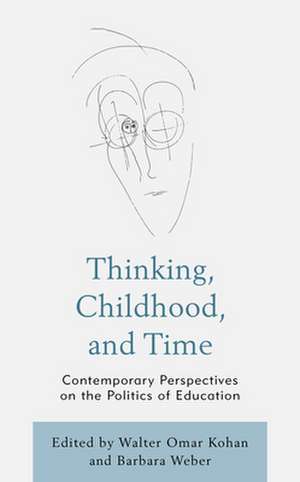
Thinking, Childhood, and Time: Contemporary Perspectives on the Politics of Education: Philosophy of Childhood
Editat de Walter Omar Kohan, Barbara Weber Contribuţii de Adrienne Argent, Iris Berger, Michael A. Bonnett, Annalisa Caputo, Peter Costello, David Kennedy, Pablo Muruzábal Lamberti, James Mensch, Juliana Merçon, Karin Murris, Toby Rollo, Cristina Delgado Vintimillaen Limba Engleză Hardback – 6 oct 2020
The contributors explore childhood as a philosophical concept in children, adults, and even beyond human beings-Childhood as a (forgotten) dimension of the world. Contributors also argue that a pedagogy that does not aim for an "exodus of childhood," but rather responds to the arrival of a new human being responsibly (dialogically), fosters a deeper appreciation of the newness that children bring in order to sensitize us for our own Childhood as adults as well and allow us to welcome other forms of childhood in the world. As a whole, this book argues that the experience of natality, such as the beginning of life, is not chronologically determined, but rather can occur more than once in a human life and beyond. Scholars of philosophy, education, psychology, and childhood studies will find this book particularly useful.



Preț: 555.37 lei
Preț vechi: 837.41 lei
-34%
Puncte Express: 833
Carte tipărită la comandă
Livrare economică 13-27 iunie
Specificații
ISBN-13: 9781793604583
ISBN-10: 1793604584
Pagini: 252
Ilustrații: 2 b/w photos; 1 tables;
Dimensiuni: 160 x 230 x 22 mm
Greutate: 0.52 kg
Editura: Bloomsbury Publishing
Colecția Lexington Books
Seria Philosophy of Childhood
Locul publicării:New York, United States
ISBN-10: 1793604584
Pagini: 252
Ilustrații: 2 b/w photos; 1 tables;
Dimensiuni: 160 x 230 x 22 mm
Greutate: 0.52 kg
Editura: Bloomsbury Publishing
Colecția Lexington Books
Seria Philosophy of Childhood
Locul publicării:New York, United States
V-ar putea interesa
-
 Preț: 370.45 lei
 -
 -25%Preț: 303.62 lei402.35 lei
 -
 Gramsci and EducationCarmel Borg-33%Preț: 357.56 lei535.59 lei
 -
 Richard Rorty: Education, Philosophy, and PoliticsMichael A. Peters-25%Preț: 333.46 lei446.19 lei
 -
 Complete Your Dissertation or Thesis in Two Semesters or LessEvelyn Hunt Ogden-31%Preț: 121.99 lei176.57 lei
 -
 Socrates, Sport, and Students: A Philosophical Inquiry into Physical Education and SportSheryle Bergmann Drewe Dixon-33%Preț: 498.92 lei744.70 lei
 -
 -33%Preț: 342.27 lei514.61 lei
 -
 Basic College Research SkillsSteven Bookman-28%Preț: 262.53 lei365.41 lei
 -
 -28%Preț: 252.80 lei349.15 lei
 -
 ADHD: Helping Parents Help Their ChildrenEdward H. Jacobs-32%Preț: 543.84 lei798.98 lei
 -
 -25%Preț: 249.10 lei331.40 lei
 -
 -18%Preț: 1078.34 lei1315.05 lei
 -
 Work Experience in Secondary SchoolsJohn Eggleston-15%Preț: 548.52 lei645.32 lei
 -
 Preț: 409.02 lei
 -
 -18%Preț: 1213.15 lei1479.45 lei
 -
 Crafting Culturally Efficacious Teacher Preparation and PedagogiesBelinda Bustos Flores-15%Preț: 623.42 lei733.43 lei
 -
 Exploring Careers in MusicThe National Association for Music Education, MENC:-26%Preț: 207.44 lei282.21 lei
 -
 Dewey and Education in the 21st Century – Fighting BackRuth Heilbronn-19%Preț: 625.67 lei772.44 lei
Cuprins
Acknowledgments
Part One: Phenomenological Explorations of Time, Thinking and Embodiment
Chapter 1: Childhood and the Genesis of Time: A Phenomenological Approach
James Mensch
Chapter 2: Child and Time: A Phenomenological Journey into the Human Conditions of Education
Barbara Weber
Chapter 3: Think Like a Girl: Scout's Time and Experience in To Kill a Mockingbird
Peter Costello
Chapter 4: Listening, Phronein and the First Principle of Happiness
Pablo Muruzábal Lamberti
Chapter 5: Thinking and the Play of Being
Michael A. Bonnett
Chapter 6: Philosophia Ludens for Children: A Proposal to Play and to Think
Annalisa Caputo
Part Two: Decolonial and Postructuralist Perspectives on the Politics of Education
Chapter 7: Becoming Child: Wild Being and the Post-Human
David Kennedy
Chapter 8: Paulo Freire and the Childhood of a Philosophical and Educational Life
Walter Omar Kohan
Chapter 9: Democratic Child's Play: Natality, Responsible Education, and Decolonial Praxis
Toby Rollo
Chapter 10:
Part One: Phenomenological Explorations of Time, Thinking and Embodiment
Chapter 1: Childhood and the Genesis of Time: A Phenomenological Approach
James Mensch
Chapter 2: Child and Time: A Phenomenological Journey into the Human Conditions of Education
Barbara Weber
Chapter 3: Think Like a Girl: Scout's Time and Experience in To Kill a Mockingbird
Peter Costello
Chapter 4: Listening, Phronein and the First Principle of Happiness
Pablo Muruzábal Lamberti
Chapter 5: Thinking and the Play of Being
Michael A. Bonnett
Chapter 6: Philosophia Ludens for Children: A Proposal to Play and to Think
Annalisa Caputo
Part Two: Decolonial and Postructuralist Perspectives on the Politics of Education
Chapter 7: Becoming Child: Wild Being and the Post-Human
David Kennedy
Chapter 8: Paulo Freire and the Childhood of a Philosophical and Educational Life
Walter Omar Kohan
Chapter 9: Democratic Child's Play: Natality, Responsible Education, and Decolonial Praxis
Toby Rollo
Chapter 10:
Recenzii
[T]he time spent contemplating, making connections, and seeking application to the brilliant ideas presented in Thinking, childhood, and Time was time well spent. This work will be read and taught for years to come.
Readers who recognize in a child's experience not merely an imperfect attempt at adulthood-but, rather, a unique and profound expressivity-will cherish the work that Peter Costello has advanced in Philosophical Children in Literary Situations. Costello's gracious and deeply insightful book engages with classics of children's literature while providing multiple, lucid points of entry into a richly-layered phenomenological method. He writes not only for philosophers but also for educators, parents, and researchers seeking new ways of understanding the complexities of gender, race, meaning, and community that shape a child's perceptual world.
This impressive book is a significant contribution to the emergent field of philosophy of childhood. It breaks new ground by extending our understanding of childhood beyond the chronological, deficit, and romantic conceptions. Thinking, Childhood, and Time includes thirteen original essays that work together to reanimate our sense of childhood as an existential state. In essays that draw upon literature, phenomenology, postmodern theories, and posthuman approaches, the contributors' explorations of time, natality, community, creativity, culture, and schooling are equally poetic, perceptive, and provocative. A testament to the philosophical interestingness of childhood, this book will have an immediate and lasting impact in education.
Readers who recognize in a child's experience not merely an imperfect attempt at adulthood-but, rather, a unique and profound expressivity-will cherish the work that Peter Costello has advanced in Philosophical Children in Literary Situations. Costello's gracious and deeply insightful book engages with classics of children's literature while providing multiple, lucid points of entry into a richly-layered phenomenological method. He writes not only for philosophers but also for educators, parents, and researchers seeking new ways of understanding the complexities of gender, race, meaning, and community that shape a child's perceptual world.
This impressive book is a significant contribution to the emergent field of philosophy of childhood. It breaks new ground by extending our understanding of childhood beyond the chronological, deficit, and romantic conceptions. Thinking, Childhood, and Time includes thirteen original essays that work together to reanimate our sense of childhood as an existential state. In essays that draw upon literature, phenomenology, postmodern theories, and posthuman approaches, the contributors' explorations of time, natality, community, creativity, culture, and schooling are equally poetic, perceptive, and provocative. A testament to the philosophical interestingness of childhood, this book will have an immediate and lasting impact in education.