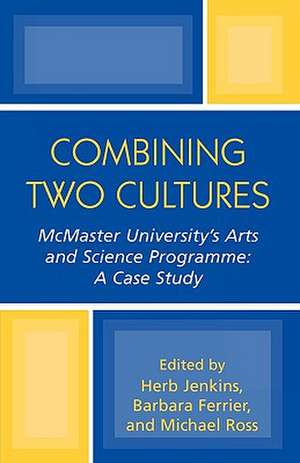
Combining Two Cultures: McMaster University's Arts and Science Programme
Editat de Herb Jenkins, Barbara Ferrier, Michael T. Ross Contribuţii de Leslie J. King, Louis Greenspan, Sylvia Bowerbank, Mark Vorobej, Graham Knight, Jennifer Smith Maguire, P.K Rangachari, Bill Harris, Miroslav Lovric, Roman Viveros-Aguilera, Jean Wilson, Bob Hudspith, and Gary Warneren Limba Engleză Paperback – aug 2004
Preț: 356.27 lei
Preț vechi: 532.06 lei
-33%
Puncte Express: 534
Carte tipărită la comandă
Livrare economică 19 noiembrie-03 decembrie
Livrare prin curier în România Termenul estimat este afișat lângă disponibilitate.
Transport gratuit de la 400.00 lei Plată online sau ramburs, în funcție de opțiunile comenzii.
Retur gratuit în 14 zile Comandă securizată și suport în română.
Specificații
ISBN-13: 9780761829294
ISBN-10: 0761829296
Pagini: 289
Dimensiuni: 177 x 214 x 23 mm
Greutate: 0.4 kg
Editura: Bloomsbury Publishing
Colecția University Press of America
Locul publicării:New York, United States
ISBN-10: 0761829296
Pagini: 289
Dimensiuni: 177 x 214 x 23 mm
Greutate: 0.4 kg
Editura: Bloomsbury Publishing
Colecția University Press of America
Locul publicării:New York, United States
V-ar putea interesa
-
 The Value of the HumanitiesHelen Small-18%Preț: 189.69 lei230.76 lei
 -
 Understanding History TeachingChris Husbands-29%Preț: 169.57 lei239.27 lei
 -
 Essential Primary HistoryChristopher Russell-29%Preț: 168.38 lei238.59 lei
 -
 Knowmad SocietyJohn W. MoravecPreț: 141.30 lei
 -
 Blackwell Guide to the PhilosoAlison SmithPreț: 321.76 lei
 -
 Leadership for a Better WorldNclp (National Clearinghouse for Leadership Programs)Preț: 329.83 lei
 -
 Humanizing the Education MachineRex MillerPreț: 192.55 lei
 -
 Educating the Reflective PractitionerDonald A. SchonPreț: 301.44 lei
 -
 Pedagogy of IndignationPaulo FreirePreț: 385.78 lei
 -
 Beyond Learning: Democratic Education for a Human FutureGert J. J. BiestaPreț: 403.72 lei
 -
 PhilosophyKevin PerryPreț: 109.04 lei
Cuprins
Chapter 1 Preface
Chapter 2 Quest for Meaning in Undergraduate Education
Chapter 3 Planning and Approval of the Arts and Science Programme
Chapter 4 The Programme in Practice
Chapter 5 Western Civilization Courses
Chapter 6 Writing and Informal Logic
Chapter 7 Inquiry Courses
Chapter 8 Mathematics and Physics Courses
Chapter 9 Literature, Technology, and Society
Chapter 10 The Human Face of the Programme
Chapter 11 What Have We Achieved?
Chapter 12 Future Directions
Chapter 13 Reflections
Chapter 14 Contributors
Chapter 2 Quest for Meaning in Undergraduate Education
Chapter 3 Planning and Approval of the Arts and Science Programme
Chapter 4 The Programme in Practice
Chapter 5 Western Civilization Courses
Chapter 6 Writing and Informal Logic
Chapter 7 Inquiry Courses
Chapter 8 Mathematics and Physics Courses
Chapter 9 Literature, Technology, and Society
Chapter 10 The Human Face of the Programme
Chapter 11 What Have We Achieved?
Chapter 12 Future Directions
Chapter 13 Reflections
Chapter 14 Contributors
Recenzii
Since C.P. Snow coined a famous term for an old dichotomy?namely, the Two Cultures?attempts have been made to overcome the great divide between the humanities and the sciences in the modern university and in modern culture. Most attempts have failed topay anything more than lipservice?the divide remains enormous. But since 1981, McMaster University in Hamilton, Ontario, has put its money where its mouth is by offering the justifiably prestigious undergraduate degree programme (students selected from amongst some of the best in the country) combines a thorough liberal arts and humanities schooling intertwined witha comprehensive science education (including math, physics, and biology). Unique in its origins, the Arts and Science programme has becomea model for fully integrated science and liberal arts programmes across North America. 'Combining Two Cultures', collectively written to commemorate the 25th year of this exemplary programme, brings together past and present Arts and Sciencesfounders, instructors, directors and commentators to explore in detail the birth, history,. structure, meaning, place, and future of this uniquely integrated programme? its instructional philosophy, the structure of its instruction, and its place in the u
Since C.P. Snow coined a famous term for an old dichotomy-namely, the "Two Cultures"-attempts have been made to overcome the great divide between the humanities and the sciences in the modern university and in modern culture. Most attempts have failed to pay anything more than lipservice-the divide remains enormous. But since 1981, McMaster University in Hamilton, Ontario, has put its money where its mouth is by offering the justifiably prestigious undergraduate degree programme (students selected from amongst some of the best in the country) combines a thorough "liberal arts and humanities" schooling intertwined witha comprehensive science education (including math, physics, and biology). Unique in its origins, the "Arts and Science" programme has become a model for fully integrated science and liberal arts programmes across North America. 'Combining Two Cultures', collectively written to commemorate the 25th year of this exemplary programme, brings together past and present "Arts and Sciences" founders, instructors, directors and commentators to explore in detail the birth, history,. structure, meaning, place, and future of this uniquely integrated programme- its instructional philosophy, the structure of its instruction, and its place in the university and body politic. The excitement and skill of their mission jump from every page. (An interesting and delightful addition to the book is the set of responses from graduates of "Arts and Sciences" in their own words showing the program's success at producing well-rounded, confident, and socially engaged public intellectuals.) 'Combining Two Cultures' will be of much interest to those concerned about the fate of education in our modern culture, to educators and students alike, to those who are engaged in similar and hopeful enterprises, and especially tho those who, like C.P. Snow, see enormous value-indeed, urgency-in the overcoming of the 'Two Cultures' dichotomy in our modern world.
Since C.P. Snow coined a famous term for an old dichotomy-namely, the "Two Cultures"-attempts have been made to overcome the great divide between the humanities and the sciences in the modern university and in modern culture. Most attempts have failed to pay anything more than lipservice-the divide remains enormous. But since 1981, McMaster University in Hamilton, Ontario, has put its money where its mouth is by offering the justifiably prestigious undergraduate degree programme (students selected from amongst some of the best in the country) combines a thorough "liberal arts and humanities" schooling intertwined witha comprehensive science education (including math, physics, and biology). Unique in its origins, the "Arts and Science" programme has become a model for fully integrated science and liberal arts programmes across North America. 'Combining Two Cultures', collectively written to commemorate the 25th year of this exemplary programme, brings together past and present "Arts and Sciences" founders, instructors, directors and commentators to explore in detail the birth, history,. structure, meaning, place, and future of this uniquely integrated programme- its instructional philosophy, the structure of its instruction, and its place in the university and body politic. The excitement and skill of their mission jump from every page. (An interesting and delightful addition to the book is the set of responses from graduates of "Arts and Sciences" in their own words showing the program's success at producing well-rounded, confident, and socially engaged public intellectuals.) 'Combining Two Cultures' will be of much interest to those concerned about the fate of education in our modern culture, to educators and students alike, to those who are engaged in similar and hopeful enterprises, and especially tho those who, like C.P. Snow, see enormous value-indeed, urgency-in the overcoming of the 'Two Cultures' dichotomy in our modern world.