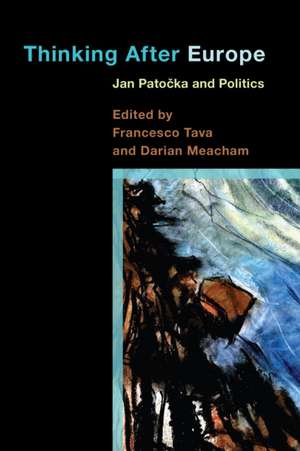
Thinking After Europe: Jan Patocka and Politics
Editat de Francesco Tava, Darian Meachamen Limba Engleză Paperback – 16 aug 2016
Europe as an idea and a political project is a central issue in contemporary political theory. Patocka's political thought offers many original insights into questions surrounding the European project. Here, for the first time, a group of leading scholars from different disciplines gathers together to discuss the specific political impact of Patocka's philosophy and its lasting significance.
Preț: 372.35 lei
Preț vechi: 486.48 lei
-23%
Puncte Express: 559
Carte tipărită la comandă
Livrare economică 07-21 decembrie
Livrare prin curier în România Termenul estimat este afișat lângă disponibilitate.
Transport gratuit de la 400.00 lei Plată online sau ramburs, în funcție de opțiunile comenzii.
Retur gratuit în 14 zile Comandă securizată și suport în română.
Specificații
ISBN-13: 9781783486854
ISBN-10: 1783486856
Pagini: 416
Ilustrații: 1 b/w photos;
Dimensiuni: 154 x 224 x 30 mm
Greutate: 0.64 kg
Editura: Bloomsbury Publishing
Colecția Rowman & Littlefield
Locul publicării:New York, United States
ISBN-10: 1783486856
Pagini: 416
Ilustrații: 1 b/w photos;
Dimensiuni: 154 x 224 x 30 mm
Greutate: 0.64 kg
Editura: Bloomsbury Publishing
Colecția Rowman & Littlefield
Locul publicării:New York, United States
V-ar putea interesa
-
 -15%Preț: 63.83 lei75.08 lei
 -
 The Phenomenal SelfBarry Dainton-19%Preț: 370.43 lei459.22 lei
 -
 Heidegger and Cognitive ScienceJ. Kiverstein-15%Preț: 704.77 lei829.15 lei
 -
 Preț: 268.48 lei
 -
 Heidegger on Being and Acting – From Principles to AnarchyReiner SchürmannPreț: 237.07 lei
 -
 Jean-Paul Sartre: Basic WritingsStephen PriestPreț: 319.09 lei
 -
 Preț: 157.11 lei
 -
 Maurice Merleau-Ponty: Basic WritingsThomas BaldwinPreț: 379.76 lei
 -
 The Archaic: The Past in the PresentPaul BishopPreț: 426.32 lei
 -
 Phenomenology of PerceptionMaurice Merleau-PontyPreț: 332.94 lei
 -
 Preț: 251.88 lei
 -
 Fear and Trembling and the Sickness Unto DeathSøren KierkegaardPreț: 88.56 lei
 -
 Not SavedPeter SloterdijkPreț: 238.71 lei
 -
 Communication Despite PostmodernismJoseph J. Pilotta-27%Preț: 1607.54 lei2188.40 lei
 -
 Toward an Existential Philosophy of the SoulRichard SchainPreț: 80.30 lei
Cuprins
Editors' Introduction / Acknowledgements / Part I: Intellectuals and Opposition
1. Translators' Preface / 2. Intellectuals and Opposition, Jan Patocka / 3. Appendix / Part II: Dissidence and Political Commitment / 4. Jan Patocka and the Possibility of a Spiritual Politics, Ivan Chvatík / 5. Resisting Fear: On Dissent and the Solidarity of the Shaken in Contemporary European and Global Society, Jiri Príbán / 6. The Soul as Site of Dissidence, Simona Forti / Part III: Political Phenomenology / 7. Polemos in Jan Patocka's Political Thought, James Dodd / 8. Supercivilisation and Biologism, Darian Meacham / 9. Caring for the Asubjective Soul, James Mensch / Part IV: Philosophy of History / 10. He Who Saw the Deep: The Epic of Gilgamesh in Patocka's Philosophy of History, Nicolas De Warren / 11. The Dark Night of the Care for the Soul - Politics and Despair in Jan Patocka's Sixth Heretical Essay, Daniel Leufer / 12. The Heresy of History: Patocka's Reflections on Marx and Marxism, Francesco Tava / 13. The End of H
1. Translators' Preface / 2. Intellectuals and Opposition, Jan Patocka / 3. Appendix / Part II: Dissidence and Political Commitment / 4. Jan Patocka and the Possibility of a Spiritual Politics, Ivan Chvatík / 5. Resisting Fear: On Dissent and the Solidarity of the Shaken in Contemporary European and Global Society, Jiri Príbán / 6. The Soul as Site of Dissidence, Simona Forti / Part III: Political Phenomenology / 7. Polemos in Jan Patocka's Political Thought, James Dodd / 8. Supercivilisation and Biologism, Darian Meacham / 9. Caring for the Asubjective Soul, James Mensch / Part IV: Philosophy of History / 10. He Who Saw the Deep: The Epic of Gilgamesh in Patocka's Philosophy of History, Nicolas De Warren / 11. The Dark Night of the Care for the Soul - Politics and Despair in Jan Patocka's Sixth Heretical Essay, Daniel Leufer / 12. The Heresy of History: Patocka's Reflections on Marx and Marxism, Francesco Tava / 13. The End of H
Recenzii
More than any other volume, Thinking after Europe demonstrates the philosophical and political relevance of Patocka. Not only does it include two new texts written by Patocka, it also presents new essays on Patocka written by the best scholars. Thinking after Europe runs through political dissidence to political phenomenology, to the philosophy of history, and the rethinking of community - in order to arrive at the very question of Europe. This is an immensely valuable collection.
Thinking after Europe makes important contributions to both phenomenology and political philosophy. Exploring the neglected political dimensions of Patocka's a-subjective phenomenology, these essays show how its grounding in a provocative rethinking of human historicity affords productive new philosophical resources for engaging critically with vital issues of global significance. With phenomenology at a methodological crossroads and enlightened political thought prone to naïve optimism or undue pessimism, this stimulating reconsideration of Patocka's 'heretical' project is timely and very welcome indeed.
Even if the problem of the political, in all its dimensions, was always at the centre of Patocka's work, it has never before been the object of an exhaustive and profound study. This book, edited by Francesco Tava and Darian Meacham, changes that. For Patocka the question of the political is inseparable from phenomenology itself. This is clear across his theory of the three movements of human existence, but also in the themes of community, dissidence, history, and finally the meaning and current situation of of Europe. This book takes on all these questions in a rigorous, lucid, and profound fashion. It is an indispensable reference for anyone interested in Patocka's work.
Thinking after Europe makes important contributions to both phenomenology and political philosophy. Exploring the neglected political dimensions of Patocka's a-subjective phenomenology, these essays show how its grounding in a provocative rethinking of human historicity affords productive new philosophical resources for engaging critically with vital issues of global significance. With phenomenology at a methodological crossroads and enlightened political thought prone to naïve optimism or undue pessimism, this stimulating reconsideration of Patocka's 'heretical' project is timely and very welcome indeed.
Even if the problem of the political, in all its dimensions, was always at the centre of Patocka's work, it has never before been the object of an exhaustive and profound study. This book, edited by Francesco Tava and Darian Meacham, changes that. For Patocka the question of the political is inseparable from phenomenology itself. This is clear across his theory of the three movements of human existence, but also in the themes of community, dissidence, history, and finally the meaning and current situation of of Europe. This book takes on all these questions in a rigorous, lucid, and profound fashion. It is an indispensable reference for anyone interested in Patocka's work.