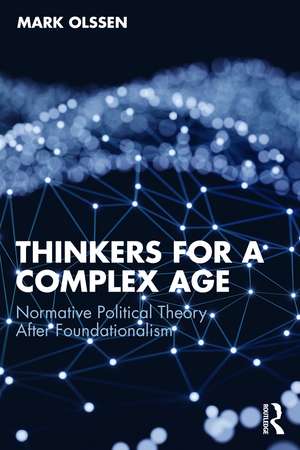
Thinkers for a Complex Age: Normative Political Theory After Foundationalism
Autor Mark Olssenen Limba Engleză Paperback – 24 noi 2026
Organised into six thematic sections, the book traces a clear conceptual progression across traditions and debates, from genealogies of the modern subject through poststructural, materialist, ecological, and institutional approaches to contemporary questions of justice and freedom. Each chapter provides a focused engagement with a major thinker, identifying both their key contributions and their limits, while contributing to an overarching argument. The book’s modular structure and its substantial annotated bibliography also make it especially well suited for advanced teaching, offering readers a coherent orientation across complex intellectual terrain.
Against both foundational moral theory and post-foundational scepticism, it advances a distinctive account of 'life continuance' as an immanent basis for ethical and political judgement—one grounded not in universal principles, but in the conditions that sustain agency, institutions, and collective life over time. Bringing together insights from continental philosophy, political theory, and contemporary social thought, this book offers a compelling framework for thinking ethics, freedom, and governance in an age marked by ecological crisis, technological transformation, and global interdependence. It will be of interest to scholars and students in political theory, philosophy, education, and the social sciences more broadly.
Preț: 347.29 lei
Preț vechi: 388.06 lei
-11% Precomandă
Puncte Express: 521
Carte nepublicată încă
Livrare prin curier în România Precomanda se expediază când titlul devine disponibil.
Transport gratuit de la 400.00 lei Plată online sau ramburs, în funcție de opțiunile comenzii.
Retur gratuit în 14 zile Comandă securizată și suport în română.
Doresc să fiu notificat când acest titlu va fi disponibil:
Se trimite...
Specificații
ISBN-13: 9781041382553
ISBN-10: 1041382553
Pagini: 344
Dimensiuni: 152 x 229 mm
Ediția:1
Editura: Taylor & Francis
Colecția Routledge
Locul publicării:Oxford, United Kingdom
ISBN-10: 1041382553
Pagini: 344
Dimensiuni: 152 x 229 mm
Ediția:1
Editura: Taylor & Francis
Colecția Routledge
Locul publicării:Oxford, United Kingdom
Public țintă
Postgraduate, Undergraduate Advanced, and Undergraduate CoreCuprins
Preface. Introduction: Thinking in a Complex Age: Genealogy, Relationality, and the Reworking of Political Theory Section I — Foundations and Genealogies of the Modern Subject 1. How to Read Kant? 2. Friedrich Nietzsche 3. Martin Heidegger Section II — Immanence, Power, and the Poststructural Turn 4. Gilles Deleuze 5. Georges Canguilhem 6. Michel Foucault 7. Judith Butler 8. Georges Bataille 9. Louis Althusser 10. Hannah Arendt 11. Jürgen Habermas Section III — Materialism, Ecology, Posthumanism 12. Bruno Latour 13. Jane Bennett 14. Karen Barad 15. Donna Haraway 16. Rosi Braidotti 17. Dipesh Chakrabarty 18. Achille Mbembe 19. Hans Jonas Section IV — Governance, Democracy, Institutions 20. Montesquieu 21. T.H. Green 22. L.T. Hobhouse 23. Karl Polanyi 24. Pierre Bourdieu 25. Pierre Rosanvallon 26. John Dewey 27. Elinor Ostrom 28. William Connolly Section V — Normativity, Justice, and Freedom 29. Martha Nussbaum 30. Amartya Sen 31. Philip Pettit Section VI — Relational Ethics After Foundations 32. Conclusion
Notă biografică
Mark Olssen is Emeritus Professor of Political Theory and Higher Education Policy at the University of Surrey, UK. His work focuses on political theory, social philosophy, and education policy, with particular interests in Foucault, neoliberalism, and contemporary debates on normativity and governance. He is the author of numerous books, including Constructing Foucault’s Ethics (2021) and The Return of the Good in the Age of AI (2026). His recent work develops a relational, post-foundational account of ethics centred on the concept of life continuance.
Recenzii
Ambitious, uncommonly wide-ranging, and intellectually serious, Thinkers for a Complex Age offers a valuable map of contemporary debates on normativity, critique and political judgement.
Enzo Rossi, Associate Professor of Political Science, University of Amsterdam
Enzo Rossi, Associate Professor of Political Science, University of Amsterdam
Descriere
This book addresses how normative judgement remains possible after the collapse of philosophical foundations. Moving from Kant, Nietzsche, and Heidegger through Foucault, Deleuze, Butler, and Latour, the book reconstructs a mode of critical inquiry that is genealogical, relational, and normatively oriented.