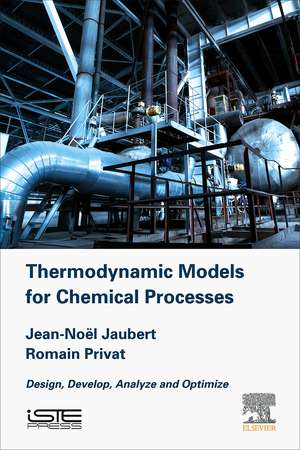
Thermodynamic Models for Chemical Engineering: Design, Develop, Analyse and Optimize
Autor Jean-Noel Jaubert, Romain PRIVATen Limba Engleză Hardback – 25 iun 2021
- Presents a comprehensive overview of the main thermodynamic models
- Explains their theoretical base
- Gives detailed methods to estimate model parameters
Preț: 475.27 lei
Preț vechi: 633.91 lei
-25%
Puncte Express: 713
Carte tipărită la comandă
Livrare economică 10-24 noiembrie
Livrare prin curier în România Termenul estimat este afișat lângă disponibilitate.
Transport gratuit pentru acest produs Plată online sau ramburs, în funcție de opțiunile comenzii.
Retur gratuit în 14 zile Comandă securizată și suport în română.
Specificații
ISBN-13: 9781785482090
ISBN-10: 1785482092
Pagini: 198
Dimensiuni: 152 x 229 mm
Greutate: 0.44 kg
Editura: ELSEVIER SCIENCE
ISBN-10: 1785482092
Pagini: 198
Dimensiuni: 152 x 229 mm
Greutate: 0.44 kg
Editura: ELSEVIER SCIENCE
V-ar putea interesa
-
 -41%Preț: 1127.42 lei1906.36 lei
 -
 Microbial Services in Restoration EcologyJay Shankar Singh-24%Preț: 744.72 lei981.33 lei
 -
 -26%Preț: 1130.21 lei1530.57 lei
 -
 Data-Centric Safety: Challenges, Approaches, and Incident InvestigationAlastair Faulkner-40%Preț: 813.75 lei1357.44 lei
 -
 Current Status and Future Scope of Microbial CellulasesDeepak K. Tuli-31%Preț: 1129.91 lei1639.97 lei
 -
 Valorization of Biomass to Bioproducts: Biochemicals and BiomaterialsVijai Kumar Gupta-26%Preț: 1135.69 lei1535.44 lei
 -
 Process Safety CalculationsRenato Benintendi-33%Preț: 992.22 lei1479.86 lei
 -
 Heat Transfer a Laboratory ManualDr N. S. SrinivasPreț: 200.47 lei
 -
 -18%Preț: 776.58 lei947.05 lei
 -
 Fiber Lasers: Technology and ApplicationsHelen Young-18%Preț: 796.05 lei970.78 lei
 -
 Introduction to NanomaterialsJeffrey Carson-18%Preț: 788.57 lei961.66 lei
 -
 Metallurgy: Processes, Technologies and DesignDarren Wang-18%Preț: 820.92 lei1001.12 lei
 -
 -18%Preț: 788.32 lei961.37 lei
 -
 Power Systems Harmonics: Modeling and AnalysisJacob Hunter-18%Preț: 889.39 lei1084.61 lei
 -
 -18%Preț: 821.10 lei1001.34 lei
 -
 Insecticides and Pesticides: Methods for Crop ProtectionZoe Wordsworth-18%Preț: 768.44 lei937.12 lei
 -
 Introduction to Wind EnergyJayce McCarthy-18%Preț: 749.31 lei913.79 lei
 -
 Solar PowerJaime Hunter-18%Preț: 814.25 lei992.99 lei
 -
 Energy Conservation HandbookSamuel Palmer-18%Preț: 740.37 lei902.90 lei
 -
 Introduction to Petroleum EngineeringJames Cameron-18%Preț: 724.75 lei883.84 lei
 -
 Fundamentals of Renewable EnergyDylan Carter-18%Preț: 774.50 lei944.52 lei
 -
 Photovoltaic SystemsJaime Hunter-18%Preț: 811.91 lei990.13 lei
 -
 Nuclear Engineering HandbookLindsay Garfield-18%Preț: 772.17 lei941.67 lei
 -
 Composite Materials: Science and EngineeringDouglas Holliday-18%Preț: 743.24 lei906.39 lei
 -
 Corrosion EngineeringTheodore Schneider-18%Preț: 768.08 lei936.67 lei
 -
 Fundamentals of Materials Science and EngineeringDiane Jeffers-18%Preț: 796.80 lei971.71 lei
 -
 -23%Preț: 765.77 lei994.50 lei
Public țintă
Engineers in the Chemical Industries; Engineering researchers using thermodynamic models to simulate processesCuprins
Part 1 Activity Coefficient Models
1. Correlations for the estimation of thermodynamic properties of pure substances in the liquid, perfect gas, or vapor-liquid states
2. Estimation of thermodynamic properties of pure substances using equation of state: Overview of available models and calculation procedures
3. Low-pressure vapor-liquid and liquid-liquid equilibria of binary systems: Activity-coefficient models
4. Estimation of the themodynamic properties of mixtures from an equation of state: An overview of models and calculation procedures
5. General Summary: decision tree to select a themodynamic model in order to simulate or design a chemical process
1. Correlations for the estimation of thermodynamic properties of pure substances in the liquid, perfect gas, or vapor-liquid states
2. Estimation of thermodynamic properties of pure substances using equation of state: Overview of available models and calculation procedures
3. Low-pressure vapor-liquid and liquid-liquid equilibria of binary systems: Activity-coefficient models
4. Estimation of the themodynamic properties of mixtures from an equation of state: An overview of models and calculation procedures
5. General Summary: decision tree to select a themodynamic model in order to simulate or design a chemical process