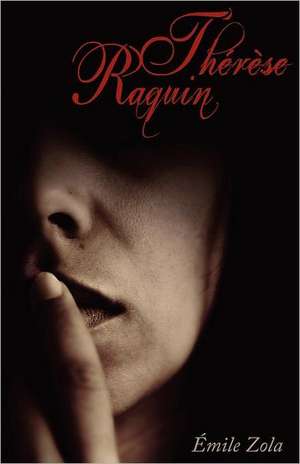
Therese Raquin: Book Two
Autor Emile Zola Design de Cricket House Booksen Limba Engleză Paperback – 30 apr 2010
Preț: 60.67 lei
Puncte Express: 91
Carte disponibilă
Livrare economică 10-24 noiembrie
Livrare prin curier în România Termenul estimat este afișat lângă disponibilitate.
Transport gratuit de la 400.00 lei Plată online sau ramburs, în funcție de opțiunile comenzii.
Retur gratuit în 14 zile Comandă securizată și suport în română.
Specificații
ISBN-13: 9781935814054
ISBN-10: 1935814052
Pagini: 170
Dimensiuni: 140 x 216 x 10 mm
Greutate: 0.22 kg
Editura: CRICKET HOUSE BOOKS LLC
ISBN-10: 1935814052
Pagini: 170
Dimensiuni: 140 x 216 x 10 mm
Greutate: 0.22 kg
Editura: CRICKET HOUSE BOOKS LLC
V-ar putea interesa
-
 Thérèse RaquinEmile Zola-18%Preț: 53.36 lei65.16 lei
 -
 Au Bonheur des DamesEmile Zola-36%Preț: 59.65 lei93.00 lei
 -
 Therese RaquinÉmile ZolaPreț: 71.76 lei
 -
 The Drinking DenEmile Zola-35%Preț: 60.98 lei94.37 lei
 -
 The Beast WithinÉmile Zola-30%Preț: 65.50 lei93.33 lei
 -
 Therese DesqueyrouxFrancois Mauriac-28%Preț: 50.96 lei70.68 lei
 -
 A Love StoryÉmile ZolaPreț: 64.55 lei
 -
 NanaÉmile ZolaPreț: 60.69 lei
 -
 Ãmile Zola: A Very Short IntroductionBrian Nelson-20%Preț: 56.65 lei70.82 lei
 -
 Thérèse RaquinÉmile ZolaPreț: 52.70 lei
 -
 The KillÉmile ZolaPreț: 59.13 lei
 -
 La Bête humaineÉmile ZolaPreț: 55.19 lei
 -
 EarthÉmile Zola-18%Preț: 77.37 lei94.27 lei
 -
 Preț: 108.70 lei
 -
 Dangerous LiaisonsPierre Laclos Choderlos de-28%Preț: 85.05 lei118.87 lei
 -
 Thérèse RaquinEmile ZolaPreț: 84.55 lei
 -
 Mona's EyesThomas SchlesserPreț: 147.49 lei
 -
 Émile Zola: A Determined LifeRobert LethbridgePreț: 193.65 lei
 -
 Th?r?se Raquin?Mile ZolaPreț: 107.70 lei
Notă biografică
Émile Zola (1840-1902) was a French novelist, journalist, critic, and one of the central figures of literary naturalism. Best known for the twenty-volume Rougon-Macquart cycle, Zola brought an ambitious social, political, and scientific seriousness to the nineteenth-century novel, examining how heredity, environment, class, labour, money, sexuality, and institutions shape human life. His fiction often focused on the forces that polite society preferred not to see: poverty, exploitation, alcoholism, prostitution, industrial danger, political corruption, and the pressure of economic power on ordinary families.Born in Paris and raised partly in Aix-en-Provence, Zola became one of the most influential and controversial writers of modern France. Novels such as Thérèse Raquin, L'Assommoir, Nana, Germinal, La Bête humaine, and La Débâcle helped define naturalist fiction through their detailed social observation, unsentimental realism, and willingness to confront the physical and moral conditions of modern life. Germinal, his great novel of coal miners and class struggle, is among his most enduring works and remains a cornerstone of French literature, labour fiction, and the European realist tradition. Zola was also a major public intellectual, famously intervening in the Dreyfus Affair with "J'Accuse...!", an act that confirmed his place not only in literary history but in the history of political conscience.
Textul de pe ultima copertă
'Therese Raquin' is a clinically observed, sinister tale of adultery and murder among the lower orders in nineteenth-century Paris. Zola's dispassionate dissection of the motivations of his characters, mere 'human beasts' who kill in order to satisfy their lust, is much more than an atmospheric Second Empire period-piece. 'Therese Raquin' stands as a key early manifesto of the French Naturalist movement, of which Zola was the founding father. Even today, this novel has lost none of its power to shock.