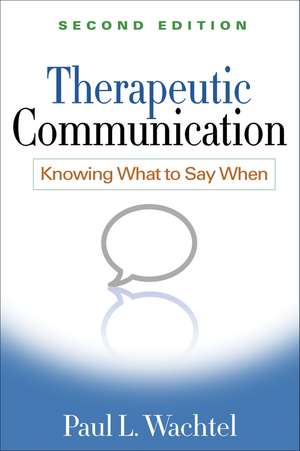
Therapeutic Communication, Second Edition: Knowing What to Say When
Autor Paul L. Wachtelen Limba Engleză Hardback – 8 iun 2011
A uniquely practical guide and widely adopted text, this book shows precisely what therapists can say at key moments to enhance the process of healing and change. Paul Wachtel explains why some communications in therapy are particularly effective, while others that address essentially the same content may actually be countertherapeutic. He offers clear and specific guidelines for how to ask questions and make comments in ways that facilitate collaborative exploration and promote change. Illustrated with vivid case examples, the book is grounded in an integrative theory that draws from features of psychodynamic, cognitive-behavioral, systemic, and experiential approaches.
New to This Edition
* Reflects nearly 20 years of advances in the field and refinements of the author's approach.
*Broader audience: in addition to psychodynamic therapists, cognitive-behavioral therapists and others will find specific, user-friendly recommendations.
*Chapter on key developments and convergences across different psychotherapeutic approaches.
*Chapter on the therapeutic implications of attachment theory and research.
See also Wachtel's Relational Theory and the Practice of Psychotherapy, which explores a new direction in psychoanalytic thought that can expand and deepen clinical practice.
New to This Edition
* Reflects nearly 20 years of advances in the field and refinements of the author's approach.
*Broader audience: in addition to psychodynamic therapists, cognitive-behavioral therapists and others will find specific, user-friendly recommendations.
*Chapter on key developments and convergences across different psychotherapeutic approaches.
*Chapter on the therapeutic implications of attachment theory and research.
See also Wachtel's Relational Theory and the Practice of Psychotherapy, which explores a new direction in psychoanalytic thought that can expand and deepen clinical practice.
Preț: 546.31 lei
Preț vechi: 575.06 lei
-5%
Puncte Express: 819
Carte tipărită la comandă
Livrare economică 30 noiembrie-14 decembrie
Livrare prin curier în România Termenul estimat este afișat lângă disponibilitate.
Transport gratuit pentru acest produs Plată online sau ramburs, în funcție de opțiunile comenzii.
Retur gratuit în 14 zile Comandă securizată și suport în română.
Specificații
ISBN-13: 9781609181710
ISBN-10: 1609181719
Pagini: 398
Dimensiuni: 152 x 229 x 36 mm
Greutate: 0.7 kg
Ediția:Revizuită
Editura: Guilford Publications
Colecția Guilford Press
ISBN-10: 1609181719
Pagini: 398
Dimensiuni: 152 x 229 x 36 mm
Greutate: 0.7 kg
Ediția:Revizuită
Editura: Guilford Publications
Colecția Guilford Press
V-ar putea interesa
-
 Psychotherapy Relationships that Work, 2 vol setJohn C. Norcross-5%Preț: 1018.61 lei1072.23 lei
 -
 Systems of Psychotherapy: A Transtheoretical AnalysisJames O. Prochaska-16%Preț: 1080.70 lei1284.98 lei
 -
 -5%Preț: 261.97 lei275.76 lei
 -
 -5%Preț: 248.85 lei261.95 lei
 -
 -30%Preț: 65.27 lei93.51 lei
 -
 CO CREATING CHANGEJon Frederickson-5%Preț: 346.43 lei364.67 lei
 -
 Clinical Case FormulationsBarbara Lichner Ingram-5%Preț: 627.66 lei660.69 lei
 -
 The Handbook of Person-Centred Psychotherapy and CounsellingDr. Gina Di Malta-22%Preț: 293.51 lei376.01 lei
 -
 Preț: 409.53 lei
 -
 Preț: 286.58 lei
 -
 Attachment in PsychotherapyDavid J. Wallin-5%Preț: 333.68 lei351.24 lei
 -
 -5%Preț: 345.28 lei363.45 lei
 -
 The Heart of Couple Therapy: Knowing What to Do and How to Do ItEllen F. Wachtel-5%Preț: 278.50 lei293.16 lei
 -
 Essential Psychotherapies, Fourth Edition: Theory and PracticeStanley B. Messer-5%Preț: 463.14 lei487.51 lei
 -
 Cognitive Behavior Therapy, Third Edition: Basics and BeyondJudith S. Beck-5%Preț: 498.29 lei524.52 lei
 -
 -5%Preț: 376.94 lei396.78 lei
 -
 Psychodynamic Therapy, Second Edition: A Guide to Evidence-Based PracticeRichard F. Summers-5%Preț: 361.76 lei380.80 lei
 -
 New Approaches to Integration in PsychotherapyEleanor O'Leary-5%Preț: 213.03 lei224.24 lei
 -
 Schema Therapy: A Practitioner's GuideJeffrey E. Young-5%Preț: 427.34 lei449.83 lei
 -
 Minimax InterventionsManfred PriorPreț: 93.24 lei
Public țintă
Professional Practice & DevelopmentNotă biografică
Paul L. Wachtel, PhD, is Distinguished Professor in the Clinical Psychology Doctoral Program at The City College of New York. Dr. Wachtel has been a leading voice for integrative thinking in the human sciences and is a cofounder and past president of the Society for the Exploration of Psychotherapy Integration. He is a recipient of the Hans H. Strupp Memorial Award; the Distinguished Psychologist Award from Division 29 (Psychotherapy) of the American Psychological Association (APA); the Scholarship and Research Award from Division 39 (Psychoanalysis) of APA; and the Sidney J. Blatt Award for Outstanding Contributions to Psychotherapy, Scholarship, Education and Practice
Recenzii
"Therapeutic Communication, Second Edition, builds on the foundation of Wachtel's original book, but it very substantially updates and revises it, reflecting many exciting advances that have occurred in our field. Wachtel presents theoretical and clinical material that will sharpen any psychotherapist's understanding of how to communicate with patients."--Leslie S. Greenberg, PhD, Distinguished Research Professor Emeritus of Psychology, York University, Canada
"Paul Wachtel is among the very few teachers and theorists of psychotherapy whose writing has an immediate, direct, and powerful impact on my clinical practice. I have long used and recommended this excellent text and am delighted to see the revised second edition, which incorporates recent developments across the range of therapeutic approaches. Wachtel does not speak in generalities or abstractions; rather, he moves easily among theoretical formulations, research findings, and their practical application, illustrating his principles with numerous recognizable examples. He examines in great detail the nuances and subtleties of what you say to patients, how you say it, and the relational context within which you convey your therapeutic messages. This book is essential reading for practicing therapists of all persuasions. I can't wait to start reading it with my students."--Lewis Aron, PhD, Director, Postdoctoral Program in Psychotherapy and Psychoanalysis, New York University
"The wisdom and experience of a creative therapist are reflected in every chapter. As the subtitle indicates, it's what you say and when you say it that determines what a patient hears. Novice and experienced therapists of any theoretical orientation will find this book to be of significant value. It is clear that therapy is not simply about techniques--it's about relations that work. This book shows you how and why that is true."--Robert L. Leahy, PhD, Director, American Institute for Cognitive Therapy; Department of Psychiatry, Weill Cornell Medical College
-This is the best book on how to talk to one's patients I have ever read, and it is the book I most frequently recommend to my trainees....The lessons on language embodied in this book are experience-near and clinically useful for anyone who talks with patients, regardless of theoretical orientation....Wachtel addresses with tremendous sophistication a number of thorny issues that are seldom addressed in such a clear, clinically genuine (as opposed to theoretically driven) way, such as the uses and limits of therapeutic self-disclosure and suggestion....A profound and important book.--Journal of Psychotherapy Integration, 1/3/1996ƒƒ Quite simply, an excellent book. It is comprehensively researched; it takes an inclusive and integrative theoretical and practical approach; it engages deeply and with precision on tendentious issues and difficult concepts; and it renders explicit what a seasoned and experienced therapist may be doing intuitively....My copy is now well scribbled and earmarked, and I can imagine coming back to it again and again, not only to refine my own understanding of the difficult nettles grasped therein, but to simply begin to do all the secondary reading that Wachtel so expertly integrated into this formidable and profitable piece of work. This is a text that one would profit from greatly by reading straight through like any book; but my sense is that it will be ultimately more valuable as a reference and teaching guide.--Psychodynamic Practice, 4/13/2011ƒƒ A comprehensive and provocative examination of the uses of language by therapists in clinical practice....Paul L. Wachtel, a noted expert, clinician, and theorist of psychotherapy...generously shares his extensive professional experience throughout the text....This book will be very helpful to clinicians in guiding their decisions about the best uses of language in clinical practice. Wachtel generously interweaves relevant theory and clinical experiences in the clearly written and informative chapters....It is up to date, comprehensive, well referenced, and strongly grounded in relevant theory and practice....Wachtel's book provides a strong impetus for examining the nature of therapeutic communication and encourages careful thought about the strategic exchange of messages to achieve therapeutic outcomes.--PsycCRITIQUES, 4/13/2011ƒƒShould be of significant help to students and to practitioners of psychotherapy....Nuances of communication style are treated comparatively and persuasively rather than pejoratively....Wachtel's material is fecund with an admixture of theoretical knowledge, experience, and universally applicable clinical vignettes. The chapter on achieving resolution of the patient's difficulties is particularly germane....Overall, this book would be very useful and productive in training programs for all those engaging in forms of psychotherapy.--Journal of Behavior Therapy and Experimental Psychiatry, 6/3/1995"Paul Wachtel is among the very few teachers and theorists of psychotherapy whose writing has an immediate, direct, and powerful impact on my clinical practice. I have long used and recommended this excellent text and am delighted to see the revised second edition, which incorporates recent developments across the range of therapeutic approaches. Wachtel does not speak in generalities or abstractions; rather, he moves easily among theoretical formulations, research findings, and their practical application, illustrating his principles with numerous recognizable examples. He examines in great detail the nuances and subtleties of what you say to patients, how you say it, and the relational context within which you convey your therapeutic messages. This book is essential reading for practicing therapists of all persuasions. I can't wait to start reading it with my students."--Lewis Aron, PhD, Director, Postdoctoral Program in Psychotherapy and Psychoanalysis, New York University
"The wisdom and experience of a creative therapist are reflected in every chapter. As the subtitle indicates, it's what you say and when you say it that determines what a patient hears. Novice and experienced therapists of any theoretical orientation will find this book to be of significant value. It is clear that therapy is not simply about techniques--it's about relations that work. This book shows you how and why that is true."--Robert L. Leahy, PhD, Director, American Institute for Cognitive Therapy; Department of Psychiatry, Weill Cornell Medical College
"Therapeutic Communication, Second Edition, builds on the foundation of Wachtel's original book, but it very substantially updates and revises it, reflecting many exciting advances that have occurred in our field. Wachtel presents theoretical and clinical material that will sharpen any psychotherapist's understanding of how to communicate with patients."--Leslie S. Greenberg, PhD, Distinguished Research Professor Emeritus of Psychology, York University, Canada
"Paul Wachtel is among the very few teachers and theorists of psychotherapy whose writing has an immediate, direct, and powerful impact on my clinical practice. I have long used and recommended this excellent text and am delighted to see the revised second edition, which incorporates recent developments across the range of therapeutic approaches. Wachtel does not speak in generalities or abstractions; rather, he moves easily among theoretical formulations, research findings, and their practical application, illustrating his principles with numerous recognizable examples. He examines in great detail the nuances and subtleties of what you say to patients, how you say it, and the relational context within which you convey your therapeutic messages. This book is essential reading for practicing therapists of all persuasions. I can't wait to start reading it with my students."--Lewis Aron, PhD, Director, Postdoctoral Program in Psychotherapy and Psychoanalysis, New York University
"The wisdom and experience of a creative therapist are reflected in every chapter. As the subtitle indicates, it's what you say and when you say it that determines what a patient hears. Novice and experienced therapists of any theoretical orientation will find this book to be of significant value. It is clear that therapy is not simply about techniques--it's about relations that work. This book shows you how and why that is true."--Robert L. Leahy, PhD, Director, American Institute for Cognitive Therapy; Department of Psychiatry, Weill Cornell Medical College
"I have used Therapeutic Communication in my graduate seminars, and students have been consistently appreciative of its combination of theoretical rationale and detailed examples (the 'why' and the 'how-to'). This combination has made it possible for students from all therapeutic orientations to apply the book's insights to their clinical thinking and practice. Wachtel's formulation of 'cyclical psychodynamics' is consistent with perpetuating factors, awareness of which is critically important for effective psychotherapy of any school."--Steven A. Kvaal, PhD, Department of Psychology, Roosevelt University
"Students in my master's-level class in Interpersonal Communication have consistently found Therapeutic Communication to be the best text to help them understand how change and growth take place through dialogue and disclosure. Wachtel seamlessly interweaves theory and skills, explicating not just one theory but several, in some of the clearest writing in the field. The chapters on building on patients' strengths and therapeutic communication with couples are a 'must' for practitioners. The focused session transcripts are a valuable teaching tool; the extensive references and detailed index are also significant assets of the book."--Delores Friesen, PhD, LMFT, Professor Emerita of Pastoral Counseling, Fresno Pacific Biblical Seminary
- Quite simply, an excellent book. It is comprehensively researched; it takes an inclusive and integrative theoretical and practical approach; it engages deeply and with precision on tendentious issues and difficult concepts; and it renders explicit what a seasoned and experienced therapist may be doing intuitively....My copy is now well scribbled and earmarked, and I can imagine coming back to it again and again, not only to refine my own understanding of the difficult nettles grasped therein, but to simply begin to do all the secondary reading that Wachtel so expertly integrated into this formidable and profitable piece of work. This is a text that one would profit from greatly by reading straight through like any book; but my sense is that it will be ultimately more valuable as a reference and teaching guide.--Psychodynamic Practice, 4/13/2011Æ’Æ’ A comprehensive and provocative examination of the uses of language by therapists in clinical practice....Paul L. Wachtel, a noted expert, clinician, and theorist of psychotherapy...generously shares his extensive professional experience throughout the text....This book will be very helpful to clinicians in guiding their decisions about the best uses of language in clinical practice. Wachtel generously interweaves relevant theory and clinical experiences in the clearly written and informative chapters....It is up to date, comprehensive, well referenced, and strongly grounded in relevant theory and practice....Wachtel's book provides a strong impetus for examining the nature of therapeutic communication and encourages careful thought about the strategic exchange of messages to achieve therapeutic outcomes.--PsycCRITIQUES, 4/13/2011Æ’Æ’ Should be of significant help to students and to practitioners of psychotherapy....Nuances of communication style are treated comparatively and persuasively rather than pejoratively....Wachtel's material is fecund with an admixture of theoretical knowledge, experience, and universally applicable clinical vignettes. The chapter on achieving resolution of the patient's difficulties is particularly germane....Overall, this book would be very useful and productive in training programs for all those engaging in forms of psychotherapy.--Journal of Behavior Therapy and Experimental Psychiatry, 6/3/1995Æ’Æ’ This is the best book on how to talk to one's patients I have ever read, and it is the book I most frequently recommend to my trainees....The lessons on language embodied in this book are experience-near and clinically useful for anyone who talks with patients, regardless of theoretical orientation....Wachtel addresses with tremendous sophistication a number of thorny issues that are seldom addressed in such a clear, clinically genuine (as opposed to theoretically driven) way, such as the uses and limits of therapeutic self-disclosure and suggestion....A profound and important book.--Journal of Psychotherapy Integration, 1/3/1996"Paul Wachtel is among the very few teachers and theorists of psychotherapy whose writing has an immediate, direct, and powerful impact on my clinical practice. I have long used and recommended this excellent text and am delighted to see the revised second edition, which incorporates recent developments across the range of therapeutic approaches. Wachtel does not speak in generalities or abstractions; rather, he moves easily among theoretical formulations, research findings, and their practical application, illustrating his principles with numerous recognizable examples. He examines in great detail the nuances and subtleties of what you say to patients, how you say it, and the relational context within which you convey your therapeutic messages. This book is essential reading for practicing therapists of all persuasions. I can't wait to start reading it with my students."--Lewis Aron, PhD, Director, Postdoctoral Program in Psychotherapy and Psychoanalysis, New York University
"The wisdom and experience of a creative therapist are reflected in every chapter. As the subtitle indicates, it's what you say and when you say it that determines what a patient hears. Novice and experienced therapists of any theoretical orientation will find this book to be of significant value. It is clear that therapy is not simply about techniques--it's about relations that work. This book shows you how and why that is true."--Robert L. Leahy, PhD, Director, American Institute for Cognitive Therapy; Department of Psychiatry, Weill Cornell Medical College
"I have used Therapeutic Communication in my graduate seminars, and students have been consistently appreciative of its combination of theoretical rationale and detailed examples (the 'why' and the 'how-to'). This combination has made it possible for students from all therapeutic orientations to apply the book's insights to their clinical thinking and practice. Wachtel's formulation of 'cyclical psychodynamics' is consistent with perpetuating factors, awareness of which is critically important for effective psychotherapy of any school."--Steven A. Kvaal, PhD, Department of Psychology, Roosevelt University
"Students in my master's-level class in Interpersonal Communication have consistently found Therapeutic Communication to be the best text to help them understand how change and growth take place through dialogue and disclosure. Wachtel seamlessly interweaves theory and skills, explicating not just one theory but several, in some of the clearest writing in the field. The chapters on building on patients' strengths and therapeutic communication with couples are a 'must' for practitioners. The focused session transcripts are a valuable teaching tool; the extensive references and detailed index are also significant assets of the book."--Delores Friesen, PhD, LMFT, Professor Emerita of Pastoral Counseling, Fresno Pacific Biblical Seminary
Cuprins
Introduction
1. Rethinking the Talking Cure: The Therapist Speaks Too
I. Theoretical and Empirical Foundations
2. The Continuing Evolution of Psychotherapy: New and Converging Developments in Psychoanalytic, Cognitive-Behavioral, Systemic, and Experiential Approaches
3. Attending to Attachment: Accelerating Interest in the Therapeutic Implications of Attachment Theory and Research
4. Cyclical Psychodynamics I: Vicious and Virtuous Circles
5. Cyclical Psychodynamics II: Anxiety, Exposure, and Interpretation
6. Cyclical Psychodynamics III: Insight, the Therapeutic Relationship, and the World Outside
II. Clinical Applications and Guidelines
7. Accusatory and Facilitative Comments: Criticism and Permission in the Therapeutic Dialogue
8. Exploration, Not Interrogation
9. Building on the Patient’s Strengths
10. Affirmation and Change
11. Attribution and Suggestion
12. Reframing, Relabeling, and Paradox
13. Therapist Self-Disclosure: Prospects and Pitfalls
14. Achieving Resolution of the Patient's Difficulties: Resistance, Working Through, and Following Through
III. Postscript
15. Therapeutic Communication with Couples, Ellen F. Wachtel
Descriere
A uniquely practical guide and widely adopted text, this book shows precisely what therapists can say at key moments to enhance the process of healing and change. Paul Wachtel explains why some communications in therapy are particularly effective, while others that address essentially the same content may actually be countertherapeutic. He offers clear and specific guidelines for how to ask questions and make comments in ways that facilitate collaborative exploration and promote change. Illustrated with vivid case examples, the book is grounded in an integrative theory that draws from features of psychodynamic, cognitive-behavioral, systemic, and experiential approaches.
New to This Edition
* Reflects nearly 20 years of advances in the field and refinements of the author's approach.
*Broader audience: in addition to psychodynamic therapists, cognitive-behavioral therapists and others will find specific, user-friendly recommendations.
*Chapter on key developments and convergences across different psychotherapeutic approaches.
*Chapter on the therapeutic implications of attachment theory and research.
See also Wachtel's Relational Theory and the Practice of Psychotherapy, which explores a new direction in psychoanalytic thought that can expand and deepen clinical practice.
New to This Edition
* Reflects nearly 20 years of advances in the field and refinements of the author's approach.
*Broader audience: in addition to psychodynamic therapists, cognitive-behavioral therapists and others will find specific, user-friendly recommendations.
*Chapter on key developments and convergences across different psychotherapeutic approaches.
*Chapter on the therapeutic implications of attachment theory and research.
See also Wachtel's Relational Theory and the Practice of Psychotherapy, which explores a new direction in psychoanalytic thought that can expand and deepen clinical practice.