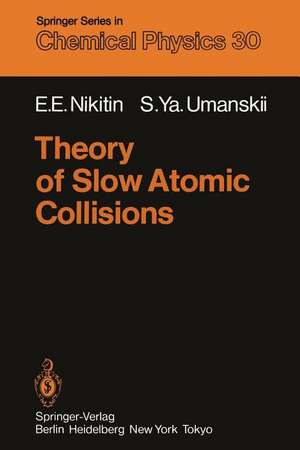
Theory of Slow Atomic Collisions: Springer Series in Chemical Physics, cartea 30
Autor E. E. Nikitin, S. y. Umanskiien Limba Engleză Paperback – 22 dec 2011
Din seria Springer Series in Chemical Physics
- 15%
 Preț: 613.80 lei
 - 15%
 Preț: 618.19 lei
 - 15%
 Preț: 611.43 lei
 - 15%
 Preț: 619.75 lei
 - 15%
 Preț: 613.80 lei
 - 15%
 Preț: 612.55 lei
 - 15%
 Preț: 624.14 lei
 - 15%
 Preț: 622.42 lei
 - 15%
 Preț: 627.14 lei
 - 15%
 Preț: 614.24 lei
 - 18%
 Preț: 911.05 lei
 - 18%
 Preț: 915.58 lei
 - 18%
 Preț: 916.03 lei
 - 15%
 Preț: 611.89 lei
 - 15%
 Preț: 624.77 lei
 - 15%
 Preț: 634.24 lei
 - 18%
 Preț: 916.64 lei
 - 18%
 Preț: 859.33 lei
 - 15%
 Preț: 622.29 lei
 - 18%
 Preț: 1200.39 lei
 - 15%
 Preț: 621.34 lei
 - 18%
 Preț: 917.09 lei
 - 24%
 Preț: 1327.80 lei
 - 18%
 Preț: 924.39 lei
 - 18%
 Preț: 1068.01 lei
 - 24%
 Preț: 700.48 lei
 - 18%
 Preț: 854.02 lei
 - 18%
 Preț: 872.80 lei
 - 15%
 Preț: 616.64 lei
 - 15%
 Preț: 562.85 lei
 - 15%
 Preț: 615.22 lei
 - 18%
 Preț: 862.19 lei
Preț: 622.91 lei
Preț vechi: 732.83 lei
-15% Nou
Puncte Express: 934
Preț estimativ în valută:
110.23€ • 129.25$ • 96.80£
110.23€ • 129.25$ • 96.80£
Carte tipărită la comandă
Livrare economică 02-16 februarie 26
Preluare comenzi: 021 569.72.76
Specificații
ISBN-13: 9783642820472
ISBN-10: 3642820476
Pagini: 452
Ilustrații: XII, 434 p.
Dimensiuni: 155 x 235 x 24 mm
Greutate: 0.63 kg
Ediția:Softcover reprint of the original 1st ed. 1984
Editura: Springer Berlin, Heidelberg
Colecția Springer
Seria Springer Series in Chemical Physics
Locul publicării:Berlin, Heidelberg, Germany
ISBN-10: 3642820476
Pagini: 452
Ilustrații: XII, 434 p.
Dimensiuni: 155 x 235 x 24 mm
Greutate: 0.63 kg
Ediția:Softcover reprint of the original 1st ed. 1984
Editura: Springer Berlin, Heidelberg
Colecția Springer
Seria Springer Series in Chemical Physics
Locul publicării:Berlin, Heidelberg, Germany
V-ar putea interesa
-
 Dreams Of A Final TheorySteven WeinbergPreț: 108.28 lei
 -
 Elementary Atomic StructureG. K. Woodgate-24%Preț: 372.70 lei491.80 lei
 -
 Molecular BeamsNorman Ramsey-27%Preț: 517.69 lei706.64 lei
 -
 Collisions and CollaborationMax Boisot-12%Preț: 366.21 lei416.87 lei
 -
 -18%Preț: 433.44 lei526.20 lei
 -
 -31%Preț: 467.33 lei674.67 lei
 -
 Nuclear PhysicsJohn LilleyPreț: 372.52 lei
 -
 Introduction to High Energy PhysicsDonald H. Perkins-8%Preț: 547.88 lei595.53 lei
 -
 A Walk through the Southern SkyMilton HeifetzPreț: 255.99 lei
 -
 -15%Preț: 649.93 lei764.62 lei
 -
 Electron-Atom Scattering: An IntroductionMaurizio Dapor-26%Preț: 869.75 lei1171.31 lei
 -
 Introducing Particle Physics: A Graphic GuideTom WhyntiePreț: 60.82 lei
 -
 Quantum PhysicsAlistair I M RaePreț: 75.88 lei
 -
 Preț: 135.48 lei
Public țintă
ResearchCuprins
1. Introduction.- 2. General Formulation of Scattering Problem Under Quasi-Classical Conditions.- 2.1 Scattering Amplitudes and Cross Sections.- 2.2 Scattering Equations.- 2.3 Collisions of Two Many-Electron Atoms.- 2.4 Integral Cross Sections for Isotropic Collisions.- 3. Diatomic Electronic States.- 3.1 Quantum Numbers and Wave Functions of a Free Atom..- 3.2 Quantum Numbers and Wave Functions of Diatoms.- 3.3 Adiabatic States, Diabatic States, and Correlation Diagrams.- 3.4 Coupling Between Electronic States. Selection Rules.- 4. Approximate Calculation of the Electronic States of Diatoms.- 4.1 Atomic Potential and Atomic Orbitals.- 4.2 Diatomic Interactions at Large Distances and the Heitler-London Approximation.- 4.3 Pseudopotential Method for Interatomic Interactions.- 4.4 Short-Range Atomic Interactions.- 4.5 Coupling Between Electronic States.- 5. Elastic Scattering.- 5.1 Quasi-Classical Scattering Amplitude.- 5.2 Quasi-Classical Scattering Matrix.- 5.3 Classical Scattering.- 5.4 Integral Cross Sections.- 5.5 Differential Cross Sections.- 6. Approximate Calculation of a Multichannel Quasi-Classical Scattering Matrix.- 6.1 Common-Trajectory Approach.- 6.2 Matching Approach.- 6.3 Perturbation Approach.- 7. Two-State Scattering Problem.- 7.1 The Two-State Model. Adiabatic and Diabatic Representations.- 7.2 Construction of the Two-State Quasi-Classical S Matrix by the Matching Method.- 7.3 Two-State Semiclassical Models.- 7.4 Differential Cross Sections and Deflection Functions.- 8. The Linear Two-State Landau-Zener Model.- 8.1 Formulation of the Model.- 8.2 Nonadiabatic Transitions Far from the Turning Point. Landau-Zener-Stueckelberg Solution.- 8.3 Nonadiabatic Transitions Near the Turning Point.- 8.4 Validity of Linear Model and of Analytical Expressions for Transition Probabilities.- 8.5 Cross Sections for the Linear Model.- 9. Nonlinear Two-State Models of Nonadiabatic Coupling.- 9.1 Exponential Model.- 9.2 Linear-Exponential Model.- 9.3 Other Nonlinear Models.- 10. Multistate Models of Nonadiabatic Coupling.- 10.1 Transitions Between Degenerate States.- 10.2 Transitions Between Highly Excited States.- 10.3 Generalizations of the Linear Model.- 11. Case Study — Intramultiplet Mixing and Depolarization of Alkalis in Collisions with Noble Gases.- 11.1 Formulation of the M* — X Scattering Problem.- 11.2 The Scattering Matrix.- 11.3 Transition Probabilities and Cross Sections for Isotropic Collisions.- A. Quantum Theory of Angular Momentum.- A. l Rotation Matrices and Spherical Functions.- A.2 Coupling of Angular Momenta, Clebsch-Gordan.- A.3 Matrix Elements of the Irreducible Tensor.- Operators.- References.