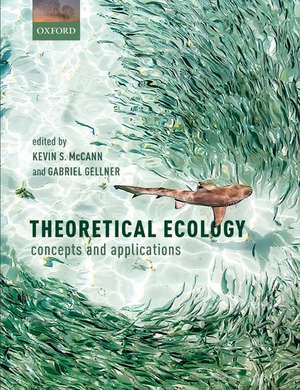
Theoretical Ecology: concepts and applications
Editat de Kevin S. McCann, Gabriel Gellneren Limba Engleză Hardback – 14 mai 2020
Preț: 878.25 lei
Preț vechi: 1292.76 lei
-32%
Puncte Express: 1317
Carte disponibilă
Livrare economică 13-18 noiembrie
Livrare prin curier în România Termenul estimat este afișat lângă disponibilitate.
Transport gratuit pentru acest produs Plată online sau ramburs, în funcție de opțiunile comenzii.
Retur gratuit în 14 zile Comandă securizată și suport în română.
Specificații
ISBN-13: 9780198824282
ISBN-10: 0198824289
Pagini: 318
Dimensiuni: 195 x 249 x 23 mm
Greutate: 0.84 kg
Editura: OUP OXFORD
Colecția OUP Oxford
Locul publicării:Oxford, United Kingdom
ISBN-10: 0198824289
Pagini: 318
Dimensiuni: 195 x 249 x 23 mm
Greutate: 0.84 kg
Editura: OUP OXFORD
Colecția OUP Oxford
Locul publicării:Oxford, United Kingdom
V-ar putea interesa
-
 -6%Preț: 162.60 lei172.41 lei
-
 An Introduction to Radiation ProtectionAlan D. MartinPreț: 373.16 lei
-
 Urban EcologyRichard T. T. Forman-11%Preț: 488.51 lei548.88 lei
-
 Temporal Dynamics and Ecological ProcessColleen K. Kelly-11%Preț: 675.59 lei759.10 lei
-
 Terrestrial Biosphere-Atmosphere FluxesRussell Monson-11%Preț: 700.93 lei787.57 lei
-
 Adaptive Food WebsJohn C. Moore-11%Preț: 711.28 lei799.19 lei
-
 Autecology: Organisms, Interactions and Environmental DynamicsGimme H. Walter-18%Preț: 1624.27 lei1980.82 lei
-
 Stable Isotope EcologyBrian FryPreț: 492.62 lei
-
 Antarctic Terrestrial MicrobiologyDon A. Cowan-18%Preț: 986.96 lei1203.61 lei
-
 Capparis spinosa L. en Tunisie : Diversité et EcologieEzzeddine Saadaoui-19%Preț: 539.58 lei666.14 lei
-
 Activités anthropiques et dynamique de la faune sauvageOllo Théophile Dibloni-19%Preț: 460.79 lei568.88 lei
-
 Preț: 340.15 lei
-
 Preț: 422.74 lei
-
 -15%Preț: 510.52 lei600.61 lei
-
 Preț: 432.36 lei
-
 Restoring the Oceanic Island EcosystemIsamu Okochi-18%Preț: 920.46 lei1122.51 lei
-
 Écotourisme et patrimoineBoubacar-SPreț: 396.11 lei
-
 -19%Preț: 540.17 lei666.88 lei
-
 Behavioural approach to larval dispersal in the oceanJean-Olivier Irisson-19%Preț: 493.17 lei608.86 lei
-
 -19%Preț: 461.68 lei569.97 lei
-
 -19%Preț: 549.13 lei677.93 lei
-
 Preț: 476.90 lei
-
 Preț: 286.65 lei
-
 -15%Preț: 612.98 lei721.14 lei
-
 Spatial Resilience in Social-Ecological SystemsGraeme S. Cumming-18%Preț: 906.64 lei1105.65 lei
-
 -18%Preț: 1074.51 lei1310.39 lei
-
 Ecology RevisitedAstrid Schwarz-18%Preț: 1258.58 lei1534.86 lei
Recenzii
A great and condensed overview of the state of the art including currently unresolved questions and challenges. Accordingly, the book will be extremely useful for scientists who are ready to establish their own research agenda in mathematically-oriented theoretical ecology.
This volume provides a valuable introduction to the field of theoretical ecology, and some interesting thoughts about its future.
This volume provides a valuable introduction to the field of theoretical ecology, and some interesting thoughts about its future.
Notă biografică
Kevin McCann joined the faculty at the University of Guelph in 2003 as a Canadian Research Chair in Biodiversity after starting his career at McGill University in 1999. McCann is a leading theoretical ecologist with an expertise in food webs. McCann combines theoretical ecology with experimental and empirical work across aquatic ecosystems (lakes, rivers and coastal marine ecosystems). His research seeks to examine the biological structure underlying diversity and the critical relationship between this structure, ecosystem function and stability. In 2013, McCann was elected lifetime fellow to the Ecological Society of America for research achievements.Gabriel Gellner is a researcher at the University of Guelph, having completed his PhD in 2014. Gellner is a theoretical ecologist with wide ranging interests in food webs, mathematical and computational methods, and disease ecology. Gellner has worked with leading scientists in North America (University of Guelph, UC Davis, Colorado State, USDA) and internationally (Japan, Brazil, UK). His work looks at how complex networks can be decomposed into fundamental dynamic subsystems from a conceptual and methodological perspective.
Cuprins
- 1: Introduction Gabriel Gellner, Kevin S. McCann and Emily J. Champagne
- 2: Species coexistence Peter Chesson
- 3: The synergistic effects of interaction strength and lags on ecological stability Gabriel Gellner, Kevin S. McCann and Christopher Greyson-Gaito
- 4: Non-equilibrium dynamics and stochastic processes Karen C. Abbott
- 5: The impact of population structure on population and community dynamics André M. de Roos
- 6: Models for large ecological communities - a random matrix approach Stefano Allesina and Jacopo Grilli
- 7: A structural theory of mutualistic networks Jordi Bascompte and Antonio Ferrera
- 8: A data driven approach to complex ecological systems Michio Kondoh, Kazutaka Kawatsu, Yutaka Osada and Masayuki Ushio
- 9: Trait-based models of complex ecological network Ulrich Brose
- 10: Ecological networks: from structure to dynamics Sonia Kéfi
- 11: Trait-based ecological and eco-evolutionary theory Christopher A. Klausmeier, Colin T. Kremer and Thomas Koffel
- 12: Toward a general theory of metacommunity ecology Dominique Gravel and François Massol
- 13: Theories of diversity in disease ecology T. Alex Perkins and Jason R. Rohr
- 14: Climate change: Studying the effects of temperature on population and community dynamics David A. Vasseur
- 15: Alternative stable states, tipping points, and early warning signals of ecological transitions John M. Drake, Suzanne M. O'Regan, Vasilis Dakos, Sonia Kéfi and Pejman Rohani
- 16: Areas of current and future growth Kevin S. McCann and Gabriel Gellner