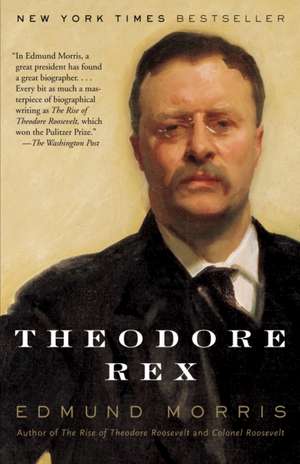
Theodore Rex
Autor Edmund Morrisen Limba Engleză Paperback – oct 2002
Trenul coboară în viteză de pe muntele Marcy, spintecând noaptea spre Buffalo, unde un bărbat de doar 42 de ani se pregătește să preia frâiele unei națiuni în stare de șoc. Descoperim aici momentul tensionat în care Theodore Roosevelt devine cel mai tânăr președinte din istoria SUA, având în spate sicriul lui McKinley ca pe o fantomă a secolului al XIX-lea care refuză să plece. Reținem controversa care l-a urmărit pe tot parcursul mandatului: deși adorat de mase, „Theodore Rex” a fost privit cu o ostilitate viscerală de către Wall Street și propria conducere republicană, fiind considerat un personaj imprevizibil și periculos pentru ordinea stabilită. În aceeași familie cu The Rise of Theodore Roosevelt, volumul adaugă o analiză riguroasă a exercițiului puterii brute, transformând biografia într-o cronică a transformării Americii în cea mai bogată națiune a lumii. Dacă primul volum explora formarea omului, aici vedem politicianul adroit care invită primul bărbat de culoare la cină în Casa Albă și care, în secret, previne un război între SUA și Germania. Stilul lui Edmund Morris este unul cinematic, aproape romanesc, dar ancorat solid în documente de arhivă, oferindu-ne acces direct la vocea pasionată și adesea ironică a președintelui. Considerăm acest titlu piesa centrală a trilogiei lui Morris, poziționându-se între începuturile tumultuoase și finalul melancolic descris în Colonel Roosevelt. Față de abordările mai concise, precum cele din Lion in the White House, Morris alege o perspectivă de „timp real”, refuzând să judece deciziile lui TR prin prisma cunoștințelor actuale, preferând să ne lase să simțim ritmul amețitor al unei epoci în plină schimbare.
Preț: 149.07 lei
Carte disponibilă
Livrare economică 12-26 noiembrie
Livrare express 28 octombrie-03 noiembrie pentru 49.11 lei
Specificații
ISBN-10: 0812966007
Pagini: 792
Ilustrații: PHOTOS THROUGHOUT
Dimensiuni: 131 x 203 x 35 mm
Greutate: 0.55 kg
Ediția:Revised edition
Editura: Random House
Locul publicării:New York, NY
V-ar putea interesa
-
 The Wilderness WarriorDouglas BrinkleyPreț: 179.84 lei
 -
 Woodrow WilsonJohn Milton Cooper, Jr.-24%Preț: 127.01 lei166.76 lei
 -
 The Rise of Theodore RooseveltEdmund MorrisPreț: 153.57 lei
 -
 Colonel RooseveltEdmund MorrisPreț: 152.94 lei
 -
 Who Was Theodore Roosevelt?Michael BurganPreț: 39.72 lei
 -
 Lion in the White HouseAida D DonaldPreț: 108.61 lei
 -
 Theodore RooseveltNathan MillerPreț: 173.22 lei
 -
 Edmund Morris's Theodore Roosevelt Trilogy BundleEdmund Morris-8%Preț: 759.08 lei825.10 lei
 -
 -21%Preț: 136.89 lei173.26 lei
 -
 TitanRon ChernowPreț: 165.86 lei
 -
 A Companion to Theodore RooseveltSerge Ricard-23%Preț: 1194.04 lei1550.69 lei
 -
 To Dare Mighty Things: The Life Of Theodore RooseveltDoreen Rappaport-25%Preț: 43.37 lei57.89 lei
 -
 Theodore Roosevelt's Wilderness WritingsTheodore RooseveltPreț: 123.82 lei
 -
 Through the Brazilian WildernessTheodore RooseveltPreț: 54.02 lei
 -
 The Strenuous LifeTheodore RooseveltPreț: 38.67 lei
 -
 Preț: 227.15 lei
 -
 Good Hunting: In Pursuit of Big Game in the WestTheodore RooseveltPreț: 70.32 lei
 -
 Theodore Roosevelt on BraveryTheodore RooseveltPreț: 84.20 lei
 -
 Theodore Roosevelt an American OriginalJanet BengePreț: 68.51 lei
De ce să citești această carte
Recomandăm această carte cititorilor pasionați de istorie politică și diplomație care doresc să înțeleagă cum s-a născut America modernă. Veți descoperi nu doar un lider carismatic, ci și un strateg care a navigat crize internaționale și tensiuni rasiale profunde. Este o lecție despre managementul puterii și despre curajul de a reforma instituții pietrificate, scrisă cu o eleganță literară rar întâlnită în biografiile politice.
Despre autor
Edmund Morris s-a născut în Kenya și a studiat în Africa de Sud înainte de a emigra în Statele Unite în 1968. A devenit unul dintre cei mai respectați biografi americani, fiind distins cu Premiul Pulitzer și American Book Award pentru volumul The Rise of Theodore Roosevelt. Experiența sa diversă, de la copywriter în Londra la biograf autorizat al lui Ronald Reagan (pentru volumul Dutch), i-a permis să dezvolte un stil narativ unic, care îmbină rigoarea istorică cu o tehnică literară captivantă, fiind un colaborator constant al publicațiilor New Yorker și New York Times.
Descriere scurtă
Extras
The First Administration: 1901-1904
The epigraphs at the head of every chapter are by "Mr. Dooley," Theodore Roosevelt's favorite social commentator.
The Shadow of the Crown
I see that Tiddy, Prisidint Tiddy-here's his health-is th' youngest prisidint we've iver had, an' some iv th' pa-apers ar-re wondherin' whether he's old enough f'r th' raysponsibilities iv' th' office.
On the morning after McKinley's interment, Friday, 20 September 1901, a stocky figure in a frock coat sprang up the front steps of the White House. A policeman, recognizing the new President of the United States, jerked to attention, but Roosevelt, trailed by Commander Cowles, was already on his way into the vestibule. Nodding at a pair of attaches, he hurried into the elevator and rose to the second floor. His rapid footsteps sought out the executive office over the East Room. Within seconds of arrival he was leaning back in McKinley's chair, dictating letters to William Loeb. He looked as if he had sat there for years. It was, a veteran observer marveled, "quite the strangest introduction of a Chief Magistrate . . . in our national history."
As the President worked, squads of cleaners, painters, and varnishers hastened to refurbish the private apartments down the hall. He sent word that he and Mrs. Roosevelt would occupy the sunny riverview suite on the south corner. Not for them the northern exposure favored by their predecessors, with its cold white light and panorama of countless chimney pots.
A pall of death and invalidism hung over the fusty building. Roosevelt decided to remain at his brother-in-law's house until after the weekend. It was as if he wanted the White House to ventilate itself of the sad fragrance of the nineteenth century. Edith and the children would breeze in soon enough, bringing what he called "the Oyster Bay atmosphere."
At eleven o'clock he held his first Cabinet meeting. There was a moment of strangeness when he took his place at the head of McKinley's table. Ghostly responsibility sat on his shoulders. "A very heavy weight," James Wilson mused, "for anyone so young as he is."
But the President was not looking for sympathy. "I need your advice and counsel," he said. He also needed their resignations, but for legal reasons only. Every man must accept reappointment. "I cannot accept a declination."
This assertion of authority went unchallenged. Relaxing, Roosevelt asked for briefings on every department of the Administration. His officers complied in order of seniority. He interrupted them often with questions, and they were astonished by the rapidity with which he embraced and sorted information. His curiosity and apparent lack of guile charmed them.
The President's hunger for intelligence did not diminish as the day wore on. He demanded naval-construction statistics and tariff-reciprocity guidelines and a timetable for the independence of Cuba, and got two visiting Senators to tell him more than they wanted to about the inner workings of Congress. In the late afternoon, he summoned the heads of Washington's three press agencies.
"This being my first day in the White House as President of the United States," Roosevelt said ingratiatingly, "I desired to have a little talk with you gentlemen who are responsible for the collection and dissemination of the news."
A certain code of "relations," he went on, should be established immediately. He glanced at the Associated Press and Sun service representatives. "Mr. Boynton and Mr. Barry, whom I have known for many years and who have always possessed my confidence, shall continue to have it." They must understand that this privilege depended on their "discretion as to publication." Unfortunately, he could not promise equal access to Mr. Keen of the United Press, "whom I have just met for the first time."
Boynton and Barry jumped to their colleague's defense. Roosevelt was persuaded to trust him, but warned again that he would bar any White House correspondent who betrayed him or misquoted him. In serious cases, he might even bar an entire newspaper. Barry said that was surely going too far. Roosevelt's only reply was a mysterious smile. "All right, gentlemen, now we understand each other."
Much later that evening, after a small dinner with friends in the Cowles house on N Street, the President allowed himself a moment or two of querulousness. "My great difficulty, my serious problem, will meet me when I leave the White House. Supposing I have a second term . . ."
Commander Cowles, replete with roast beef, sank deep into leather cushions and folded his hands over his paunch. He paid no attention to the cataract of talk pouring from the walnut chair opposite. For years he had benignly suffered his brother-in-law's fireside oratory; he was as deaf to Rooseveltian self-praise as he was to these occasional moments of self-doubt. How like Theodore to worry about moving out of the White House before moving in! The Commander's eyes drooped. His breathing grew rhythmic; he began to snore.
"I shall be young, in my early fifties," Roosevelt was saying. "On the shelf! Retired! Out of it!"
Two other guests, William Allen White and Nicholas Murray Butler, listened sympathetically. Prodigies themselves-White, at thirty-three, had a national reputation for political journalism, and Butler, at thirty-nine, was about to become president of Columbia University-they were both aware that they had reached the top of their fields, and could stay there for another forty years. Roosevelt was sure of only three and a half. Of course, the power given him dwarfed theirs, and he might win an extension of it in 1904. But that would make its final loss only harder to bear.
So Butler and White allowed the President to continue lamenting his imminent retirement. They interrupted only when he grew maudlin-"I don't want to be the old cannon loose on the deck in the storm!"
Undisturbed by the clamor of younger voices, Commander Cowles slept on.
Recenzii
“Magnificent . . . a sweeping narrative of the outward man and a shrewd examination of his character. . . . It is one of those rare works that is both definitive for the period it covers and fascinating to read for sheer entertainment. There should be a queue awaiting the next volume.”
-W. A. Swanberg, The New York Times Book Review
“Theodore Roosevelt, in this meticulously researched and beautifully written biography, has a claim on being the most interesting man ever to be President of this country.”
-Robert Kirsch, Los Angeles Times Book Review
“Spectacles glittering, teeth and temper flashing, high-pitched voice rasping and crackling, Roosevelt surges out of these pages with the force of a physical presence.”
-The Atlantic Monthly
“Morris’s book is beautifully written as well as thoroughly scholarly-clearly a masterpiece of American biography. . . . Hundreds of thousands will soon be reading this book . . . and will look forward, as I do, to Morris’s second volume.”
-Kenneth S. Davis, Worcester Sunday Telegram
Descriere
In the long-awaited sequel to "The Rise of Theodore Roosevelt, " which won the Pulitzer Prize and the American Book Award for biography, Morris tells the story of Teddy Roosevelt's two successful terms as president of the United States. Photos throughout.