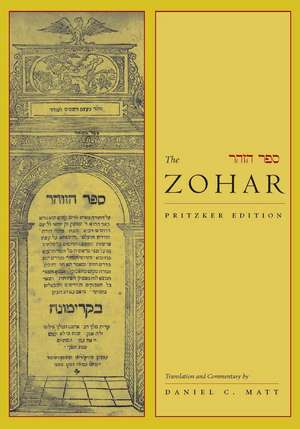
The Zohar: Pritzker Edition, Volume Five: The Zohar: Pritzker Edition, cartea 5
Traducere de Daniel Matten Limba Engleză Hardback – 21 oct 2009
Sefer ha-Zohar (The Book of Radiance) has amazed and overwhelmed readers ever since it emerged mysteriously in medieval Spain toward the end of the thirteenth century. Written in a unique, lyrical Aramaic, this masterpiece of Kabbalah exceeds the dimensions of a normal book; it is virtually a body of literature, comprising over twenty discrete sections. The bulk of the Zohar consists of a running commentary on the Torah, from Genesis through Deuteronomy.
This fifth volume of The Zohar: Pritzker Edition opens in the middle of Exodus immediately following the revelation at Mount Sinai. The first chapter features a famous narrative about two rabbis and an old donkey-driver they encounter on the road. This old man seems like a complete ignoramus and pesters them with nonsensical riddles, but he turns out to be a sage and explains to them one of the most tightly guarded secrets of Kabbalah: the reincarnation of the soul. In the course of his exposition, the old man enthralls his two listeners with a romantic account of Torah as a maiden who reveals herself only to one who pursues her lovingly.
The rest of this volume consists mainly of the Zohar's commentary on the biblical description of the mishkan, the Dwelling (or Tabernacle) in the desert. The mishkan symbolizes Shekhinah, the feminine presence of God who "dwells" on earth. Since the Dwelling was the center of worship, the Zohar explores here the theme of prayer.
The volume concludes with one of the shortest yet most important sections of the Zohar—Sifra di-Tsni'uta (The Book of Concealment). This enigmatic and poetic composition contains a veiled description of God's body, focusing on the beard. Its few pages convey the central teachings of Kabbalah, including the balance between male and female energies, and how divine breath animates all that exists.
This fifth volume of The Zohar: Pritzker Edition opens in the middle of Exodus immediately following the revelation at Mount Sinai. The first chapter features a famous narrative about two rabbis and an old donkey-driver they encounter on the road. This old man seems like a complete ignoramus and pesters them with nonsensical riddles, but he turns out to be a sage and explains to them one of the most tightly guarded secrets of Kabbalah: the reincarnation of the soul. In the course of his exposition, the old man enthralls his two listeners with a romantic account of Torah as a maiden who reveals herself only to one who pursues her lovingly.
The rest of this volume consists mainly of the Zohar's commentary on the biblical description of the mishkan, the Dwelling (or Tabernacle) in the desert. The mishkan symbolizes Shekhinah, the feminine presence of God who "dwells" on earth. Since the Dwelling was the center of worship, the Zohar explores here the theme of prayer.
The volume concludes with one of the shortest yet most important sections of the Zohar—Sifra di-Tsni'uta (The Book of Concealment). This enigmatic and poetic composition contains a veiled description of God's body, focusing on the beard. Its few pages convey the central teachings of Kabbalah, including the balance between male and female energies, and how divine breath animates all that exists.
| Toate formatele și edițiile | Preț | Express |
|---|---|---|
| Hardback (4) | 370.34 lei 3-5 săpt. | |
| Stanford University Press – 5 oct 2011 | 370.34 lei 3-5 săpt. | |
| Stanford University Press – 14 noi 2012 | 378.59 lei 3-5 săpt. | |
| Stanford University Press – 5 dec 2005 | 379.19 lei 3-5 săpt. | |
| Stanford University Press – 21 oct 2009 | 385.76 lei 3-5 săpt. | +72.84 lei 6-12 zile |

Preț: 385.76 lei
Puncte Express: 579
Preț estimativ în valută:
68.24€ • 79.100$ • 59.36£
68.24€ • 79.100$ • 59.36£
Carte disponibilă
Livrare economică 12-26 februarie
Livrare express 28 ianuarie-03 februarie pentru 82.83 lei
Preluare comenzi: 021 569.72.76
Specificații
ISBN-13: 9780804762199
ISBN-10: 0804762198
Pagini: 656
Ilustrații: diagrams
Dimensiuni: 178 x 254 x 43 mm
Greutate: 1.38 kg
Ediția:Pritzker
Editura: Stanford University Press
Colecția Stanford University Press
Seria The Zohar: Pritzker Edition
Locul publicării:United States
ISBN-10: 0804762198
Pagini: 656
Ilustrații: diagrams
Dimensiuni: 178 x 254 x 43 mm
Greutate: 1.38 kg
Ediția:Pritzker
Editura: Stanford University Press
Colecția Stanford University Press
Seria The Zohar: Pritzker Edition
Locul publicării:United States
V-ar putea interesa
-
 Biblical Myth and Rabbinic MythmakingMichael Fishbane-31%Preț: 497.60 lei719.89 lei
 -
 Early Yiddish Texts 1100-1750: With Introduction and CommentaryJerold C. Frakes-21%Preț: 399.03 lei502.66 lei
 -
 -14%Preț: 840.49 lei977.32 lei
 -
 -34%Preț: 817.17 lei1230.59 lei
 -
 Reading Jewish Religious TextsEliezer SegalPreț: 387.09 lei
 -
 Preț: 482.30 lei
 -
 Tiberius and His Age – Myth, Sex, Luxury, and PowerEdward ChamplinPreț: 292.50 lei
 -
 Language, Eros, Being – Kabbalistic Hermeneutics and Poetic ImaginationElliot R. WolfsonPreț: 431.59 lei
 -
 The JPS Bible Commentary: RuthTamara Cohn EskenaziPreț: 285.17 lei
 -
 Preț: 196.74 lei
 -
 Path of Kabbalah: Revealing the Hidden WisdomMichael Laitman-18%Preț: 159.85 lei194.66 lei
 -
 Ehyeh: A Kabbalah for TomorrowArthur GreenPreț: 109.32 lei
 -
 Speaking Torah Vol 2Arthur GreenPreț: 204.20 lei
 -
 Kabbalah Made EasyMaggy WhitehousePreț: 36.54 lei
 -
 The TorahJoel S. KaminskyPreț: 75.31 lei
 -
 Unlocking the Torah Text SETShmuel Goldin-9%Preț: 858.55 lei943.47 lei
Notă biografică
Daniel C. Matt is a leading authority on Jewish mysticism. He served as Professor at the Graduate Theological Union in Berkeley, California and has taught at Stanford University and the Hebrew University of Jerusalem. Matt is the author of The Essential Kabbalah (1996); Zohar: Annotated and Explained (2002); and God and the Big Bang (1996). Matt is also the translator of the first four volumes of The Zohar: Pritzker Edition
Recenzii
"Without Matt's clarifications in his running commentary at the bottom of every page, the mysteries that unfold from the rabbis' discussions would be too esoteric for my humble brain. Matt, [...], is an amazing decoder of the mysteries that the kabbalistic rabbis herein reveal."—Tim Boxer, 15 Minutes Magazine
"A monumental contribution to the history of Jewish thought."—Koret Jewish Book Award
"A superbly fashioned translation and commentary that opens up the Zohar to the English-speaking world. The lucidity and overwhelming relevance of Matt's Zohar will provide both common and uncommon readers with access to a work capable of changing the consciousness of those who enter it."—Harold Bloom, Max Sterling Professor of Humanities, Yale University
"Daniel Matt's landmark translation of the Zohar . . . is a tour de force of scholarship and linguistic imagination. An English Zohar that sounds like literary Aramaic in the same way that Ezra Pound invented an English poetry that sounds like Chinese."—First Things
"Daniel Matt's work is superior to any other available translation of the Zohar because of its superb poetic language, the exegetical contribution of its copious notes, and its superior underlying Aramaic text, which was specially prepared by Dr. Matt from numerous original Zohar manuscripts."—Moshe Idel, Max Cooper Professor of Jewish Thought, Hebrew University of Jerusalem
Textul de pe ultima copertă
“Daniel Matt's translation of the Zohar is a masterful approach to one of the most enchanting and intriguing texts of religious literature. . . . This new volume will be read and reread with delight and fervor by teachers and students alike.”—Elie Wiesel
“An epochal event. . . . This work of learning will free us from the errors and misrepresentations that have long existed in almost all the popular accounts of the Zohar. We shall have this text in which the Zohar appears in all of its spiritual depth.”—Rabbi Arthur Hertzberg
“An epochal event. . . . This work of learning will free us from the errors and misrepresentations that have long existed in almost all the popular accounts of the Zohar. We shall have this text in which the Zohar appears in all of its spiritual depth.”—Rabbi Arthur Hertzberg
Descriere
Descriere de la o altă ediție sau format:
This third volume of The Zohar: Pritzker Edition completes the Zohar's commentary on the book of Genesis. Here we find spiritual explorations of numerous biblical narratives, including Jacob's wrestling with the angel, Joseph's kidnapping by his brothers, his near seduction by Potiphar's wife, his interpretation of Pharaoh's dreams, and his reunion with his brothers and father.
Throughout, the Zohar probes the biblical text and seeks deeper meaning—for example, the divine intention behind Joseph's disappearance, or the profound significance of human sexuality. Divine and human realities intertwine, affecting one another.
Toward the end of Genesis, the Bible states: Jacob's days drew near to die—an idiomatic expression that the Zohar insists on reading hyperliterally. Each human being is challenged to live his days virtuously. If he does, those days themselves are woven into a garment of splendor; at death, they "draw near," enveloping him, escorting him to the beyond.
Sefer ha-Zohar (The Book of Radiance) has amazed and overwhelmed readers ever since it emerged mysteriously in medieval Spain toward the end of the thirteenth century. Written in a unique Aramaic, this masterpiece of Kabbalah exceeds the dimensions of a normal book; it is virtually a body of literature, comprising over twenty discrete sections. The bulk of the Zohar consists of a running commentary on the Torah, from Genesis through Deuteronomy.
Throughout, the Zohar probes the biblical text and seeks deeper meaning—for example, the divine intention behind Joseph's disappearance, or the profound significance of human sexuality. Divine and human realities intertwine, affecting one another.
Toward the end of Genesis, the Bible states: Jacob's days drew near to die—an idiomatic expression that the Zohar insists on reading hyperliterally. Each human being is challenged to live his days virtuously. If he does, those days themselves are woven into a garment of splendor; at death, they "draw near," enveloping him, escorting him to the beyond.
Sefer ha-Zohar (The Book of Radiance) has amazed and overwhelmed readers ever since it emerged mysteriously in medieval Spain toward the end of the thirteenth century. Written in a unique Aramaic, this masterpiece of Kabbalah exceeds the dimensions of a normal book; it is virtually a body of literature, comprising over twenty discrete sections. The bulk of the Zohar consists of a running commentary on the Torah, from Genesis through Deuteronomy.