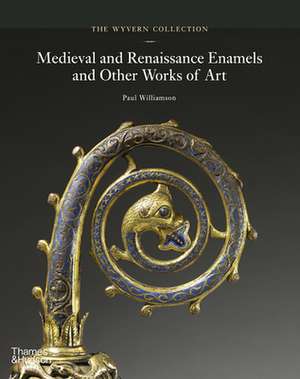
The Wyvern Collection
Autor Paul Williamsonen Limba Engleză Hardback – 7 dec 2021
This volume also includes other outstanding works of art such as an important Anglo-Carolingian chrismatory of the ninth century, a small group of enigmatic twelfth-century drinking cups, and sumptuous examples of German late medieval goldsmiths' work. Stained and painted glass roundels, Italian Renaissance ceramics, luxurious textiles and tapestries, and German and Italian armor are also featured. An appendix presents several important pieces, recently acquired, which supplement those published in the first two volumes.
With more than 250 objects, all specially photographed, this is a beautiful addition to the collection of catalogs documenting one of the greatest private collections.
Preț: 510.88 lei
Preț vechi: 600.14 lei
-15%
Puncte Express: 766
Carte disponibilă
Livrare economică 21 noiembrie-05 decembrie
Livrare express 07-13 noiembrie pentru 187.84 lei
Livrare prin curier în România Termenul estimat este afișat lângă disponibilitate.
Transport gratuit pentru acest produs Plată online sau ramburs, în funcție de opțiunile comenzii.
Retur gratuit în 14 zile Comandă securizată și suport în română.
Specificații
ISBN-13: 9780500024560
ISBN-10: 0500024561
Pagini: 480
Ilustrații: 400 Illustrations, color
Dimensiuni: 230 x 284 x 48 mm
Greutate: 2.86 kg
Editura: Thames & Hudson
ISBN-10: 0500024561
Pagini: 480
Ilustrații: 400 Illustrations, color
Dimensiuni: 230 x 284 x 48 mm
Greutate: 2.86 kg
Editura: Thames & Hudson
V-ar putea interesa
-
 The Grove Encyclopedia of Medieval Art and ArchitectureColum Hourihane-23%Preț: 5885.44 lei7643.43 lei
-
 -9%Preț: 687.29 lei755.27 lei
-
 Craftsman's HandbookCennio D'Andrea Cennini-18%Preț: 72.73 lei89.20 lei
-
 Fantastic OrnamentMichel LiénardPreț: 54.55 lei
-
 -15%Preț: 514.43 lei602.23 lei
-
 RingsDiana Scarisbrick-14%Preț: 209.75 lei243.62 lei
-
 -23%Preț: 655.31 lei851.05 lei
-
 -8%Preț: 526.76 lei572.57 lei
-
 Radiance And ReverieDiane C. Wright-8%Preț: 439.84 lei478.09 lei
-
 The Middle Ages in 50 ObjectsElina GertsmanPreț: 231.79 lei
-
 Wortes and AllEmma KayPreț: 112.98 lei
-
 A Medieval Cabinet of CuriositiesLorris ChevalierPreț: 122.82 lei
-
 How to Read Medieval ArtWendy A. SteinPreț: 178.01 lei
-
 European Sculpture in the Collection of His Majesty The KingJonathan Marsden-9%Preț: 2847.51 lei3129.12 lei
-
 -58%Preț: 601.22 lei1423.29 lei
-
 The Jewelry BookMelanie Grant-11%Preț: 457.22 lei513.73 lei
-
 The Medieval WorldMartin Bagnoli-32%Preț: 205.79 lei302.52 lei
-
 Preț: 369.71 lei
-
 Wyvern Collection: Objects in Focus Volume 1: The Baird CasketPaul WilliamsonPreț: 174.38 lei
-
 The Sorcerer's Scholar: The High Magic and Spells of the Middle AgesClaude Lecouteux-23%Preț: 488.66 lei631.46 leiRecomandat
Notă biografică
Paul Williamson is Keeper Emeritus and Honorary Senior Research Fellow at the Victoria and Albert Museum, and an Honorary Research Fellow at the Courtauld Institute of Art, University of London. His many books include Gothic Sculpture 1140-1300, Medieval and Renaissance Stained Glass in the Victoria and Albert Museum, Medieval Ivory Carvings: Early Christian to Romanesque, and two previous catalogues of the Wyvern Collection (Thames & Hudson, 2018 and 2019). He is a past Vice-President of the Society of Antiquaries of London, a Fellow of the Royal Historical Society, and was appointed OBE in 2016 for services to medieval art.
Cuprins
Foreword
Preface
Explanatory Notes on the Catalogue Entries
The Catalogue
I Early Medieval Works of Art
Catalogue numbers 1-12
II Romanesque Enamels, excluding Limoges
Catalogue numbers 13-21
III Limoges Enamels
Catalogue numbers 22-87
IV Gothic and Renaissance Works of Art
Catalogue numbers 88-143
V Stained and Painted Glass
Catalogue numbers 144-152
VI Limoges Painted Enamels
Catalogue numbers 153-182
VII Ceramics
Catalogue numbers 183-189
VIII Textiles and Tapestry
Catalogue numbers 190-194
IX Later Works of Art
Catalogue numbers 195-204
X Appendix to Wyvern Collection, Volumes 1 and 2
Catalogue numbers 205-210
Concordance
Bibliography
Descriere
The fourth catalogue devoted to the Wyvern Collection, an exceptional private collection of medieval and Renaissance art, comparable to the holdings of many of the world's great museums.
Recenzii
“Excellently produced supplement to the Wyvern Collection catalogues. . . . To his enormous credit, Williamson treats each work of art with scholarly authority but also with stirring appreciation.”—Jessica Savage, Medieval Review