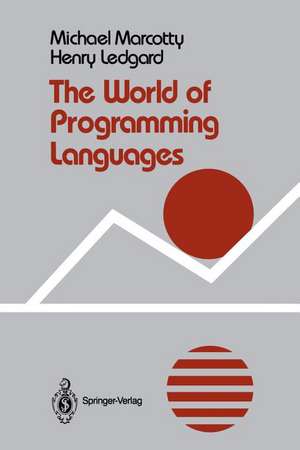
The World of Programming Languages: Springer Books on Professional Computing
Autor Michael Marcotty, Henry Ledgarden Limba Engleză Paperback – 16 dec 1986

Preț: 782.98 lei
Preț vechi: 978.73 lei
-20%
Puncte Express: 1174
Carte tipărită la comandă
Livrare economică 04-18 decembrie
Livrare prin curier în România Termenul estimat este afișat lângă disponibilitate.
Transport gratuit pentru acest produs Plată online sau ramburs, în funcție de opțiunile comenzii.
Retur gratuit în 14 zile Comandă securizată și suport în română.
Specificații
ISBN-13: 9780387964409
ISBN-10: 0387964401
Pagini: 360
Ilustrații: XVI, 360 p. 14 illus.
Dimensiuni: 155 x 235 x 17 mm
Greutate: 0.53 kg
Ediția:Softcover reprint of the original 1st ed. 1987
Editura: Springer
Colecția Springer
Seria Springer Books on Professional Computing
Locul publicării:New York, NY, United States
ISBN-10: 0387964401
Pagini: 360
Ilustrații: XVI, 360 p. 14 illus.
Dimensiuni: 155 x 235 x 17 mm
Greutate: 0.53 kg
Ediția:Softcover reprint of the original 1st ed. 1987
Editura: Springer
Colecția Springer
Seria Springer Books on Professional Computing
Locul publicării:New York, NY, United States
V-ar putea interesa
-
 The C++ Programming LanguageBjarne Stroustrup-20%Preț: 507.21 lei634.02 lei
 -
 ADA®Henry Ledgard-20%Preț: 319.39 lei399.24 lei
 -
 Using the STL: The C++ Standard Template LibraryRobert Robson-20%Preț: 639.25 lei799.07 lei
 -
 Python Programming for BiologyTim J. Stevens-20%Preț: 460.01 lei575.01 lei
 -
 Beginning Programming with C++ For DummiesStephen R. Davis-20%Preț: 173.62 lei217.02 lei
 -
 Pro ASP.NET Web API SecurityBadrinarayanan Lakshmiraghavan-20%Preț: 525.86 lei657.33 lei
 -
 -20%Preț: 230.97 lei288.71 lei
 -
 -20%Preț: 156.43 lei195.54 lei
 -
 Functional Programming in ScalaRunar Bjarnason-20%Preț: 340.60 lei425.75 lei
 -
 Python Programming for BeginnersJoseph Joyner-20%Preț: 53.61 lei67.02 lei
 -
 Murachs C# 2012Joel Murach-28%Preț: 359.74 lei496.79 lei
 -
 Rewriting Logic and Its ApplicationsDorel Lucanu-20%Preț: 317.26 lei396.57 lei
 -
 Programming LanguagesFernando Castor-20%Preț: 317.04 lei396.30 lei
 -
 Computer Safety, Reliability, and SecurityAmund Skavhaug-20%Preț: 324.22 lei405.27 lei
 -
 -20%Preț: 307.20 lei384.00 lei
 -
 -20%Preț: 309.77 lei387.21 lei
Public țintă
ResearchCuprins
Preface.- Acknowledgements.- 1. Introduction.- 1.1 The Building of the Tower of Babel.- 1.2 What Is a Programming Language?.- 1.3 Why Study Programming Languages?.- 1.4 What Should We Look for in a Language?.- 1.5 Language Design Issues.- 1.6 The Study of Programming Languages.- Further Reading.- 2. Elements of a Programming Language.- 2.1 Informal Description of Mini-language Core.- 2.2 Informal Semantics of Mini-language Core.- 2.3 Language Design and the Programming Process.- 2.4 The Definition of Programming Languages.- 2.5 The Formal Description of Syntax.- 2.6 Other Context-free Syntax Definitions.- Further Reading.- 3. Names, Locations, and Values.- 3.1 Mini-language Ref.- 3.2 Declarations.- 3.3 Assignment.- 3.4 Statements as Expressions.- 3.5 Where to Look: Algol 68, Smalltalk.- Further Reading.- 4. Control Structures.- 4.1 Mini-language Control.- 4.2 Basic Control Structures and Flowgraphs.- 4.3 Theorems on Control Structures.- 4.4 Other One-in, One-out Control Structures.- 4.5 The Goto Statement and Label Values.- 4.6 Conclusions.- 4.7 Where to Look: Pascal, Ada.- Further Reading.- 5. Data Types.- 5.1 Mini-language Type.- 5.2 The Meaning of Type.- 5.3 Primitive Types.- 5.4 Array Types.- 5.5 Record Types.- 5.6 Type Checking.- 5.7 Where to Look: Fortran, PL/I.- Further Reading.- 6. Input and Output.- 6.1 Mini-language Format.- 6.2 Varieties of Input-output Specifications.- 6.3 Communication with the Outside World.- 6.4 Where to Look: Fortran, Cobol, Ada.- Further Reading.- 7. Procedures and Parameters.- 7.1 Mini-language Procedures.- 7.2 Procedures as Abstractions.- 7.3 Arguments and Parameters.- 7.4 Value-returning Procedures.- 7.5 Coroutines.- 7.6 Where to Look: PL/I, Ada.- Further Reading.- 8. Nesting and Scope.- 8.1 Mini-language Scope.- 8.2 The Idea of Scope.- 8.3 Storage Allocation.- 8.4 Dynamic Scope.- 8.5 Where to Look: Pascal, PL/I, APL.- Further Reading.- 9. Definition of New Data Types.- 9.1 Mini-language Typedef.- 9.2 Type Definitions.- 9.3 Definition of Structured Types.- 9.4 User Defined Operators.- 9.5 Where to Look: Pascal, Algol 68.- Further Reading.- 10. Dynamically Varying Structures.- 10.1 Mini-language Structures.- 10.2 Dynamically Varying Data Structures.- 10.3 Pointers.- 10.4 Design Criteria for Data Structures.- 10.5 Dynamic Allocation of Storage.- 10.6 Where to Look: PL/I, Pascal, Ada.- Further Reading.- 11. Exception Handling.- 11.1 Mini-language Exceptions.- 11.2 Exceptions.- 11.3 Issues in Exception Handling.- 11.4 Where to Look: PL/I, Ada.- Further Reading.- 12. Parallel Processing.- 12.1 Mini-language Parallel.- 12.2 A First Solution to the Decoding Problem.- 12.3 Putting a Buffer in a Task.- 12.4 Interrupting.- 12.5 Issues in Parallel Processing.- 12.6 Where to Look: Concurrent Pascal, Modula-2, Ada.- Further Reading.- 13. Separately Compiled Modules.- 13.1 Mini-language Modules.- 13.2 Packaging Subprograms.- 13.3 Abstract Data Types.- 13.4 Where to Look: PL/I, Modula 2, Ada, Smalltalk.- Further Reading.- 14. The Swamp of Complexity.- 14.1 The Forms of Complexity.- 14.2 Escaping from the Swamp.- References.