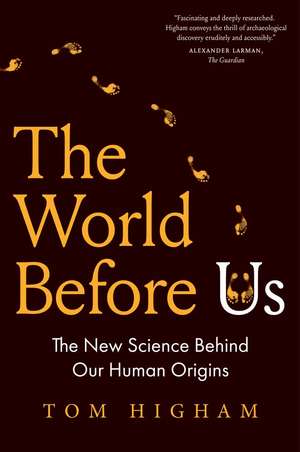
The World Before Us: The New Science Behind Our Human Origins
Autor Tom Highamen Limba Engleză Paperback – 28 feb 2023
Nivelul de studiu vizat de această lucrare este cel de licență și master în arheologie sau antropologie, servind totodată ca o referință profesională solidă pentru cercetătorii interesați de ultimele metode de datare. În The World Before Us, Tom Higham propune o incursiune riguroasă în peisajul uman al Pleistocenului târziu, o perioadă în care Homo sapiens nu era singura specie umană de pe planetă. Suntem de părere că forța acestui volum rezidă în autoritatea directă a autorului, profesor la Oxford, care a participat activ la identificarea Denisovanilor, oferind astfel o perspectivă „din interior” asupra modului în care știința rescrie istoria. Textul analizează minuțios salturile tehnologice — de la spectrometria de masă la secvențierea genomului antic — care ne-au permis să identificăm nu doar existența unor specii precum Homo luzonensis sau Homo floresiensis, ci și interacțiunile complexe, inclusiv hibridizarea, dintre acestea și strămoșii noștri. Găsim în această carte o demontare a modelului liniar al evoluției umane, în favoarea unei rețele complexe de populații interconectate. Lucrarea completează perspectiva oferită de The Science of Human Origins, adăugând un accent mult mai pronunțat pe tehnicile de laborator și pe cronologia fină a evenimentelor de extincție și migrație. Spre deosebire de abordările pur teoretice, Higham ancorează narațiunea în date empirice recente, explicând cum fragmente infime de os pot răsturna paradigme întregi. Ritmul este alert, specific unei cronici de descoperire, dar păstrează rigoarea academică necesară unei discipline aflate în plină revoluție tehnologică.
Preț: 163.39 lei
Carte disponibilă
Livrare economică 16-30 noiembrie
Specificații
ISBN-10: 0300271123
Pagini: 320
Ilustrații: 25 color + 37 b-w illus.
Dimensiuni: 156 x 235 mm
Greutate: 0.45 kg
Editura: Yale University Press
Colecția Yale University Press
De ce să citești această carte
Recomandăm această carte oricărui cititor pasionat de originile noastre care dorește să înțeleagă nu doar „ce” știm, ci „cum” știm. Tom Higham transformă arheologia dintr-o disciplină a obiectelor prăfuite într-o știință de frontieră a geneticii. Veți câștiga o înțelegere clară a modului în care moștenirea Denisovanilor și a Neanderthalienilor ne influențează biologia actuală, totul printr-o expunere logică și extrem de actualizată.
Despre autor
Tom Higham este un renumit arheolog și specialist în datarea cu radiocarbon, ocupând poziția de profesor de arheologie științifică la Universitatea din Oxford. Cariera sa a fost marcată de activitatea de director adjunct al Unității de Accelerare a Radiocarbonului din Oxford, unde a coordonat proiecte esențiale pentru cronologia preistoriei europene. Este recunoscut la nivel mondial pentru contribuția sa la identificarea și datarea rămășițelor Denisovanilor în Siberia, munca sa fiind fundamentală pentru înțelegerea modului în care oamenii moderni s-au răspândit în Eurasia și au interacționat cu alte grupuri de hominini.
Descriere scurtă
“Conveys the thrill of archaeological discovery.”—Alexander Larman, The Observer
“Packs in startling discoveries, impressive insights and the occasional debunking of a foolish idea.”—Michael Marshall, New Scientist
Fifty thousand years ago, Homo sapiens was not the only species of humans in the world. There were also Neanderthals in what is now Europe, the Near East, and parts of Eurasia; Hobbits (H. floresiensis) on the island of Flores in Indonesia; Denisovans in Siberia and eastern Eurasia; and H. luzonensis in the Philippines. Tom Higham investigates what we know about these other human species and explores what can be learned from the genetic links between them and us. He also looks at whether H. erectus may have survived into the period when our ancestors first moved into Southeast Asia.
Filled with thrilling tales of recent scientific discoveries, this book offers an engaging synopsis of our current understanding of human origins and raises new and interesting possibilities—particularly concerning what contact, if any, these other species might have had with us prior to their extinction.
Recenzii
“A fascinating insight into groups belonging to the same Homo genus as us that lived alongside us for much of their existence. . . . Higham devotes whole chapters, sometimes multiple chapters, to each extinct hominin group. He packs in startling discoveries, impressive insights and the occasional debunking of a foolish idea.”—Michael Marshall, New Scientist
“A clear and lucid account of how to study archaic DNA. [Higham] tells an engaging story.”—Felipe Fernández-Armesto, Literary Review
“A brilliant exposition of the way in which archaeology and science are completely changing our understanding of early humans. This is essential reading for all interested in our early ancestors and the sheer excitement of their discovery.”—Barry Cunliffe, author of The Scythians and Europe Between the Oceans: 9000 BC–AD 1000
“The World Before Us ventures far beyond fossils and archaeology into the realm of today’s multidisciplinary science. This is a magnificent tour de force making cutting-edge science easily understandable and profoundly entertaining at the same time.”—Brian Fagan, author of A Little History of Archaeology and World Prehistory
“From lab bench to trench, The World Before Us offers a personal tour of the newest science in palaeoanthropology. Higham’s work on some of the most important and remarkable fossils ever found imbues his account with fascinating detail.”—Rebecca Wragg Sykes, author of Kindred: Neanderthal Life, Love, Death, and Art
“A brilliant distillation of the ideas and discoveries revolutionizing our understanding of human evolution. Tom Higham introduces us to a complex world of many human species, whose genes and deeds live on in us today.”—Chris Gosden, author of Prehistory: A Very Short Introduction
“A bang-up-to-date insider’s review of a critical period in the emergence of modern humans. It also provides fascinating, intelligible and authoritative glimpses into a wide variety of new technologies.”—Ian Tattersall, coauthor of The Accidental Homo sapiens: Genetics, Behavior, and Free Will