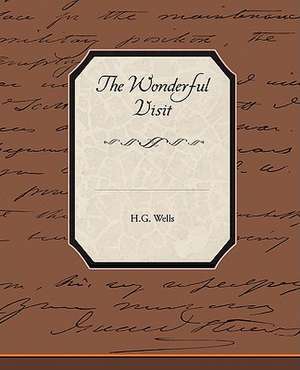
The Wonderful Visit
Autor H. G. Wellsen Limba Engleză Paperback – 13 mar 2009
Preț: 165.83 lei
Puncte Express: 249
Carte tipărită la comandă
Livrare economică 04-18 decembrie
Livrare prin curier în România Termenul estimat este afișat lângă disponibilitate.
Transport gratuit de la 400.00 lei Plată online sau ramburs, în funcție de opțiunile comenzii.
Retur gratuit în 14 zile Comandă securizată și suport în română.
Specificații
ISBN-13: 9781438514000
ISBN-10: 143851400X
Pagini: 264
Dimensiuni: 191 x 235 x 14 mm
Greutate: 0.46 kg
Editura: Book Jungle
ISBN-10: 143851400X
Pagini: 264
Dimensiuni: 191 x 235 x 14 mm
Greutate: 0.46 kg
Editura: Book Jungle
V-ar putea interesa
-
 XISLAND OF DOCTOR_CLASSICS PBH. G. WellsPreț: 28.01 lei
 -
 Men Like GodsH. G. WellsPreț: 28.01 lei
 -
 The Country of the Blind and Other StoriesH. G. Wells-18%Preț: 76.81 lei94.07 lei
 -
 The Great Science FictionH. G. Wells-27%Preț: 80.67 lei110.30 lei
 -
 The War of the WorldsH. WellsPreț: 155.46 lei
 -
 The First Men in the MoonH. G. WellsPreț: 53.36 lei
 -
 The Invisible ManH. G. WellsPreț: 33.13 lei
 -
 Preț: 158.84 lei
 -
 HG Wells Classic CollectionH. G. Wells-28%Preț: 142.19 lei198.26 lei
 -
 -27%Preț: 46.65 lei63.61 lei
 -
 World Classics Library: H. G. WellsH. G. WellsPreț: 154.72 lei
 -
 In the Days of the CometH. G. WellsPreț: 50.58 lei
 -
 A Modern UtopiaH. G. WellsPreț: 51.18 lei
 -
 H. G. WellsH. G. Wells-12%Preț: 134.29 lei153.36 lei
 -
 Selected Works of H. G. WellsH. G. Wells-12%Preț: 73.95 lei84.37 lei
 -
 Preț: 50.57 lei
 -
 Preț: 42.27 lei
 -
 Preț: 140.66 lei
 -
 The Time MachineH. G. WellsPreț: 33.23 lei
Notă biografică
Herbert George Wells is called the Father of Science Fiction because of his groundbreaking works in establishing the genre. His most influential pieces include The Time Machine, The War of the Worlds, The Invisible Man, and The Island of Doctor Moreau.
The youngest of four children, Wells was born in Kent, England in 1866 to former domestic servants. He became enamored with reading in his childhood while mending a broken leg. During his failed early career paths he still read extensively from the house library where his mother had returned to working as a servant. He became a teacher at Midhurst Grammar school and later won a scholarship to study science at what became the Royal College of Science in London. He joined the Debating Society there and developed an interest in philosophers and the reformation of society-specifically, the concept of socialism. He wrote for the school journal and published his first serialized fiction story soon after, a precursor to The Time Machine.
A prolific writer, Wells dabbled in nearly every genre, but is best known for his science fiction, and is credited with predicting the invention of tanks, nuclear weaponry, aircraft, and even the nebulous concept of the internet. He was a four-time nominee for the Nobel Prize in Literature. He died at the age of 79 in his home at Regent's Park on August 13, 1946.