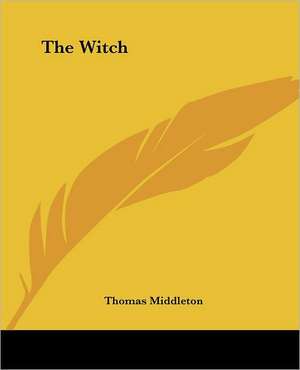
The Witch
Autor Thomas Middletonen Limba Engleză Paperback – 17 iun 2004
Preț: 95.94 lei
Puncte Express: 144
Carte tipărită la comandă
Livrare economică 16-22 iulie
Livrare prin curier în România Termenul estimat este afișat lângă disponibilitate.
Transport gratuit de la 400.00 lei Plată online sau ramburs, în funcție de opțiunile comenzii.
Retur gratuit în 14 zile Comandă securizată și suport în română.
Specificații
ISBN-13: 9781419188251
ISBN-10: 1419188259
Pagini: 112
Dimensiuni: 191 x 235 x 7 mm
Greutate: 0.23 kg
Editura: Kessinger Publishing
Locul publicării:United States
ISBN-10: 1419188259
Pagini: 112
Dimensiuni: 191 x 235 x 7 mm
Greutate: 0.23 kg
Editura: Kessinger Publishing
Locul publicării:United States
V-ar putea interesa
-
 Reinventing the RenaissanceS. BrownPreț: 387.83 lei
 -
 The Relapse: Or Virtue in DangerJohn Vanbrugh-25%Preț: 71.58 lei95.35 lei
 -
 The CriticRichard Brinsley Sheridan-23%Preț: 67.92 lei88.00 lei
 -
 A New Way to Pay Old DebtsPhilip Massinger-18%Preț: 68.74 lei83.34 lei
 -
 Eastward Ho!Ben Jonson-19%Preț: 73.34 lei90.21 lei
 -
 The Witch of EdmontonJohn Ford-21%Preț: 69.91 lei88.88 lei
 -
 Marriage A-La-ModeJohn Dryden-17%Preț: 69.49 lei83.56 lei
 -
 A Woman Killed With KindnessThomas Heywood-25%Preț: 74.70 lei99.86 lei
 -
 The Roaring GirlThomas Dekker-25%Preț: 72.25 lei95.77 lei
 -
 TamburlaineChristopher Marlowe-19%Preț: 72.45 lei89.68 lei
 -
 Preț: 215.20 lei
 -
 Preț: 278.95 lei
 -
 The Early Republic and Rise of National Identity: 1783-1861Jeffrey H. HackerPreț: 426.00 lei
 -
 Green Retreats: Women, Gardens and Eighteenth-Century CultureStephen BendingPreț: 245.11 lei
 -
 Preț: 385.58 lei
 -
 A Yorkshire Tragedy in Plain and Simple EnglishWilliam ShakespearePreț: 89.00 lei
 -
 -38%Preț: 630.35 lei1022.39 lei
 -
 The Horse in Early Modern English Culture: Bridled, Curbed, and TamedKevin De Ornellas-35%Preț: 513.76 lei791.56 lei
 -
 A to Z guide to Rhodes 2019, Including SymiTony OswinPreț: 169.31 lei
 -
 Anything for a Quiet LifeThomas MiddletonPreț: 53.27 lei
 -
 Michaelmas term and a trick to catch the old oneThomas Middleton-23%Preț: 818.54 lei1063.04 lei
Descriere
Descriere de la o altă ediție sau format:
The Witch (1615/16?), categorised by its author as 'a tragi-comedy',
pits the intrigues of a group of Italian aristocrats against the
malevolent practices of Hecate and her witches' coven, leaving the
audience with the impression that human malevolence is by far the
fiercer and more effective. This edition sets the play into its
dramatic and literary contexts, ranging from Shakespeare's Macbeth and
Middleton's own later tragedies to Reginald Scot's sceptical Discovery
of Witchcraft and King James's virulent Daemonologie. It also argues
that Middleton wrote it as a topical satire to capitalise on the
scandal involving Frances Howard, who obtained a divorce from the Earl
of Essex on the grounds that he had been sexually incapacitated by
witchcraft; she was also rumoured to have tried to poison him.
Middleton exposes his noble characters precisely by letting them get
away with murder.
The Witch (1615/16?), categorised by its author as 'a tragi-comedy',
pits the intrigues of a group of Italian aristocrats against the
malevolent practices of Hecate and her witches' coven, leaving the
audience with the impression that human malevolence is by far the
fiercer and more effective. This edition sets the play into its
dramatic and literary contexts, ranging from Shakespeare's Macbeth and
Middleton's own later tragedies to Reginald Scot's sceptical Discovery
of Witchcraft and King James's virulent Daemonologie. It also argues
that Middleton wrote it as a topical satire to capitalise on the
scandal involving Frances Howard, who obtained a divorce from the Earl
of Essex on the grounds that he had been sexually incapacitated by
witchcraft; she was also rumoured to have tried to poison him.
Middleton exposes his noble characters precisely by letting them get
away with murder.