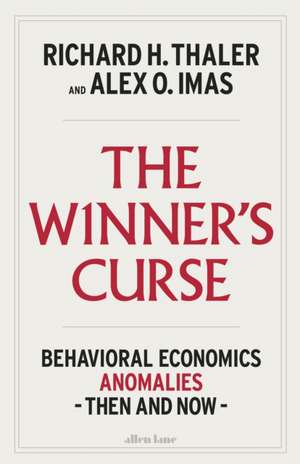
The Winner's Curse
Autor Richard H. Thaler, Alex O. Imasen Limba Engleză Hardback – 21 oct 2025
Plasăm volumul The Winner's Curse în nucleul curriculumului de economie comportamentală și teoria deciziei, fiind o resursă care fundamentează tranziția de la modelele economice abstracte la realitatea psihologică a piețelor. Subliniem că această ediție actualizată, scrisă de Richard H. Thaler împreună cu Alex O. Imas, reprezintă o sinteză necesară între coloanele clasice despre anomaliile economice și dinamica financiară contemporană. Descoperim aici o analiză riguroasă a motivelor pentru care agenții economici nu se comportă întotdeauna ca optimizatori raționali, explorând paradoxuri precum cooperarea în lipsa motivației egoiste sau atașamentul față de bunuri de valoare redusă. Remarcăm cum autorii integrează în discurs fenomene recente, de la Dogecoin la volatilitatea bursieră generată de rețelele sociale, demonstrând că anomaliile identificate în urmă cu trei decenii sunt mai relevante ca oricând. Acoperă aceeași arie tematică a proceselor decizionale ca Behavioral Decision Theory de Kazuhisa Takemura, dar cu o abordare mult mai pragmatică, axată pe anomaliile pieței reale mai degrabă decât pe structura pur teoretică a formării preferințelor. În comparație cu Thinking, Fast and Slow de Daniel Kahneman, care se concentrează pe arhitectura cognitivă a erorilor, lucrarea de față aplică aceste concepte direct în mecanismele de schimb și licitație. Această ediție consolidează temele explorate de Thaler în Misbehaving (publicată în limba română ca Comportament inadecvat) și oferă suportul empiric pentru strategiile de influențare subtilă prezentate în Nudge. Textul păstrează un echilibru fin între accesibilitate și rigoare academică, fiind structurat pentru a fi parcurs fără a necesita cunoștințe matematice avansate, dar fără a simplifica excesiv complexitatea datelor.
Preț: 224.87 lei
Carte disponibilă
Livrare economică 02-09 noiembrie
Livrare express 22-28 octombrie pentru 29.49 lei
Specificații
ISBN-10: 0241789680
Pagini: 352
Dimensiuni: 159 x 239 x 34 mm
Greutate: 0.56 kg
Editura: Penguin Books
Colecția Allen Lane
V-ar putea interesa
-
 Predictably IrrationalDan ArielyPreț: 78.52 lei
 -
 Preț: 67.84 lei
 -
 ThinkingJohn BrockmanPreț: 115.88 lei
 -
 Thinking, Fast and SlowDaniel Kahneman-27%Preț: 90.73 lei123.57 leiRecomandat
 -
 On the EdgeNate SilverPreț: 107.37 lei
 -
 Choice Theory: A Very Short IntroductionMichael Allingham-20%Preț: 57.15 lei71.12 lei
 -
 When Everyone Knows That Everyone Knows...Steven PinkerPreț: 136.05 lei
 -
 The ScoreC. Thi NguyenPreț: 193.04 lei
 -
 You Already KnowLaura HuangPreț: 122.17 lei
 -
 MisbehavingRichard H. Thaler-29%Preț: 66.47 lei94.27 lei
 -
 NegotiationMax H. BazermanPreț: 174.09 lei
 -
 Think ClearlyKiko LlanerasPreț: 122.43 lei
 -
 The Elements of ChoiceEric J. JohnsonPreț: 94.74 lei
 -
 Preț: 137.61 lei
 -
 The Art of WinningDan CarterPreț: 106.83 lei
 -
 A Trick Of The MindDaniel YonPreț: 158.93 lei
 -
 When Everyone Knows That Everyone Knows . . .Steven PinkerPreț: 184.79 lei
 -
 10 to 25David YeagerPreț: 94.32 lei
 -
 Running the RiskDavid Burrett ReidPreț: 140.40 lei
 -
 The Winner's CurseRichard H ThalerPreț: 173.17 lei
De ce să citești această carte
Recomandăm această lucrare studenților și profesioniștilor care doresc să înțeleagă de ce piețele financiare eșuează adesea în a fi eficiente. Cititorul câștigă o înțelegere profundă a anomaliilor comportamentale care guvernează licitațiile și economiile casnice. Este un instrument esențial pentru a învăța cum să navighezi într-o economie dominată de decizii umane imprevizibile, oferind o perspectivă critică asupra limitelor raționalității economice tradiționale.
Despre autor
Richard H. Thaler (n. 1945) este un economist american de renume, profesor la University of Chicago Booth School of Business și laureat al Premiului Nobel pentru Economie în 2017. Este considerat unul dintre fondatorii economiei comportamentale, cercetările sale construind punți esențiale între analiza economică și psihologia decizională. Thaler a ocupat funcția de președinte al American Economic Association și a colaborat extensiv cu figuri precum Daniel Kahneman. Opera sa, care include titluri influente precum Nudge și Misbehaving, a redefinit modul în care guvernele și organizațiile înțeleg comportamentul uman în contextul alegerilor economice.
Descriere
Notă biografică
Richard H. Thaler received the 2017 Nobel Prize in Economic Sciences. He is a distinguished service professor of economics and behavioral science at the University of Chicago's Booth School of Business. He is the New York Times bestselling coauthor of Nudge: Improving Decisions about Health, Wealth, and Happiness (with Cass Sunstein) and the author of Misbehaving: The Making of Behavioral Economics.
Alex O. Imas (Author)
Alex O. Imas is Professor of Behavioral Science and Economics at the University of Chicago School's Booth School of Business. He is the recipient of the 2023 Alfred P. Sloan Research Fellowship, the Review of Financial Studies Rising Scholar Award, the New Investigator Award from the Behavioral Science and Policy Association, the Hillel Einhorn New Investigator Award from the Society of Judgment and Decision Making, the Distinguished CESifo Affiliate Award, and the NSF Graduate Research Fellowship. Previously, he was Assistant Professor of Behavioral Economics at Carnegie Mellon University.
Descriere scurtă
Why do people cooperate with one another when they have no incentive to do so? Why do we hold onto possessions of little value? And why is the winner of an auction so often disappointed?
Over thirty years ago, Richard Thaler introduced readers to behavioral economics in his seminal Anomalies column, written with collaborators including Daniel Kahneman and Amos Tversky. These provocative articles challenged the fundamental idea at the heart of economics that people are selfish, rational optimizers, and provided the foundation for what became behavioral economics. That was then. Now, three decades later, Thaler has teamed up with economist Alex Imas to write a new book. Every chapter starts with an original Anomaly, retaining the spirit of its timestamp. Then, shifting to the present, they provide current updates to each, asking how the original findings have held up and how the field has evolved since then.
It turns out these findings still show up almost everywhere. Anomalies pop up in people's decisions to save for retirement and how they carry outstanding credit card debt. Even experts fail to optimize. The key concept of loss aversion explains missed putts by golf pros and the selection of which stocks to sell by portfolio managers. In this era of meme stocks and Dogecoin, it is hard to defend the view that financial markets are highly efficient. The good news, however, is that the anomalies have got much funnier.
With both readability and rigor, The Winner's Curse illuminates these ideas for anyone - from those with a cursory understanding of economics to fellow economists. Each chapter provides a key insight into human behavior so readers learn how to better understand the choices made by their friends, colleagues, and customers, and might just become better at making decisions themselves.