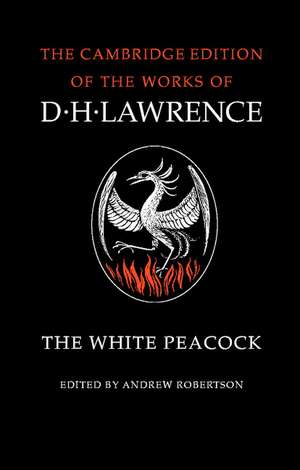
The White Peacock
Autor D. H. Lawrence Editat de Andrew Robertson, James T. Boultonen Limba Engleză Paperback – feb 2002
Preț: 489.58 lei
Puncte Express: 734
Carte tipărită la comandă
Livrare economică 03-17 decembrie
Livrare prin curier în România Termenul estimat este afișat lângă disponibilitate.
Transport gratuit pentru acest produs Plată online sau ramburs, în funcție de opțiunile comenzii.
Retur gratuit în 14 zile Comandă securizată și suport în română.
Specificații
ISBN-13: 9780521294270
ISBN-10: 0521294274
Pagini: 508
Ilustrații: 1 map
Dimensiuni: 140 x 216 x 30 mm
Greutate: 0.71 kg
Ediția:Revised
Editura: Cambridge University Press
Locul publicării:Cambridge, United Kingdom
ISBN-10: 0521294274
Pagini: 508
Ilustrații: 1 map
Dimensiuni: 140 x 216 x 30 mm
Greutate: 0.71 kg
Ediția:Revised
Editura: Cambridge University Press
Locul publicării:Cambridge, United Kingdom
V-ar putea interesa
-
 Sea and SardiniaD. H. Lawrence-19%Preț: 63.51 lei78.63 lei
 -
 The Letters of D. H. LawrenceD. H. LawrencePreț: 499.68 lei
 -
 Frances Hodgson BurnettFrances Hodgson BurnettPreț: 60.12 lei
 -
 The NegroBuckner H. 'Ariel' PaynePreț: 42.19 lei
 -
 ReneFrancois Rene De ChateaubriandPreț: 75.67 lei
 -
 The Indian TodayCharles EastmanPreț: 91.21 lei
 -
 The Common People of Ancient Rome Studies of Roman Life and LiteratureFrank Frost AbbottPreț: 44.37 lei
 -
 It Is Never Too Late to MendCharles ReadePreț: 95.83 lei
 -
 Lovely Lady, TheD. H. LawrencePreț: 78.01 lei
 -
 -19%Preț: 163.23 lei202.54 lei
 -
 Les Cinq Adresses Républicaines En Vers Précédées de l'OrphelinFaustin BonnefoyPreț: 78.95 lei
 -
 Les abeillesAmédée BoudinPreț: 79.64 lei
 -
 Les Mystères Du Lapin Blanc: Grand Roman DramatiqueJules BoulabertPreț: 345.50 lei
 -
 Preț: 254.31 lei
 -
 Veillées d'Une Chaumière de la VendéeThomas-Robert BugeaudPreț: 94.88 lei
 -
 Excursions sur les bords de l'EuphrateLéon CahunPreț: 169.26 lei
 -
 Le Livre de Quatre CouleursLouis-Antoine de CaraccioliPreț: 115.91 lei
 -
 Le bagneJean CarolPreț: 169.61 lei
 -
 Le theatre de la foire, ou L'opera comique. Tome IX.Denis CaroletPreț: 269.45 lei
 -
 Les Campagnes de Moffino: Épisodes de la Guerre de RussieÉmilie CarpentierPreț: 139.07 lei
Cuprins
General editor's preface; Acknowledgements; Chronology; Cue-titles; Map; Introduction; The White Peacock; Appendix; Explanatory notes; Textual apparatus; A note on pounds, shillings and pence.
Descriere
The Cambridge edition of The White Peacock faithfully recovers Lawrence's words and punctuation.
Notă biografică
D. H. Lawrence (1885-1930) was an English novelist, poet, essayist, and literary critic renowned for his provocative exploration of human emotions, sexuality, and societal norms. Born in the coal-mining town of Eastwood, Nottinghamshire, Lawrence's modernist works like Sons and Lovers, The Rainbow, Women in Love, and Lady Chatterley's Lover challenged prevailing conventions of his time, delving deeply into social alienation, modernity, and industrialization. Despite facing censorship and controversy, Lawrence's literary legacy endures as a testament to his daring and original contributions to literature and his unyielding quest for authenticity in artistic expression.