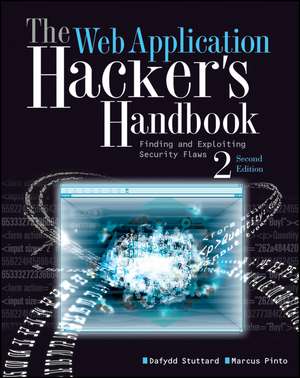
The Web Application Hacker's Handbook
Autor Dafydd Stuttard, Marcus Pintoen Limba Engleză Paperback – 7 oct 2011
Suntem de părere că această a doua ediție a The Web Application Hacker's Handbook rămâne resursa de referință pentru orice specialist în securitate, fiind actualizată pentru a aborda tehnologiile moderne care definesc web-ul actual: HTML5, noile framework-uri de remoting și mecanismele complexe de integrare cross-domain. Într-un peisaj în care aplicațiile web reprezintă principala poartă de acces pentru atacatori, volumul de față detaliază pas cu pas cum pot fi exploatate și, ulterior, securizate vulnerabilitățile critice. Ne-a atras atenția rigoarea cu care sunt tratate noile vectori de atac, precum UI redress, framebusting și HTTP parameter pollution, oferind o perspectivă tehnică asupra riscurilor ce apar la nivelul clientului. Structura este una eminamente practică, fiecare capitol fiind conceput pentru a ghida cititorul prin procesul de descoperire și exploatare a defectelor de securitate. Un element distinctiv îl reprezintă site-ul web dedicat, gestionat de autori, unde conceptele teoretice pot fi verificate într-un mediu controlat, facilitând o învățare activă. Pe linia practică a volumului Hacking Web Apps de Mike Shema, dar cu un focus mult mai extins pe metodologii de testare și pe profunzimea analizei tehnice, această carte nu se limitează la a prezenta un catalog de vulnerabilități. În schimb, Dafydd Stuttard și Marcus Pinto construiesc un cadru complet de evaluare a securității. Față de Hacking Exposed Web Applications, care oferă o privire de ansamblu asupra ecosistemului, manualul de față se concentrează pe mecanica internă a aplicațiilor, fiind indispensabil pentru cei care doresc să stăpânească arta testelor de penetrare la nivel profesional.
Preț: 305.82 lei
Preț vechi: 382.27 lei
-20%
Carte disponibilă
Livrare economică 17 noiembrie-01 decembrie
Livrare express 03-07 noiembrie pentru 90.43 lei
Specificații
ISBN-10: 1118026470
Pagini: 912
Dimensiuni: 188 x 236 x 51 mm
Greutate: 1.62 kg
Ediția:2. Auflage
Editura: Wiley
Locul publicării:Hoboken, United States
V-ar putea interesa
-
 -20%Preț: 139.57 lei174.47 lei
 -
 Internet & World Wide Web: How to ProgramHarvey Deitel-20%Preț: 641.26 lei801.58 lei
 -
 PHP and MySQL Web DevelopmentLaura Thomson-20%Preț: 316.71 lei395.88 lei
 -
 Hands-On Ethical Hacking and Network DefenseMichael Simpson-24%Preț: 409.83 lei535.83 lei
 -
 -20%Preț: 226.42 lei283.03 lei
 -
 Android Hacker's HandbookJoshua J Drake-20%Preț: 317.35 lei396.69 lei
 -
 The Browser Hacker's HandbookWade Alcorn-20%Preț: 353.85 lei442.31 lei
 -
 -28%Preț: 295.73 lei411.52 lei
 -
 -20%Preț: 303.45 lei379.31 lei
 -
 -20%Preț: 302.24 lei377.80 lei
 -
 Hacking: The Art of Exploitation, 2nd EditionJon Erickson-34%Preț: 261.36 lei396.68 lei
 -
 Attacking Network ProtocolsJames Forshaw-36%Preț: 283.27 lei440.27 lei
 -
 Real-World Bug Hunting: A Field Guide to Web HackingPeter Yaworski-20%Preț: 201.32 lei251.65 lei
 -
 Web Security for Developers: Real Threats, Practical DefenseMalcolm Mcdonald-39%Preț: 143.62 lei234.39 lei
 -
 -24%Preț: 245.42 lei324.52 lei
 -
 Grokking Web Application SecurityMalcolm McDonald-20%Preț: 341.21 lei426.52 lei
 -
 -36%Preț: 178.91 lei280.33 lei
 -
 -35%Preț: 257.90 lei394.95 lei
 -
 Metasploit, 2nd EditionDavid Kennedy-20%Preț: 295.37 lei369.22 lei
Public țintă
Primary audience: Professional web application security professionals Secondary audience: Web developers and administrators The ideal reader for this book would be: someone with a strong interest in learning how to attack or defend web applications. Some knowledge of key security concepts, and core web technologies, would be beneficial. However, all of these will be explained in the book at the appropriate point, making the book suitable both for beginners and for readers with more experience in this area.De ce să citești această carte
Recomandăm această carte profesioniștilor în securitate și dezvoltatorilor web care vor să înțeleagă în profunzime vulnerabilitățile moderne. Cititorul câștigă o metodologie clară de testare și acces la exerciții practice. Este un ghid esențial pentru a trece de la simpla cunoaștere a unor concepte la execuția unor audituri de securitate riguroase, folosind tehnici actualizate pentru HTML5 și atacuri pe partea de client.
Despre autor
Dafydd Stuttard este consultant principal în securitate la Next Generation Security Software, unde coordonează divizia de securitate a aplicațiilor web. Cu o experiență de peste nouă ani în domeniu, acesta s-a specializat în teste de penetrare pentru instituții bancare, retaileri și guverne. Este un programator experimentat în multiple limbaje, expertiza sa fiind recunoscută la nivel mondial. Alături de Marcus Pinto, a dezvoltat metodologii de securitate care au devenit standard în industrie, contribuind activ la educarea noilor generații de experți în securitate cibernetică.