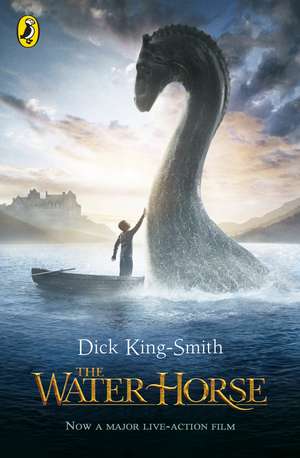
The Water Horse
Autor Dick King-Smith Ilustrat de David Parkinsen Limba Engleză Paperback – 3 ian 2008
Găsim în această carte o lecție prețioasă despre compasiune și responsabilitate, transmisă fără pic de didacticism: dragostea și îngrijirea pot transforma o creatură necunoscută într-un membru al familiei. The Water Horse pornește de la o premisă plină de candoare: Kirstie, o fetiță de opt ani, descoperă un ou neobișnuit pe malul mării în Scoția, iar ceea ce eclozează a doua zi în cada familiei este o creatură mitică, un „cal de apă” care are nevoie de protecție și un cămin. Credem că farmecul acestei lecturi rezidă în modul natural în care fantasticul se împletește cu viața de zi cu zi a unei familii obișnuite. Ritmul este domol, perfect pentru lectura de seară, iar tonul este unul de o blândețe rară, specific autorului Dick King-Smith. Atmosfera amintește de The Secret of the Kelpie de Lari Don, însă, spre deosebire de natura amenințătoare a kelpie-ului din folclorul scoțian, creatura lui King-Smith este vulnerabilă și prietenoasă, miza fiind aici creșterea și salvarea ei, nu pericolul. Această abordare umanistă a animalelor este amprenta inconfundabilă a autorului, pe care o regăsim și în The Sheep-pig sau The Hodgeheg. Dacă în alte lucrări Dick King-Smith explorează curajul animalelor de fermă, aici el extinde această empatie către legendar, oferindu-ne o poveste despre originea monstrului din Loch Ness care va rămâne în inima micilor cititori mult timp după închiderea cărții.
Preț: 55.43 lei
Carte disponibilă
Livrare economică 16-30 noiembrie
Livrare express 30 octombrie-05 noiembrie pentru 13.30 lei
Specificații
ISBN-10: 0141302232
Pagini: 96
Ilustrații: Illustrations
Dimensiuni: 130 x 195 x 10 mm
Greutate: 0.07 kg
Editura: Penguin Random House Children's UK
Locul publicării:London, United Kingdom
De ce să citești această carte
Recomandăm această carte părinților care caută o primă lectură de tip „chapter book” pentru copii de 7-10 ani. Este o poveste clasică despre prietenie și maturizare, care învață cititorul că bunătatea nu cunoaște bariere de specie. Cei mici vor câștiga o perspectivă empatică asupra naturii și a mitologiei, totul într-un format accesibil, cu ilustrații care dau viață magiei scoțiene.
Despre autor
Ronald Gordon King-Smith, cunoscut sub pseudonimul Dick King-Smith, a fost un prolific scriitor englez, distins cu Ordinul Imperiului Britanic pentru contribuția sa la literatura pentru copii. Fost fermier timp de două decenii, King-Smith a transpus dragostea sa autentică pentru animale în peste o sută de cărți. Este celebru la nivel mondial pentru The Sheep-pig (cunoscută și sub titlul Babe), ecranizată cu un succes imens. Stilul său este definit de un umor sclipitor și o capacitate unică de a umaniza creaturile fără a le știrbi natura sălbatică, transformându-l într-un maestru al aventurilor cu animale.
Descriere
Notă biografică
*Dick writes mostly about animals: farmyard fantasy, as he likes to call it, often about pigs, his special favorites. He enjoys writing for children, meeting the children who read his books, and knowing that they get enjoyment from what he does.
*Among his well-loved books is Babe, The Gallant Pig , which was recently made into a major motion picture, and was nominated for an Academy Award.
*Dick currently lives with his wife in a small 17th-century cottage, about three miles from the house where he was born.
From the Hardcover edition.
Extras
"I'm hungry," said Angus. "Is breakfast ready?"
"Ssssshh!" said Kirstie. "Don't talk so loud. We mustn't wake Mother or Grumble."
"Why not?"
"Because it's hatched. The thing. In the bathtub."
"Blow me down!" said Angus.
Angus enjoyed using what he thought to be terrible swear words, and his father, on his last shore leave, had taught him a careful selection of sailors' oaths.
They crept into the bathroom and stood side by side, gazing into the water.
"Look!" said Kirstie.
"Shiver my timbers!" said Angus.
The giant mermaid's purse lay on the bottom at the plug hole end like a sunken wreck. Wrecked it was, too, with a gaping hole in one side where something had emerged. At the other end of the bathtub swam that something.
When Kirstie was a grown woman with a family of her own, her children would ask her time and again to describe what it was she saw in the bathtub that early March morning when she was eight years of age.
"It was a little animal," she told them, ""such as neither I nor your Uncle Angus had ever seen before. Such as no one in the world had ever seen before, in fact. In size, it was about as big as a newborn kitten but quite a different shape. The first thing you noticed about it was its head, which was sticking out of the water on the end of quite a long neck. More than anything, it looked like a horse's head, with wide nostrils like a horse and even a suggestion of pricked ears. But its body was more like a turtle's. I don't mean it had a shell--it had kind of warty skin like a toad's, greeny grayish in color--but it had four flippers like a turtle has. And then it had a tail like a crocodile's. But just like you usually look at people's faces before you notice anything else about them, the thing that struck us was the look of its head. We didn't think about a crocodile or a toad or a turtle. We thought about a little horse."
Now, as Kirstie and Angus watched, the creature, which had been eyeing them in silence, dived with a plop, swam underwater with strong strokes of its little flippers, and surfaced again right in front of them. It looked up at them and chirruped.
"What does it want?" Kirstie said. The answer to this question was obvious to someone like Angus.
"Food, of course," he said. "It's hungry, like me."
"What shall we give it? What do you suppose it will eat? What do you suppose it is anyway? We don't even know what sort of animal it is."
"It's a monster," said Angus confidently. He had a number of picture books about monsters, and obviously this was one of them.
"But monsters are big," Kirstie said.
Angus sighed. "This isn't a monster monster," he said. "This is a baby one."
"A baby sea monster!" said Kirstie. "Well, then, it would eat fish, wouldn't it? We'll have to catch some fish for it."
A happy smile lit up Angus's round face. "We don't need to," he said. "There's some sardines in the pantry. I like sardines."
Opening the sardine can was difficult, but Kirstie managed to turn the key far enough to winkle one out, and they tiptoed upstairs again, carrying it on a saucer.
"Don't give it everything. It might not like it," said Angus hopefully, but when Kirstie pulled off a bit of sardine with her fingers and dropped it into the bathtub, the little animal snapped it up and gulped it down and chirruped loudly for more.
"It likes it," said Angus dolefully. He broke off another piece of fish, his hand moving automatically toward his mouth, but Kirstie said "Angus!" sharply, so he dropped it in the tub, contenting himself with licking the oil off his fingers. And, one after the other, they fed the creature the rest of the sardine. Then they went down to the pantry again to see if they could get another one out of the can."
With a great effort, for the key was very stiff to turn, Kirstie had at last got the can fully open when suddenly they heard footsteps on the stairs and Mother came into the kitchen.
"Kirstie!" she said. "Whatever are you up to? Who told you you could help yourself to sardines--and long before breakfast time, too?"
"It's for our sea monster," said Angus.
"Don't be so silly, Angus!" said Mother sharply. "Look at your fingers, all oily, you greedy little boy! And you, Kirstie, you're old enough to know better!"
"We haven't eaten any, Mother, honestly," said Kirstie. "And we have got a sea monster, truly we have."
"Now you listen to me, Kirstie," said Mother. "Whatever it is that you two have brought home--a lobster, a crab, whatever it is that you're wasting my expensive sardines on--you will take it straight back, d'you hear me?"
"Oh, no, Mother!" cried Kirstie. "Please not."
"First thing after breakfast it goes back in the sea," said Mother firmly. "Where is it anyway?"
"In the bathtub," said Angus.
"In the bathtub!" cried Mother. "Oh, no!"
"It's quite happy there," said Angus.
"Well, that's more than your grandfather will be by now. As I came down, I saw him going along the corridor with his towel and his shaving kit. He'll have a fit!"
"Specially if it's still hungry," said Angus.
But when the three of them reached the bathroom, the door was open and there was Grumble kneeling by the bathtub. With his bald head and his droopy mustache he looked like a walrus about to take a dip. He was staring silently at the little animal as it paddled about the water, now glistening with sardine oil. To their amazement they saw that he was smiling broadly. Grumble, smiling!
"It's that thing you found on the beach after the storm, isn't it Kirstie?"
"Yes, Grumble. It hatched in the night."
"I made her put salt in the water," said Angus.
"I doubt you need have bothered with that," said Grumble. "It's an air-breathing beastie, you see, like a seal. Fresh water or salt, I doubt it matters, so long as it has plenty of fish to eat."
"We've given it a sardine," said Kirstie.
Grumble got to his feet. "You've a clever couple of kids here," he said to Mother. "How I wish I could have found such a thing when I was their age. There were many stories then of this creature and I believed all of them, but I never thought I'd see one."
"You sound as though you know what this thing is," said Mother.
"I should," said Grumble. "Wasn't I born and brought up on the banks of Loch Morar? And wasn't there supposed to be one of these living in that very loch?"
"What is it, Grumble?" asked Kirstie.
"Before I tell you," said Grumble, "you must promise faithfully to tell no one outside the family. Not a word to any of your friends at school. Understand?"
"Oh, yes," said Kirstie. "Cross my heart." She crossed it. Angus crossed his stomach, perhaps by mistake, but possibly because it was to him the most important organ.
"Right," said Grumble. "Then I'll tell you. It's a monster."
"I told you," said Angus.
"Always there've been tales of sightings of such a beastie, sometimes at sea, more often in a loch," said Grumble. "Oh, when I was a boy, how I longed to see the kelpie."
"Is that what it's called?" said Kirstie.
"That's one name for it," said Grumble, "but the other is the one that I like. Most folks call it the Water Horse."
From the Hardcover edition.
Recenzii
"It's an ideal family read-aloud." --The Horn Book Magazine
Textul de pe ultima copertă
This lovable creature is the perfect pet. The only trouble is, he can't stop growing! He gets bigger. And BIGGER. And BIGGER. Before long, he's outgrown nearly every loch in sight. Will they ever find a home that's large enough for their Water Horse?