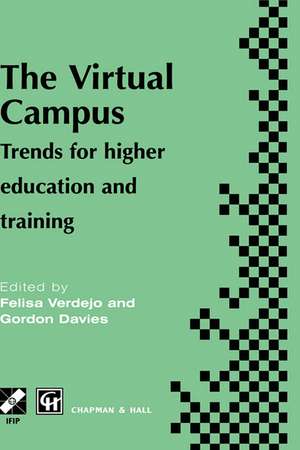
The Virtual Campus
Editat de M. F. Verdejo, Gordon Daviesen Limba Engleză Hardback – 31 ian 1997
| Toate formatele și edițiile | Preț | Express |
|---|---|---|
| Paperback (1) | 1171.97 lei 6-8 săpt. | |
| Springer – 23 mar 2013 | 1171.97 lei 6-8 săpt. | |
| Hardback (1) | 1177.32 lei 6-8 săpt. | |
| Springer – 31 ian 1997 | 1177.32 lei 6-8 săpt. |
Preț: 1177.32 lei
Preț vechi: 1435.76 lei
-18%
Puncte Express: 1766
Preț estimativ în valută:
208.19€ • 245.47$ • 180.60£
208.19€ • 245.47$ • 180.60£
Carte tipărită la comandă
Livrare economică 21 martie-04 aprilie
Specificații
ISBN-13: 9780412835506
ISBN-10: 0412835509
Pagini: 324
Ilustrații: X, 308 p.
Dimensiuni: 160 x 241 x 23 mm
Greutate: 0.65 kg
Ediția:1998
Editura: Springer
Locul publicării:New York, NY, United States
ISBN-10: 0412835509
Pagini: 324
Ilustrații: X, 308 p.
Dimensiuni: 160 x 241 x 23 mm
Greutate: 0.65 kg
Ediția:1998
Editura: Springer
Locul publicării:New York, NY, United States
V-ar putea interesa
-
 -15%Preț: 618.06 lei727.13 lei
 -
 Educational Media and Technology YearbookMichael Orey-18%Preț: 926.93 lei1130.40 lei
 -
 Technology Enhanced LearningJean-Pierre CourtiatPreț: 375.27 lei
 -
 Understanding Multimedia DocumentsRichard Lowe-15%Preț: 622.11 lei731.90 lei
 -
 Preț: 317.48 lei
 -
 Instruction Design for Microcomputing SoftwareDavid Jonassen-18%Preț: 862.39 lei1051.70 lei
 -
 Intelligent Language Tutors: Theory Shaping TechnologyV. Melissa Holland-18%Preț: 1079.12 lei1315.99 lei
 -
 Children and Computers in SchoolBetty A. Collis-18%Preț: 960.98 lei1171.93 lei
 -
 Children and Computers in SchoolBetty A. CollisPreț: 347.35 lei
 -
 Intelligent Instruction Computer: Theory And PracticeMarshall J. Farr-15%Preț: 499.52 lei587.67 lei
 -
 Fishing BC Rivers: Big Fish and Acessible WaterwaysGordon Davies-13%Preț: 108.44 lei124.11 lei
 -
 Instructional Theories in Action: Lessons Illustrating Selected Theories and ModelsCharles M. Reigeluth-18%Preț: 1072.59 lei1308.04 lei
 -
 Networking the LearnerDeryn M Watson-18%Preț: 947.42 lei1155.39 lei
 -
 Quality Education @ a DistanceG. Davies-15%Preț: 622.59 lei732.46 lei
 -
 Activity Systems Analysis MethodsLisa C Yamagata-Lynch-15%Preț: 615.07 lei723.61 lei
 -
 -18%Preț: 1169.30 lei1425.97 lei
 -
 TelE-LearningDon Ebdon-15%Preț: 622.13 lei731.92 lei
 -
 -15%Preț: 624.33 lei734.51 lei
 -
 Preț: 97.80 lei
Public țintă
ResearchCuprins
1 New wine and old bottles? Tele-learning, telematics and the University of Twente.- 2 Virtual learning centers for XXIst century organizations.- 3 New research avenues on multimedia based learning in the EU.- 4 Learning at a virtual campus: Deakin University’s experiences as a dual mode university.- 5 The university for industry pilot project.- 6 Introduction to global approaches.- 7 A Web-based learning environment: applying constructivist teaching concepts in virtual learning environments.- 8 An experience in UNED on building up a virtual campus.- 9 The impact of the Internet on academic research practices.- 10 Comparison of students’ thinking processes when studying with WWW, IMM, and text based materials.- 11 Collaboration between universities and enterprises in the knowledge age.- 12 Cultural contextualisation of learning with the World Wide Web.- 13 Questions and discussion.- 14 New approaches for collaborative learning and group activities.- 15 Towards a model of collaborative support for distance learners to perform joint tasks.- 16 Using the World Wide Web to promote educational discussion on university level courses.- 17 Distance education and distributed virtual environments.- 18 Self organised group activities supported by asynchronous structured conversations.- 19 Web tools and Web applications.- 20 How to distribute learning facilities by means of a network: some issues and a case study.- 21 A GCSE project for the distance evaluation of knowledge of French as a foreign language.- 22 Conceptual learning of sciences supported by Java compliant technologies.- 23 Extending Web educational applications via SGML structuring and content-based capabilities.- 24 SimulNet: virtual tele-laboratories over the Internet.- 25 A distance learning application based ona digital library of courseware.- 26 Authoring tools for network-based training.- 27 Using telematics to overcome educational constraints: teaching differential equations using the World-Wide-Web and multimedia technology.- Index of contributors.- Keyword index.
Recenzii
`This is an information-packed volume. The papers are timely and thought provoking and offer excellent lists of references. Overall, the book provides a perspective on networked learning and is a valuable and up-to-date resource for anyone in the field of distance education. The main topics are of primary concern to today's tele-educator: global approaches, evaluation studies, collaberative activities and web tools. Best of all, the book is international in theme and scope.'
M. Sock McIsaac, Computers & Education, 33:77-82 (1999)
M. Sock McIsaac, Computers & Education, 33:77-82 (1999)