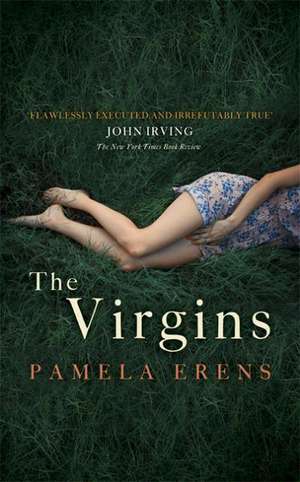
The Virgins
Autor Pamela Erensen Limba Engleză Paperback – 30 ian 2014
La Auburn Academy, un internat de elită de pe coasta de est, intervalul 1979-1980 marchează un punct de cotitură în memoria colectivă a studenților, un timp al explorării și al pierderii iremediabile a inocenței. Observăm cum Pamela Erens construiește acest spațiu izolat nu doar ca pe un cadru geografic, ci ca pe un laborator emoțional unde dinamica puterii și a dorinței este disecată cu o precizie chirurgicală. Perspectiva este una subiectivă, filtrată prin amintirile lui Bruce Bennett-Jones, care, ani mai târziu, rămâne captiv în fascinația și invidia cu care a privit relația dintre Aviva Rossner și Seung Jung. Această voce narativă adaugă un strat de complexitate, transformând povestea într-o analiză a felului în care îi observăm pe ceilalți și cum ne construim propriile mitologii pe baza intimității lor.
Subliniem tonul melancolic și ușor voyeuristic al prozei, care amintește de atmosfera densă din Trust Exercise de Susan Choi. Totuși, în timp ce Choi se concentrează pe granițele dintre adevăr și artă, The Virgins se distinge prin modul în care analizează prăbușirea unei pasiuni sub presiunea propriilor așteptări și a privirilor exterioare. Spre deosebire de explorarea viscerală a maternității din lucrarea sa ulterioară, Eleven Hours, în acest roman Pamela Erens își îndreaptă atenția către fragilitatea identității la granița dintre adolescență și maturitate. Notăm cu interes cum autoarea evită clișeele genului, oferind în schimb o tragedie nuanțată despre rușine și trădare, unde consecințele actelor de rebeliune se propagă mult dincolo de cercul restrâns al protagoniștilor. Este o lectură despre proiecții eronate și despre adevărul crud care rămâne după ce imaginea idealizată a iubirii se destramă.
Preț: 73.24 lei
Preț vechi: 99.35 lei
-26%
Carte disponibilă
Livrare economică 05-19 noiembrie
Specificații
ISBN-10: 1848549903
Pagini: 288
Dimensiuni: 135 x 214 x 22 mm
Greutate: 0.31 kg
Editura: John Murray Press
Colecția John Murray
Locul publicării:London, United Kingdom
V-ar putea interesa
-
 The Hummingbird Bakery Home Sweet HomeTarek MaloufPreț: 197.69 lei
 -
 TestimonyAnita Shreve-26%Preț: 57.89 lei78.55 lei
 -
 Branded: a spicy, dark Western romanceSaffron A. Kent-25%Preț: 60.57 lei80.42 lei
 -
 -7%Preț: 358.82 lei384.90 lei
 -
 Boys With Sharp TeethJenni HowellPreț: 65.80 lei
 -
 Crushmore: Essays on Love, Loss, and Coming-of-AgePenn Badgley-26%Preț: 89.01 lei120.70 lei
 -
 -17%Preț: 102.81 lei124.56 lei
 -
 We Love You, BunnyMona Awad-16%Preț: 93.92 lei111.16 leiRecomandat
 -
 -26%Preț: 100.77 lei136.87 lei
 -
 Before DecemberJoana MarcúsPreț: 72.74 leiRecomandat
 -
 Your Fault (Deluxe Edition)Mercedes RonPreț: 66.87 lei
 -
 Not Going To PlanTia FisherPreț: 65.87 lei
 -
 Preț: 134.27 lei
 -
 Beautiful PlayerChristina Lauren-16%Preț: 62.05 lei74.03 lei
 -
 -25%Preț: 53.37 lei71.57 lei
 -
 -25%Preț: 86.38 lei115.13 lei
 -
 -24%Preț: 94.25 lei124.63 lei
 -
 Mrs. SK. PatrickPreț: 97.92 lei
 -
 FillyRosamund Taylor-18%Preț: 88.36 lei108.27 lei
 -
 The BridesmanSavyon LiebrechtPreț: 69.67 lei
 -
 Preț: 82.74 lei
 -
 THE CINEMA OF HAYAO MIYAZAKIJeremy Mark RobinsonPreț: 211.18 lei
 -
 How Do We Relationship?, Vol. 13Tamifull-18%Preț: 54.13 lei65.62 leiRecomandat
De ce să citești această carte
Recomandăm această carte cititorilor care apreciază proza psihologică densă și atmosferele de internat american. Veți câștiga o perspectivă profundă asupra modului în care memoria și dorința modelează realitatea. Este o alegere excelentă pentru cei care caută o narațiune despre maturizare care refuză soluțiile facile, preferând în schimb o explorare onestă a complexității umane, susținută de o scriitură recunoscută de critici internaționali prestigioși.
Despre autor
PAMELA ERENS este o voce respectată în literatura contemporană americană, cunoscută pentru capacitatea sa de a explora teme dificile cu o sensibilitate aparte. Al doilea său roman, The Virgins, a fost desemnat de publicații precum The New Yorker și The New Republic drept una dintre cele mai bune cărți ale anului 2013 și a fost finalist pentru John Gardner Book Award. Debutul său, The Understory, a primit de asemenea recunoaștere, fiind finalist pentru Los Angeles Times Book Prize. Eseurile și proza sa scurtă au apărut în publicații de renume precum The New York Times și Elle, confirmându-i statutul de observator fin al condiției umane.
Descriere
'Flawlessly executed and irrefutably true' John Irving
'A must for fans of Nabokovian tragedy' Irish Tatler
The events of 1979-80 reverberate around the campus of Auburn Academy and linger many years later in the mind of narrator Bruce Bennett-Jones. Aviva Rossner and Seung Jung are an unlikely couple at the elite East Coast boarding school and are not shy in flaunting their newly discovered sexuality. Their blossoming relationship is watched with envy and fascination by Bruce and other classmates, who believe their liaison to be one of pure, unadulterated passion and pleasure.
But nothing is what it seems, and as Aviva and Seung struggle to understand themselves and each other, things begin to fall apart. Their ultimate descent into shame and betrayal has disastrous consequences beyond their own lives.
Recenzii
A brilliant and under-read fever dream of a novel
It joins the ranks of the great boarding school novels while somehow evoking the twisted, obsessive narrations of Nabokov's Pale Fire or Wharton's Ethan Frome
Flawlessly executed and irrefutably true
Erens . . . has done a star turn with the prep school tale, giving it meaning for those who might not usually care about that world
A beautifully written story
Sinking into Ms. Erens's prose feels like slipping underwater, in a lake, in the dark: at once gradual and startling; the world outside the novel seems to give way entirely to the world within
It's rare to find a book that summons the delicate emotional state of teenagers . . . without being precious or cynical, but Pamela Erens' The Virgins beautifully manages that feat
What happens between Seung and Aviva, this pair of star-crossed lovers, is truly horrible; the ending shouldn't be given away by a reviewer
[A] subtle, accomplished second novel
Now that James Salter is in his twilight years, his considerable fan base will be ecstatic to encounter his heiress apparent, Pamela Erens
Young love, unconsummated, presents its own dangers in Pamela Erens' excellent new novel
I did read one 2013 novel I completely loved. It's Pamela Erens's The Virgins . . . makes new-seeming some familiar territory. Aviva Rossner and Seung Jung are lovers at a prep school whose tragic relationship is narrated by a jealous but perceptive narrator, Bruce Bennett-Jones. Prep-school fictions tend toward the nostalgic; this one, though set in the late seventies, feels up to date . . . It's drenched in sexual urges and sexual jealousies, the way sex confers a halo on teenagers that only other teenagers can see
This book will nostalgically take the reader back to their teenage years, yet also make them very glad those heart-breaking days are over
This novel has struck a brilliant new seam . . . Erens wonderfully evokes the lethal cocktail of adolescent desire, loneliness and bitter envy
Erens' lovers are beautifully drawn and The Virgins is a haunting period piece, taking the reader back to a time before teenagers could look to the internet for answers. They were not, it turns out, such good old days after all
A cautionary and heart-wrenching tale of teenage love, with achingly nostalgic overtones that makes it a must for fans of Nabokovian tragedy
Erens has written an elegant, clever book about vulnerable individuals trying to make the difficult transition to adulthood in the hothouse atmosphere of an enclosed society
It is a well-judged piece of writing, simmering with teenage lust and confusion, the author giving readers just enough information to keep them hooked
Stunning . . . Erens brilliantly captures the dark side of adolescence . . . On a par with the likes of Jeffrey Eugenides' The Virgin Suicides or Sheila Kohler's Cracks . . . a devastating tour de force
An anthem for doomed youth, an intense tale of teenage failure to make the leap to adult life . . . sensitively told, with Updike-like observation . . . an accomplished work
[Erens] manages a delicate bit of witchcraft such that, by halfway through the novel, our fingertips are humming on the page. And that is due to the way she summons so intensely the momentousness of adolescence, when everything feels big and important, and every moment feels like the one after which you will never be the same again
Pamela Erens lives up to the promises I was given. The writing is startlingly good . . . there isn't a wasted word . . . an insightful look at the nature of love and how it contrasts with lust and need
Erens' novel is at once shocking and familiar, her prose bald, explicit and searingly honest. Best of all, she excels at encapsulating the tumultuous emotions of sexual awakening in all its rawness
Notă biografică
Erens’s first novel, The Understory, published in 2007, was the winner of the Ironweed Press Fiction Prize and a finalist for both the 2007 Los Angeles Times Book Prize for First Fiction and the William Saroyan International Prize for Writing. Erens has also published short fiction, poetry, and essays in literary journals and magazines ranging from Chicago Review and New England Review to O: The Oprah Magazine. She is the recipient of two New Jersey State Council on the Arts fellowships in fiction and was a Tennessee Williams Scholar at the Sewanee Writers’ Conference.
Extras
1979
We sit on the benches and watch the buses unload. Cort, Voss, and me.
We’re high school seniors, at long last, and it’s the privilege of seniors to take up these spots in front of the dormitories, checking out the new bodies and faces. Boys with big glasses and bangs in their eyes, girls with Farrah Fawcett hair. Last year’s girls have already been accounted for: too ugly or too studious or too strange, or already hitched up, or too gorgeous even to think about.
It’s long odds, we know: one girl here for every two boys. And the new kids don’t tend to come on these buses shuttling from the airport or South Station. Their anxious parents cling to the last hours of control and drive them, carry their things inside the neat brick buildings, fuss, complain about the drab, spartan rooms. If there’s a pretty girl among them, you can’t get close to her for the mother, the father, the scowling little brother who didn’t want to drive hundreds of miles to get here. We don’t care about the new boys, of course. We’ll get to know them later. Or not.
She turns her ankle as she comes down the bus steps--just a little wobble--laughs, and rights herself again. Her sandals are tapered and high. Only a tiny heel connects with the rubber-coated steps. She wears a silky purple dress, slit far up the side, and a white blazer. Her outfit is as strange in this place--this place of crew-neck sweaters and Docksiders--as a clown’s nose and paddle feet. Her eyes are heavily made up, blackened somehow, sleepy, deep. She waits on the pavement while the driver yanks up the storage doors at the side. She points and he pulls out two enormous matching suitcases, fabric-sided, bright yellow. His muscles bulge lifting them onto the pavement.
I jump up. Cort and Voss are still computing, trying to figure this girl out, but I don’t intend to wait. Voss makes a popping sound with his lips, to mock me and to offer his respectful surprise. After all, I supposedly already have a girlfriend.
“Do you need some help?” I ask her.
She smiles slowly, theatrically. Her teeth are very straight, very white. Orthodontia or maybe fluoride in the water. I wonder where she’s from. City, fancy suburb? It suddenly hits me. She’s one of those. I can see it in her dark eyes, the bump in her nose, her thick, dark, kinky hair.
“I’m in Hiram,” she says.
Let me recreate her journey.
She awakens in her big room at an hour when it is still dark, pushes open the curtains of her four-poster bed. Little princess. Across the hall, her brother is still sleeping. He’s four years younger than she is: twelve. She makes herself breakfast: a bagel with cream cheese, O.J., and a bowl of Cheerios; she’s always ravenous in the morning. She eats alone. Her mother, in her bathrobe, reads stacks of journals upstairs. Her father is shaving. He doesn’t like to eat in the morning. He brings her to the airport but they say nothing during the long drive through the flat gray streets of Chicago. She hopes that he’ll say he’ll miss her, that he’ll pretend this parting takes something out of him. She was the one who asked to go away, but in the car her belly acts up, she’s queasy. She thinks she may need to rush to the bathroom as soon as they get to O’Hare. She wishes she hadn’t eaten so much. If her father would act like he might miss her, is afraid for her, she could be a little less afraid for herself. She has practiced her walk, her talk, everything she needs to present herself. She is terrified of going somewhere new simply to end up invisible again.
One long heel sinks into the mud. The past days have brought late-summer rains to New Hampshire, and although the air is now dry, the grass between the parking areas and the dormitories is soft and mucky. This is a girl used to walking on city pavement, concrete. She laughs and pulls herself out. She is determined to make it seem as if everything that happens to her is something she meant to happen, or can gracefully control. She avoids the wetter grass but in a moment she sinks again. “Oh boy,” she says. Her dress is long, almost to her ankles. I put down her suitcases and hold out my hand; she takes it and I pull. Her freed shoe makes a sucking sound. When I go over the sound in my mind later, it strikes me as obscene. Her suitcases are heavy, heavy as I’ve since learned only a woman’s luggage can be. It’s only a little farther to her dorm. She tells me that she’s an upper--what other high schools call a junior--and we exchange names. Aviva Rossner. She repeats mine, Bruce Bennett-Jones, like she’s thinking it over, trying to decide if it’s a good one.
She walks ahead of me instead of following, perhaps intending me to watch her small ass shifting under the white jacket. The wind lifts the hem of her dress, pastes it against her long bare leg. The Academy flag whips around above us and clings to the flagpole in the same way. The smell of ripened apples floods the air. We’re on the pavement, finally; she click-clacks to the heavy door and opens it for me. Strong arms on such a slender girl. Someone’s playing piano in the common room, a ragtime tune. Aviva starts up the stairs, expecting me to bring the bags. It’s strictly against the rules for a boy to go up to the residential floors. I go up.
Inside the dorm, the light is dim. The walls are cream-colored and dingy, the floors ocher. She counts out the door numbers until she finds hers: 21. I put the suitcases by the dresser, the same plain wooden dresser that sits in my room and in every student room on campus. Her suitcases contain—we’ll all see in the days to come—V-necked angora sweaters, slim skirts, socks with little pom-poms at the heels, teeny cut-off shorts, cowboy boots, lots of gold jewelry, many pouches of makeup.
There’s a mirror above the dresser. I catch a view of myself: sweaty forehead, damp curls. Aviva’s roommate is not here yet. The closet yawns open, wire hangers empty.
“Thank you so much,” she says.
I give the front door a push. It hits dully against the frame, doesn’t shut. Aviva has plenty of time to do something: slip into the hallway, order me to go away. She regards me with a patient smile. I am going to slow down the action now, relating this; I want to see it all again very clearly. Like a play being blocked--my stock-in-trade. And so: I push again and the door grinding shut is the loudest and most final sound I have ever heard. Aviva steps back to lean against it and let me approach. She’s a small girl and moving close to her I feel, for once, that I have some size. The waxy collar of her jacket prickles the hair on my forearms. Her neck is damp and slippery, and her mouth, as I kiss it, tastes like cigarettes and chocolate. I picture her smoking rapidly, furtively, in the little bathroom on the plane. Her hair smells a little rancid. The perfume she put on this morning has moldered with sweat and travel and now gives off an odor of decayed pear.
“Don’t open your mouth so wide,” she says.
My feet are sweating in my sneakers. My crotch itches. My scalp itches. She drops her hand and I see that her fingernails are painted a pearly pink.
She tilts her head against the door and laughs. Her thick curls swarm. I could bite her exposed neck. I do not want to get caught, sent home. I see my father’s hand raised up to hit me and know I’m about to step off a great ledge. In a panic I reach for the doorknob, startling Aviva. I open the door carefully, listen to the stairs and hallways. “It’s all right,” she says, although how can she know this? But she happens to be correct. There’s the oddest emptiness and silence as if these moments and this place were set aside just for us amid the busyness of moving-in day at the Academy. Aviva gives the door a bump with her ass to shut it again, but I insert myself into the opening and slide past her, fleeing down the stairs and out into Hiram’s yard.
Cort and Voss are no longer sitting on the bench in front of Weld. A lone bicycle is chained to its arm.
Later I see Voss in the common room reading a New Gods comic book. “How was the chick?” he asks. I shrug. Big nose, I say. Too much makeup. Not my type.