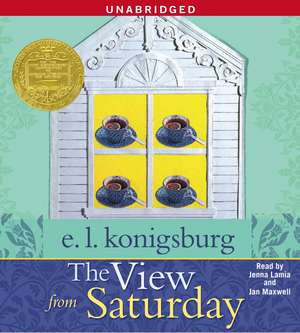
The View from Saturday
Autor E. L. Konigsburg Jenna Lamia, Jan Maxwellen Limba Engleză CD-Audio – 30 noi 2009 – vârsta de la 8 ani
Vezi toate premiile Carte premiată
Părinții care au citit cu plăcere Because of Mr. Terupt de Rob Buyea vor aprecia și această carte pentru modul cald în care explorează dinamica de grup și impactul profund pe care un mentor îl poate avea asupra elevilor săi. The View from Saturday nu este doar o cronică a unei victorii școlare neașteptate, ci o țesătură fină de experiențe umane care demonstrează că succesul este, de fapt, un produs secundar al bunătății și al înțelegerii reciproce.
Observăm în această operă o structură narativă deosebită: deși miza centrală este concursul „Academic Bowl”, nucleul cărții este format din patru povestiri distincte, ca niște bijuterii șlefuite, dedicate fiecărui membru al echipei. E. L. Konigsburg ne arată cum destinele lui Noah, Nadia, Ethan și Julian se intersectează prin coincidențe surprinzătoare — de la o nuntă neașteptată în familie până la salvarea unor broaște țestoase. Suntem de părere că forța acestui roman rezidă în vocea autentică a copiilor, care par să înțeleagă mizele prieteniei mai profund decât adulții din jurul lor.
În contextul operei sale, această carte reprezintă apogeul maturității literare a autoarei. Dacă în From the Mixed-Up Files of Mrs. Basil E. Frankweiler accentul cădea pe aventura evadării și independență, aici E. L. Konigsburg alege o abordare introspectivă. Cartea păstrează spiritul analitic din Jennifer, Hecate, Macbeth, William McKinley, and Me, Elizabeth, dar adaugă un strat de empatie față de vulnerabilitatea adultă, personificată de Mrs. Olinski. Este un roman despre cum ne găsim locul într-o echipă și, implicit, în lume, fără a ne pierde individualitatea.
Preț: 90.23 lei
Indisponibil temporar
Specificații
ISBN-10: 0743597133
Pagini: 4
Dimensiuni: 155 x 157 x 27 mm
Greutate: 0.15 kg
Editura: Simon&Schuster
V-ar putea interesa
-
 Lost in the CityEdward P. JonesPreț: 87.67 lei
 -
 Inside Out and Back AgainThanhhà LaiPreț: 110.31 lei
 -
 Domestic Violets: A NovelMatthew NormanPreț: 94.08 lei
 -
 The Westing Game (Puffin Modern Classics)Ellen RaskinPreț: 56.64 lei
 -
 Figgs & PhantomsEllen RaskinPreț: 48.03 lei
 -
 The Invisible CircusJennifer EganPreț: 102.03 lei
 -
 The Power of the DogThomas SavagePreț: 72.66 lei
 -
 Maniac MageeJerry SpinelliPreț: 51.71 lei
 -
 PlainsongKent HarufPreț: 99.44 lei
 -
 EventideKent HarufPreț: 97.06 lei
 -
 Mary and O'NeilJustin CroninPreț: 109.55 lei
 -
 Walk Through DarknessDavid Anthony DurhamPreț: 111.21 lei
 -
 Where the Red Fern GrowsWilson Rawls-18%Preț: 47.87 lei58.16 lei
 -
 Bent RoadLori RoyPreț: 134.17 lei
 -
 The Best American Short Stories 2010Richard RussoPreț: 142.08 lei
 -
 The Lies of Locke LamoraScott LynchPreț: 60.24 lei
 -
 Red Seas Under Red SkiesScott LynchPreț: 68.05 lei
 -
 DispatchesMichael HerrPreț: 106.96 lei
 -
 Midnight in the Garden of Good and EvilJohn BerendtPreț: 118.31 lei
 -
 So Long, See You TomorrowWilliam MaxwellPreț: 90.04 lei
 -
 Last Exit to BrooklynHubert SelbyPreț: 100.30 lei
 -
 Train DreamsDenis JohnsonPreț: 87.70 lei
 -
 Paco's Story (National Book Award Winner)Larry HeinemannPreț: 108.16 lei
 -
 HatchetGary PaulsenPreț: 49.55 lei
 -
 Requiem for a DreamJr. Hubert SelbyPreț: 119.70 lei
 -
 The Beautiful Things That Heaven BearsDinaw MengestuPreț: 98.18 lei
De ce să citești această carte
Recomandăm această carte copiilor de 10-12 ani și părinților care caută o lectură despre inteligență, compasiune și reziliență. Cititorul va câștiga o perspectivă nouă asupra ideii de „echipă”, învățând că micile gesturi de bunătate sunt cele care construiesc marile succese. Este o alternativă rafinată la romanele școlare clasice, oferind o structură narativă complexă care stimulează gândirea critică și empatia.
Despre autor
E. L. Konigsburg (1930–2013) a fost o figură emblematică a literaturii americane pentru copii, fiind una dintre puținele autoare distinse cu două medalii Newbery. Prima a fost obținută în 1968, iar cea de-a doua pentru The View from Saturday în 1997, stabilind un record de longevitate în excelența literară. Absolventă de chimie, Konigsburg a adus în beletristică o precizie aproape științifică în observarea comportamentului uman, dublată de o sensibilitate rară. Opera sa este recunoscută pentru portretizarea copiilor inteligenți care navighează prin complexitățile identității și ale relațiilor sociale.
Descriere scurtă
Extras
They called themselves The Souls. They told Mrs. Olinski that they were The Souls long before they were a team, but she told them that they were a team as soon as they became The Souls. Then after a while, teacher and team agreed that they were arguing chicken-or-egg.
Whichever way it began -- chicken-or-egg, team-or-The Souls -- it definitely ended with an egg. Definitely, an egg.
People still remark about how extraordinary it was to have four sixth graders make it to the finals. There had been a few seventh graders scattered among the other teams, but all the rest of the middle school regional champs were eighth graders. Epiphany had never before won even the local championship, and there they were, up on stage, ready to compete for the state trophy. All four members of Maxwell, the other team in the final round, were in the eighth grade. Both of the Maxwell boys' voices had deepened, and the girls displayed lacy bra straps inside their T-shirt necklines. The fact that the necklines were outsized and that the two pairs of straps matched -- they were apricot-colored -- made Mrs. Olinski believe that they were not making a fashion statement as much as they were saying something. To her four sixth graders puberty was something they could spell and define but had yet to experience.
Unlike football bowls, there had been no season tallies for the academic teams. There had been no best-of-five. Each contest had been an elimination round. There were winners, and there were losers. From the start, the rule was Lose one game, and you are out.
So it was on Bowl Day. At the start of the day, there had been eight regional champs. Now there were two -- Epiphany and Maxwell.
It was afternoon by the time they got to the last round, and Mrs. Olinski sat shivering in a windowless room in a building big enough and official enough to have its own zip code. This was Albany, the capital of the state of New York. This was the last Saturday in May, and some robot -- human or electronic -- had checked the calendar instead of the weather report and had turned on the air-conditioning. Like everyone else in the audience, Mrs. Olinski wore a short-sleeved T-shirt with her team's logo across the front. Maxwell's were navy; Epiphany's were red and were as loud as things were permitted to get in that large, cold room. The audience had been asked not to whistle, cheer, stomp, hold up signs, wave banners, or even applaud. They were reminded that this Bowl was for brains, not brawn, and decorum -- something between chapel and the order of the day.
Epiphany sat on one side of a long table; Maxwell, the other. At a lectern between them stood the commissioner of education of the state of New York. He smiled benevolently over the audience as he reached inside his inner breast pocket and withdrew a pair of reading glasses. With a flick of his wrist he opened them and put them on.
Mrs. Olinski hugged her upper arms and wondered if maybe it was nerves and not the quartering wind blowing from the ceiling vents that was causing her shivers. She watched with baited (and visible) breath as the commissioner placed his hand into a large clear glass bowl. His college class ring knocked bottom. (Had the room been two degrees colder, the glass would have shattered.) He withdrew a piece of paper, unfolded it, and read, "What is the meaning of the word calligraphy and from what language does it derive?"
A buzzer sounded.
Mrs. Olinski knew whose it was. She was sure of it. She leaned back and relaxed. She was not nervous. Excited, yes. Nervous, no.
The television lights glanced off Noah Gershom's glasses. He had been the first chosen.
Notă biografică
Premii
- Newbery Medal Winner, 1997