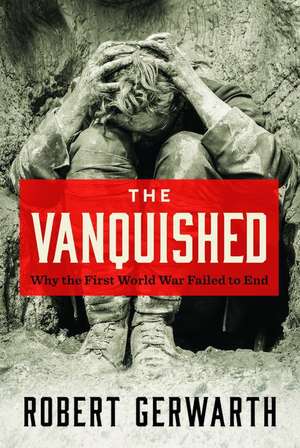
The Vanquished
Autor Robert Gerwarthen Limba Engleză Paperback
După parcurgerea acestui volum, cititorul va putea înțelege de ce data de 11 noiembrie 1918, percepută în Occident ca sfârșitul ostilităților, a marcat de fapt începutul unei perioade de violență extremă pentru restul Europei. Suntem de părere că The Vanquished oferă o perspectivă necesară asupra modului în care prăbușirea imperiilor German, Austro-Ungar și Otoman a lăsat în urmă un vid de putere ocupat de revoluții, pogromuri și purificări etnice. Apreciem rigoarea cu care Robert Gerwarth documentează aceste conflicte „post-război”, care au dus la moartea a milioane de oameni și au pus bazele ideologiilor radicale ale secolului XX.
Structura cărții urmărește o progresie logică, de la momentul înfrângerii și tratatele de pace (Brest-Litovsk), la radicalizarea politică și frica de bolșevism, culminând cu redefinirea hărții Europei Centrale și de Est. Este o alternativă excelentă la A New Europe, 1918-1923 de Bartosz Dziewanowski-Stefańczyk pentru același nivel de expertiză istorică, având avantajul unei narațiuni unitare care integrează drama umană cu analiza politică rece. În contextul operei sale, The Vanquished continuă explorarea fragilității politice începută în November 1918 și completează portretul violenței sistemice analizat în Hitler's Hangman. Recomandăm acest titlu celor care doresc să depășească viziunea simplistă a Frontului de Vest pentru a înțelege rădăcinile violente ale Europei moderne.
Preț: 174.56 lei
Carte disponibilă
Livrare economică 07-21 noiembrie
Specificații
ISBN-10: 0374537186
Pagini: 464
Greutate: 0.41 kg
Editura: Farrar, Straus and Giroux
V-ar putea interesa
-
 Preț: 81.94 lei
 -
 The Dark NetJamie Bartlett-18%Preț: 64.79 lei79.37 lei
 -
 The EndIan Kershaw-18%Preț: 100.75 lei123.33 lei
 -
 Berlin. 75th Anniversary EditionAntony Beevor-17%Preț: 79.09 lei95.52 lei
 -
 Penguin Classics Ring of SteelAlexander Watson-22%Preț: 112.70 lei143.66 lei
 -
 The Oxford Handbook of School PsychologyMelissa A. Bray-26%Preț: 1342.45 lei1803.44 lei
 -
 Wannsee: The Road to the Final SolutionPeter Longerich-25%Preț: 164.18 lei219.04 lei
 -
 Networks of the BrainOlaf Sporns-5%Preț: 541.21 lei569.70 lei
 -
 Operation PaperclipAnnie JacobsenPreț: 144.36 lei
 -
 It's Only a Movie: Alfred Hitchcock A Personal BiographyCharlotte Chandler-55%Preț: 47.54 lei105.94 lei
 -
 Competencies for Science LibrariansDavid Stern-15%Preț: 422.92 lei497.56 lei
 -
 Dark ArchivesMegan RosenbloomPreț: 108.48 lei
 -
 -19%Preț: 196.36 lei242.35 lei
 -
 The Road to EleusisR Gordon WassonPreț: 112.05 lei
 -
 Academic E-Books: Publishers, Librarians, and UsersSuzanne M. WardPreț: 234.50 lei
 -
 Laying the FoundationJohn W. WhitePreț: 233.52 lei
 -
 A History of Modern Librarianship: Constructing the Heritage of Western CulturesPamela Spence Richards-21%Preț: 384.90 lei485.40 lei
 -
 Preț: 217.56 lei
 -
 Frans Hals: The Male PortraitLelia Packer-43%Preț: 133.84 lei234.82 lei
 -
 Notes from a Small IslandBill Bryson-18%Preț: 65.33 lei79.72 lei
 -
 Preț: 152.33 lei
De ce să citești această carte
Recomandăm această carte pasionaților de istorie care doresc să înțeleagă de ce pacea de la 1918 a fost, pentru mulți, doar o iluzie. Cititorul câștigă o perspectivă clară asupra tranziției violente de la imperii la state-națiune și asupra modului în care conflictele din Europa de Est au modelat ascensiunea fascismului. Este o lectură esențială pentru a decoda complexitatea geopolitică actuală a regiunii, oferită de un specialist de renume în studiul războiului.
Despre autor
Robert Gerwarth este profesor de istorie modernă și director al Centrului pentru Studii de Război din cadrul University College Dublin. Expertiza sa în istoria europeană a secolului XX este recunoscută internațional, fiind autorul unor lucrări de referință precum The Bismarck Myth, pentru care a primit Premiul Fraenkel. În lucrările sale, Gerwarth se concentrează pe analiza violenței politice și a prăbușirii ordinii imperiale, oferind perspective noi asupra perioadei interbelice și a ascensiunii regimurilor totalitare în Germania și Europa Centrală.
Descriere scurtă
A Times Literary Supplement Best Book of 2016
An epic, groundbreaking account of the ethnic and state violence that followed the end of World War I conflicts that would shape the course of the twentieth century
For the Western Allies, November 11, 1918, has always been a solemn date the end of fighting that had destroyed a generation, but also a vindication of a terrible sacrifice with the total collapse of the principal enemies: the German Empire, Austria-Hungary, and the Ottoman Empire. But for much of the rest of Europe this was a day with no meaning, as a continuing, nightmarish series of conflicts engulfed country after country.
In The Vanquished, a highly original and gripping work of history, Robert Gerwarth asks us to think again about the true legacy of the First World War. In large part it was not the fighting on the Western Front that proved so ruinous to Europe s future, but the devastating aftermath, as countries on both sides of the original conflict were savaged by revolutions, pogroms, mass expulsions, and further major military clashes. In the years immediately after the armistice, millions would die across central, eastern, and southeastern Europe before the Soviet Union and a series of rickety and exhausted small new states would come into being. It was here, in the ruins of Europe, that extreme ideologies such as fascism would take shape and ultimately emerge triumphant.
As absorbing in its drama as it is unsettling in its analysis, The Vanquished is destined to transform our understanding of not just the First World War but the twentieth century as a whole.
"Cuprins
PART I: DEFEAT
A Train Journey in Spring
Russian Revolutions
Brest-Litovsk
The Taste of Victory
Reversals of Fortune
PART II: Revolution and Counter-Revolution
No End to War
The Russian Civil Wars
The Apparent Triumph of Democracy
Radicalization
Fear of Bolshevism and the Rise of Fascism
PART III: Imperial Collapse
Pandora's Box: Paris and the Problem of Empire
Reinventing East-Central Europe
Vae Victis
Fiume
From Smyrna to Lausanne
Epilogue: The "Post-War" and Europe's Mid-Century Crisis
Recenzii
Pulls together a complex narrative about the uneasy peace of the late Twenties and shine a piercing light into darkened corners of history ... an unnerving reminder of how stubbornly some geopolitical fault-lines endure
A mixture of fast-paced narrative and fluent analysis ... Gerwarth demonstrates with an impressive concentration of detail that in central, eastern and south-eastern Europe the carnage of the first world war by no means came to an end, as it did for the British and French, in late 1918.
Combining a big-picture overview with close-up detail - we hear the voices of soldiers, politicians, civilians - Gerwarth has written a vivid if disturbing account
Searing and vivid ... a timely reminder that the roots of century-long violence can be traced back to the cataclysmic end of the Great War
A thorough explanation for the rise of the nationalist and fascist groups who set the stage for World War II.
Gerwarth's fascinating and finely crafted book is a rich combination of military, political, cultural and social history. He makes good use of literary sources and witness testimony to bring the events he narrates to life ... an impressive work of highly accessible scholarship
This is an important and compelling book with a fascinating and chilling narrative ... Gerwarth reveals how the forgotten postwar violence comprised a key step on Europe's descent into darkness.
While Gerwarth's warfare theories are cogent and convincing, he never loses sight of the human dimension. He skillfully avoids the danger of getting bogged down in a mass of detail, livening up his narrative by using contemporary quotes from politicians, soldiers and writers. One mark of a good history book is that it allows the reader to see familiar events from a new perspective. In this respect, The Vanquished is an exceptional history book.
[Gerwarth] shines a light on what is, from a western European point of view, a somewhat obscure and relatively short period of time ... from the layman's vantage point, it is so well written that it reads like a novel. Tragically, for the people killed, wounded and forced to flee from their homes, it is not. This book is well worth the read.
This fine and timely study makes a compelling case for the argument that the bloody aftermath of the war did more to destroy European civilisation than the declarations of war in 1914 ... at a time when Vladimir Putin seems intent on regaining Tsarist Russia's frontiers, and the map of the Middle East drawn by the victorious powers becomes ever more blurred, we might well ask whether the First World War has ended yet.
A clear and excellent account of the abrupt break-up of the Habsburg, Hohenzollern, Ottoman and Romanov empires and the difficult birth of their successor states during 1917-23
This is difficult, often horrifying reading, but Gerwarth provides an essential contribution to our understanding of the interwar years.