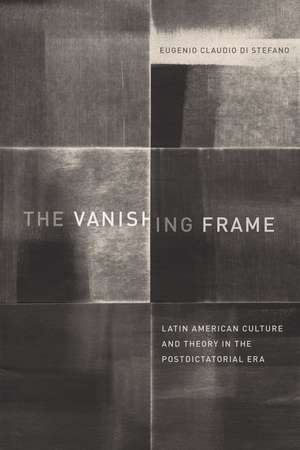
The Vanishing Frame: Latin American Culture and Theory in the Postdictatorial Era: Border Hispanisms
Autor Eugenio Claudio Di Stefanoen Limba Engleză Paperback – 3 aug 2018
Reținem în „The Vanishing Frame” o abordare curajoasă a interdependenței dintre studiile literare, teoria politică și economia politică. Eugenio Claudio Di Stefano analizează modul în care cultura Americii Latine din era post-dictatorială a fost modelată de imperativul experienței directe a victimei, un proces care, în opinia sa, a dus la ștergerea distincției dintre artă și viață. Autorul argumentează că această estetică a „mărturiei” a devenit, paradoxal, complice cu structurile economice neoliberale, ignorând inegalitatea de clasă în favoarea unui discurs centrat strict pe drepturile omului.
Credem că forța acestui volum rezidă în analiza sa critică asupra unor figuri canonice precum Diamela Eltit sau Ariel Dorfman, pe care îi pune în contrast cu autori care refuză estetica experienței, precum Roberto Bolaño sau Alejandro Zambra. Cartea este organizată riguros: prima parte investighează modul în care istoria neoliberală a fost construită prin „estetica post-dictatorială”, în timp ce partea a doua propune o „politică a cadrului” (frame), pledând pentru autonomia artei ca punct de plecare spre o politică anticapitalistă. Această structură indică o progresie clară de la deconstrucția miturilor democratizării către o nouă paradigmă a formei literare.
The Vanishing Frame acoperă aceeași arie tematică precum After Human Rights de Fernando J. Rosenberg, dar cu o abordare mult mai critică la adresa stângii neoliberale. În timp ce Rosenberg explorează posibilitatea justiției prin narațiunile drepturilor omului, Di Stefano avertizează că tocmai aceste narațiuni pot limita capacitatea artei de a contesta nedreptatea economică structurală. Este o lectură densă, esențială pentru înțelegerea peisajului cultural actual al Americii Latine.


Preț: 145.14 lei
Carte disponibilă
Livrare economică 07-21 noiembrie
Livrare express 24-30 octombrie pentru 25.37 lei
Specificații
ISBN-10: 1477316191
Pagini: 200
Dimensiuni: 152 x 229 x 36 mm
Greutate: 0.31 kg
Editura: University of Texas Press
Colecția University of Texas Press
Seria Border Hispanisms
De ce să citești această carte
Recomandăm această lucrare cercetătorilor și studenților interesați de relația dintre estetică și ideologie. Cititorul câștigă o perspectivă critică asupra modului în care arta contemporană poate supraviețui pieței libere fără a-și sacrifica autonomia. Este un argument solid pentru reîntoarcerea la formă și cadru ca instrumente de rezistență împotriva simplificării politice a actului artistic.
Despre autor
Eugenio Claudio Di Stefano este un cercetător specializat în cultura și teoria latino-americană, cu un interes marcat pentru intersecția dintre estetică și politică. Prin contribuțiile sale, el explorează limitele discursului despre drepturile omului și modul în care producția culturală din regiune răspunde presiunilor economice globale. În volumul de față, publicat de University of Texas Press, Di Stefano își consolidează poziția de critic al curentelor neoliberale în studiile hispanice, aducând în discuție necesitatea unei noi viziuni asupra autonomiei artistice în contextul post-dictaturii.
Descriere scurtă
Di Stefano demonstrates that while artists such as Diamela Eltit, Ariel Dorfman, and Albertina Carri develop a concept of justice premised on recognizing victims’ experiences of torture or disappearance, they also ignore the injustice of economic inequality and exploitation. By examining how artists such as Roberto Bolaño, Alejandro Zambra, and Fernando Botero not only reject an aesthetics of experience (and the politics it entails) but also insist on the work of art as a point of departure for an anticapitalist politics, this new reading of Latin American cultural production offers an alternative understanding of recent developments in Latin American aesthetics and politics that puts art at its center and the postdictatorship at its end.
Notă biografică
Cuprins
- Acknowledgments
- Introduction: Freedom at the End of the Postdictatorial Era
- Part 1. Postdictatorial Aesthetics
- Chapter 1. From Revolution to Human Rights
- Chapter 2. Disability and Redemocratization
- Chapter 3. Making Neoliberal History
- Part 2. Toward a Politics of the Frame
- Chapter 4. The Reappearance of the Frame
- Chapter 5. Anti-intentionalism and the Neoliberal Left
- Chapter 6. Literary Form Now
- Coda: The Victim, the Frame
- Notes
- Works Cited
- Index