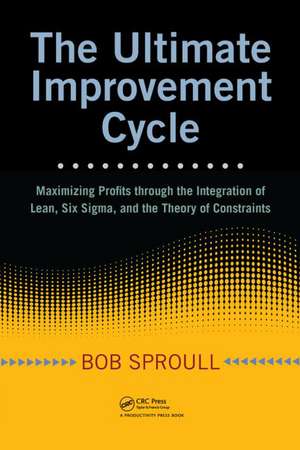
The Ultimate Improvement Cycle: Maximizing Profits through the Integration of Lean, Six Sigma, and the Theory of Constraints
Autor Bob Sproullen Limba Engleză Hardback – 11 mar 2009
The Ultimate Improvement Cycle (UIC) integrates Lean, Six Sigma, and the Theory of Constraints into a combined strategy that will help you immediately focus your efforts on those areas that will make the greatest difference. The book presents basic laws of factory physics that show why the UIC delivers significant bottom-line improvement while other initiatives so often fail. It explains to you why focusing your efforts on apparent problems rather than systemic concerns is wasted effort.
Focus on key areas and take improvement to the next level
The Ultimate Improvement Cycle: Maximizing Profits through the Integration of Lean, Six Sigma, and the Theory of Constraints show you how to draw the best from Lean and Six Sigma by employing principles drawn from the Theory of Constraints. This approach will ensure that your effort is focused in the right place, at the right time, using the right tools, and the right amount of resources. This multi-pronged approach addresses cost accounting, variation, waste, and performance measurements. But most importantly, it focuses your organization on the right areas to optimize.
Applying years of hands-on work in many environments, Bob Sproull has developed a unique proven method that capitalizes on a time-release formula for evoking the key tools that improvement requires. He shows you how to take advantage of the cyclical nature of improvement to implement change that is perpetually effective, and his approach does not require more resources than you have on hand. Although originally developed in manufacturing, the UIC works equally well in any environment whether it be manufacturing or service-oriented, including Maintenance, Repair and Overhaul (MRO) and Critical Chain Project Management (CCPM).
Preț: 618.67 lei
Preț vechi: 727.85 lei
-15%
Puncte Express: 928
Carte tipărită la comandă
Livrare economică 08-22 decembrie
Livrare prin curier în România Termenul estimat este afișat lângă disponibilitate.
Transport gratuit pentru acest produs Plată online sau ramburs, în funcție de opțiunile comenzii.
Retur gratuit în 14 zile Comandă securizată și suport în română.
Specificații
ISBN-13: 9781420090345
ISBN-10: 1420090348
Pagini: 288
Ilustrații: 54 black & white illustrations, 13 black & white tables
Dimensiuni: 152 x 229 x 23 mm
Greutate: 0.54 kg
Ediția:New.
Editura: Taylor & Francis
Colecția Productivity Press
Locul publicării:Oxford, United Kingdom
ISBN-10: 1420090348
Pagini: 288
Ilustrații: 54 black & white illustrations, 13 black & white tables
Dimensiuni: 152 x 229 x 23 mm
Greutate: 0.54 kg
Ediția:New.
Editura: Taylor & Francis
Colecția Productivity Press
Locul publicării:Oxford, United Kingdom
V-ar putea interesa
-
 What is Lean Six SigmaMichael George-13%Preț: 96.03 lei110.90 lei
 -
 -12%Preț: 119.40 lei135.04 lei
 -
 The Toyota Way FieldbookJeffrey Liker-15%Preț: 233.99 lei274.36 lei
 -
 -16%Preț: 194.29 lei230.54 lei
 -
 -16%Preț: 217.01 lei258.22 lei
 -
 -15%Preț: 217.89 lei257.36 lei
 -
 -41%Preț: 215.05 lei364.88 lei
 -
 The Improvement GuideGerald J Langley-19%Preț: 445.95 lei550.56 lei
 -
 Lean ThinkingJames P. WomackPreț: 226.56 leiRecomandat
 -
 The Goal: 40th Anniversary EditionEliyahu M GoldrattPreț: 150.14 lei
 -
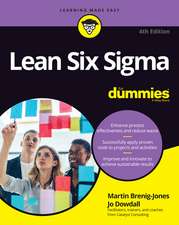 Lean Six Sigma For DummiesMartin Brenig-JonesPreț: 162.44 lei
 -
 -24%Preț: 176.58 lei231.72 lei
 -
 Andy & Me: Crisis & Transformation on the Lean JourneyPascal DennisPreț: 317.17 lei
 -
 -15%Preț: 501.02 lei589.43 lei
 -
 Preț: 415.17 lei
 -
 5 Pillars of the Visual WorkplaceHiro-Yuki Hirano-9%Preț: 993.55 lei1091.81 lei
 -
 -15%Preț: 411.78 lei484.45 lei
 -
 Lean & Green: Best PracticeDaniel ReichertPreț: 451.09 lei
Public țintă
Professional and Professional Practice & DevelopmentCuprins
The Ultimate Improvement Cycle. Lean, Six Sigma and TOC Principles, Tools and Methods. Identifying the Value Stream, Current and Next. Define, Measure & Analyze NVA Waste, Variation. Planning How to Exploit the Current Constraint. Reducing Waste and Variation in the Current Constraint. Plan How to Subordinate Non-Constraints to the Current Constraint. Line Balancing and Flow Optimization. Optimize the Constraint Buffer and Establish Pull System in the Non-Constraints. Elevate the Constraint and Implement Protective Controls. Breaking the Current Constraint. Implement Protective Controls to Sustain the Gains. System Constraints and Problems. Establishing the Environment for Change.
Descriere
This text uniquely integrates lean concepts, Six Sigma, and the Theory of Constraints into a combined business strategy aptly named the Ultimate Improvement Cycle (UIC). Unlike other systems,the UIC is all about economizing resources byfocusing improvement efforts on those key leverage points that will prove most optimal, rather than diluting one’s efforts with an expensive across-the board-approach to improvement.The UIC is derived from Bo Sproull’s years ofexecutive experience with the Toyota Production System and consulting work with several high profile companies. He shows you how to take advantage of the cyclical nature of improvement to implement change that is perpetually effective, and his approach does not require more resources than you have on hand.