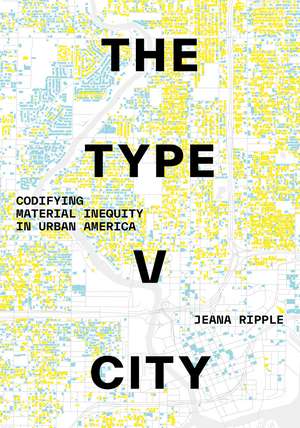
The Type V City: Codifying Material Inequity in Urban America
Autor Jeana Rippleen Limba Engleză Hardback – 19 aug 2025
Almost every American city contains neighborhoods dominated by wood frame construction—light, cheap, combustible, and requiring the lowest upfront investment of labor and material in the building industry. Known as a Type V (five) construction in the terminology of building codes, these buildings became ubiquitous in the American urban landscape thanks to the abundance of timber, housing affordability aspirations, and the adoption of a uniform code.
In The Type V City, Jeana Ripple examines the social and spatial history of building codes and material patterns in five cities—New York, Tampa, Chicago, Philadelphia, and Seattle—to reframe the stories of America’s building priorities, methods, negotiations, and assumptions. By examining the development of building materials and codes alongside the environmental, social, economic, and political context of each city’s development, Ripple reveals previously overlooked connections between the power structures underpinning regulatory evolution and the impacts that lay just beyond the frame of city builders’ priorities. Handsomely illustrated and informed by both archival research and insights enabled by contemporary data analysis, The Type V City critiques the homogenous construction practices underlying US urbanization and raises pointed questions for future generations of data-driven city planners and architects.
Preț: 364.27 lei
Puncte Express: 546
Carte disponibilă
Livrare economică 16-30 noiembrie
Livrare prin curier în România Termenul estimat este afișat lângă disponibilitate.
Transport gratuit de la 400.00 lei Plată online sau ramburs, în funcție de opțiunile comenzii.
Retur gratuit în 14 zile Comandă securizată și suport în română.
Specificații
ISBN-13: 9781477331620
ISBN-10: 147733162X
Pagini: 224
Ilustrații: 33 b&w photos, 19 b&w illustrations, 11 maps, 20-page color insert
Dimensiuni: 178 x 254 x 28 mm
Greutate: 0.72 kg
Editura: University of Texas Press
Colecția University of Texas Press
ISBN-10: 147733162X
Pagini: 224
Ilustrații: 33 b&w photos, 19 b&w illustrations, 11 maps, 20-page color insert
Dimensiuni: 178 x 254 x 28 mm
Greutate: 0.72 kg
Editura: University of Texas Press
Colecția University of Texas Press
V-ar putea interesa
-
 A Pattern Language: Towns, Buildings, ConstructionChristopher Alexander-8%Preț: 416.42 lei452.62 lei
 -
 Preț: 267.91 lei
 -
 Metropolitan Latinidad: Transforming American Urban HistoryA. K. Sandoval-StrauszPreț: 263.04 lei
 -
 The Image of the CityKevin LynchPreț: 277.67 lei
 -
 Key to the CitySara C BroninPreț: 161.86 lei
 -
 Peripheral Centralities: The Lost and Past Urbanity of the SuburbsNicholas A. Phelps-14%Preț: 1098.00 lei1276.74 leiRecomandat
 -
 Practising Wood in Architecture: Connecting Design, Construction and SustainabilityJames Benedict BrownPreț: 350.83 leiRecomandat
 -
 Building Codes IllustratedFrancis D. K. Ching-19%Preț: 464.42 lei573.36 lei
 -
 The Art of the New Urbanism, Volume 1James DoughertyPreț: 452.94 lei
 -
 City of Wood: San Francisco and the Architecture of the Redwood Lumber IndustryJames Michael BuckleyPreț: 350.79 lei
 -
 The Unfinished Metropolis: Igniting the City-Building RevolutionBenjamin SchneiderPreț: 205.35 lei
 -
 Fifth AvenueMosette BroderickPreț: 232.05 lei
 -
 The Homegrown CityMatias EchanovePreț: 152.61 lei
 -
 Up in the AirHolly SmithPreț: 154.08 lei
 -
 The Death and Life of Great American CitiesJane Jacobs-16%Preț: 122.30 lei146.36 lei
 -
 Dual Cities: Social Housing in London & New YorkKarakusevic PaulPreț: 406.22 lei
 -
 American FramingPaul Andersen-15%Preț: 277.31 lei326.25 lei
 -
 -11%Preț: 413.65 lei464.78 lei
Notă biografică
Jeana Ripple is the chair of the Department of Architecture at the University of Virginia and the founder and principal of Mir Collective Architects.
Cuprins
- List of Acronyms
- Introduction
- Type V Chicago: Durability and Disinvestment
- Type V New York: Saturation and Health
- Type V Philadelphia: Labor and Affordability
- Type V Tampa: Occupancy and Urban Vitality
- Type V Seattle: Adaptive Capacity and Lifespan
- Conclusion
- Acknowledgments
- Notes
- Index
Recenzii
Building codes remain understudied, not least because they are impenetrable, technical, and preposterously long. Perhaps more importantly, the organizations that write these codes have carefully guarded their decision-making from public scrutiny. In her timely exploration of Type V buildings, Jeana Ripple blows open building codes, allowing readers to view them not just as technical tools for fire safety, but as regionally specific and politically reactive determinants of neighborhood form. This clear and accessible book offers a vital window into how codes shape cities, making it an essential resource for architects, urban designers, planners focused on climate change, and scholars of environmental justice both within and beyond academia.
The Type V City exposes how building codes—often seen as neutral safeguards—are, in fact, powerful tools that shape urban inequality. Through five American cities, Jeana Ripple uncovers the hidden consequences of material regulations, revealing how policies originally meant to ensure health, safety, and well-being have instead evolved to codify risk, disinvestment, labor exclusion, and environmental vulnerabilities. A sharp and compelling analysis of regulatory inertia, this one-of-a-kind book draws much-needed attention to building regulations most of us barely understand—let alone question—and challenges us to recognize their role in shaping social and economic systems while reinforcing political agendas.
Building codes are not a given but socially constructed, revealing much about the society that creates and implements them. This book illuminates how construction types as social artifacts code salient environmental and political concerns such as safety, durability, adaptability, health, affordability, and labor. By articulating the relations between low-quality forests, low-quality lumber, low-quality housing, and low-quality urbanism, Jeana Ripple helps explicate how Type V construction sanctions and structures inequity in American urbanism.
Ripple’s case studies provide insight into the myriad ways building codes affect the form and function of cities.
The scope of the book is ambitious, even exhilarating at times...the narrative’s shifts in scale from wood fibers to regional ecosystems and the neighborhoods in between make for a dynamic and engaging structure...The book’s most admirable quality may be its willingness to traverse the difficult and necessary territory between academia and practice.
Descriere
How building codes shaped material, social, and environmental landscapes in American cities.