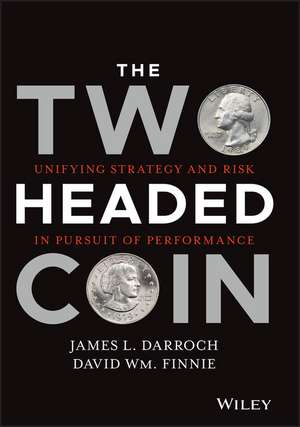
The Two Headed Coin
Autor James L Darroch, David Wm Finnieen Limba Engleză Hardback – 11 mai 2021
Preț: 210.98 lei
Preț vechi: 231.86 lei
-9%
Puncte Express: 316
Carte indisponibilă temporar
Doresc să fiu notificat când acest titlu va fi disponibil:
Se trimite...
Specificații
ISBN-13: 9781119794202
ISBN-10: 111979420X
Pagini: 224
Dimensiuni: 150 x 231 x 23 mm
Greutate: 0.41 kg
Editura: Wiley
Locul publicării:Hoboken, United States
ISBN-10: 111979420X
Pagini: 224
Dimensiuni: 150 x 231 x 23 mm
Greutate: 0.41 kg
Editura: Wiley
Locul publicării:Hoboken, United States
Notă biografică
DR. JAMES L. DARROCH is currently CIT Chair in Financial Services, Schulich School of Business, York University and Associate Professor, Policy, Schulich School of Business, York University. James is a sought-after expert in strategy and financial services education. In 2017, James and his co-author Patricia Meredith won the distinguished Donner Prize (award for the best public policy book by a Canadian) for Stumbling Giants: Transforming Canada's Banks for the Information Age. DAVID WM. FINNIE is a senior corporate executive with over 20 years' experience leading large and mid-sized multinationals and Fortune 100 companies in the building and optimization of their financial, capital, and risk management strategies and capabilities. In addition to risk management expertise, he also offers strengths as a strategic business leader helping to define and implement business growth strategies and drive new business development. David has published four short articles on risk management, governance, and strategy.
Cuprins
Preface: Risk is Good and Uncertainty is the Reality! xi Acknowledgments xxv About the Authors xxix Chapter 1 Strategy and Risk: Two Sides of the Same Coin 1 Strategic Positioning and Risk 6 Strategy and Risk in a Start-Up 7 Chapter 2 Executing on the Plan and Discovering New Risks 17 The Assumption of Goal Congruence and the Importance of Culture 21 Conclusion 27 Chapter 3 Which Risks to Keep 31 Strategic Positioning and Risk Governance 38 How Does Risk Management Help Close the Gap Between Strategy Formulation and Execution? 40 Conclusion: Embracing and Managing Risk 42 Chapter 4 How Do We Achieve Independent Risk Governance and Improve Performance? 47 What Do We Mean by ERM? 51 Chapter 5 Who Has the Specific Knowledge to Design the Risk Architecture? Why You Need an Independent Risk Function 61 The Strategy-Risk-Governance Process 61 Meeting the Objective and the Categorization of Risks 69 The Risk Architecture 71 Creation of a Risk Function 73 Conclusion 76 Chapter 6 Enterprise Risk Management and Competitive Advantage 79 How Does Strategy Affect Randomness? 86 Chapter 7 What Reputation Do We Want? With Whom? 91 Managing Reputation Risk 99 Chapter 8 Uncertainty, Scenario Planning, and Real Options 105 Real Options 113 Conclusion 116 Chapter 9 Risk Culture and Ethics: Can You Have Excellence and Consistency at the Same Time? 121 The Advisor-Customer Encounter 124 Control Systems, Discretion, and Ethics 127 Culture, Ethics, Performance, and Risk Management 135 Chapter 10 The Top of the Pyramid: The CEO as Integrator of Strategy and Risk and the Board as the Fourth Line of Defense 141 The CEO: The Operational Integration of Strategy and Risk 145 The Board: The Governance Integration of Strategy and Risk 145 The Board Provides More Than Oversight 146 Epilogue: Decision-Making at the Restaurant: Creating and Executing a Risk-Aware Strategy 151 Appendix I: Risk Transformation and the Need for an Integrated Risk Approach 157 Appendix II: Resiliency 161 Bibliography 167 Index 183