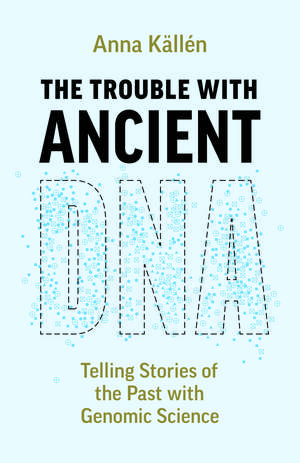
The Trouble with Ancient DNA: Telling Stories of the Past with Genomic Science
Autor Anna Källénen Limba Engleză Paperback – 20 ian 2025
In recent years, discoveries brought to light through analysis of ancient DNA—or aDNA—have made headlines around the world. While ancient DNA studies may appear to focus on laboratory science and objective results, the findings have also relied heavily on storytelling and can be influenced by political interests.
In The Trouble with Ancient DNA, Anna Källén explores how the parameters of genetic science influence the stories we tell about our ancient ancestors, questioning what narratives we can and should take at face value. Through accounts of migrations, warriors, and figures like Cheddar Man, we see enticing and potent narratives that reach far beyond what can be gathered from the scientific study of molecules alone. Rather, by privileging certain narratives and questions—like those about sex or eye and skin color—our stories of ancient DNA are spun around the structure of today’s methodologies, technologies, and popular and political interests. Källén considers how DNA is used to sensationalize stories, how its use poses questions of ethics and care, and who is responsible if stories of ancient DNA are adopted for dangerous political projects.
Preț: 139.59 lei
Puncte Express: 209
Carte disponibilă
Livrare economică 27 octombrie-10 noiembrie
Livrare express 13-17 octombrie pentru 19.89 lei
Livrare prin curier în România Termenul estimat este afișat lângă disponibilitate.
Transport gratuit de la 400.00 lei Plată online sau ramburs, în funcție de opțiunile comenzii.
Retur gratuit în 14 zile Comandă securizată și suport în română.
Specificații
ISBN-13: 9780226835570
ISBN-10: 022683557X
Pagini: 160
Ilustrații: 10 halftones
Dimensiuni: 140 x 216 x 13 mm
Greutate: 0.23 kg
Ediția:First Edition
Editura: University of Chicago Press
Colecția University of Chicago Press
ISBN-10: 022683557X
Pagini: 160
Ilustrații: 10 halftones
Dimensiuni: 140 x 216 x 13 mm
Greutate: 0.23 kg
Ediția:First Edition
Editura: University of Chicago Press
Colecția University of Chicago Press
Notă biografică
Anna Källén is professor and chair of museology at Umeå University in Sweden. She is the author or editor of books including Stones Standing, The Archaeologist In-Between, Heritage and Borders, and Critical Perspectives on Ancient DNA.
Cuprins
Introduction
1 Ancient DNA
2 Return of the Arrows
3 A Family Tree of Everyone
4 Paleopersonalities
5 In Defense of the Molecule
Acknowledgments
Notes
Index
1 Ancient DNA
2 Return of the Arrows
3 A Family Tree of Everyone
4 Paleopersonalities
5 In Defense of the Molecule
Acknowledgments
Notes
Index
Recenzii
"Adding ancient DNA (aDNA) analysis to the toolbox of methods used to reconstruct the human past has sparked amazement and criticism alike. In her new book, The Trouble with Ancient DNA, archaeologist Anna Källén eloquently adds to critiques of the technique by reflecting on how archaeogenetic results are presented within the scientific community, communicated beyond its boundaries, and integrated into public knowledge."
"Ancient DNA’s allure is obvious, writes archaeologist Källén—less so its pitfalls. . . . And prehistoric samples are even more tricky. 'When we write history with ancient DNA, we are finders of fact and tellers of stories,' her intriguing book concludes.
"Genetic science is commonly considered to produce untainted truth. However, Källén cautions readers that uncritical interpretation of ancient DNA (aDNA) data, often as part of narrative devices used to report findings to nonexpert colleagues and especially the public, can convey disinformation. . . . The book is particularly noteworthy as a cautionary tale for researchers when presenting aDNA-based findings as a history of our ancient ancestors. . . . Highly recommended."
"Journalists and scientists have spread dubious historical narratives based on over-extrapolations from DNA evidence, according to this penetrating study. Källén . . . explains the limits of collecting DNA from ancient bones and other archaeological finds, noting that the DNA is often so deteriorated that scientists can only recover less than 10% of the genome. . . . Shedding light on how geneticists’ theories of the past often say more about themselves than their subjects, this provides plenty of food for thought."
"Källén’s in-depth methodological explanations and explicit examination of the real-world political consequences inherent in aDNA research are welcome additions to the debate—in particular, the considered discussion of who bears the ethical responsibility to set the record straight if the results of an aDNA study are distorted . . . . those who engage with the overarching themes presented by Källén will find a useful space for self-reflection."
"Källén thoughtfully considers how scientific information might be interpreted by members of the public who haven't had a lot of scientific training, or who might have last taken a science class many years ago. . . Educators and other scientific communicators will likely appreciate Källén's focus on the way that members of the general public might interpret scientific figures and statements."
“In this book, Källén delivers a personal and at times impassioned indictment of the field of ancient DNA research, focusing on studies of ancient humans.”
“Källén delves into how ancient DNA techniques have been implemented and interpreted in the context of human evolution, both within and outside the field. With The Trouble with Ancient DNA, she considers three broad applications of ancient DNA—large-scale migrations, genetic relationships between past and present populations, and phenotype reconstruction—looking closely at a series of case studies from existing literature and working to flesh out the societal impacts of such works, including the ways they’ve been co-opted to advance racist agendas.”
“This one is a must-read! Geneticists have made an unfortunate habit of approaching the past with a twenty-first-century toolkit and a nineteenth-century mindset—and now they are getting called on it. This wonderfully stern examination of the interpretations of widely promoted ancient DNA data in archaeology shows that a technological revolution is quite separate from a scientific revolution. It will hopefully help to pull geneticists intellectually into the modern age, and to effect a real synthesis between the two classes of data.”
“A timely, nuanced and much-needed analysis of the genomic revolution in the science of the past. DNA molecules are venerated in ‘celebrity science’ stories about charismatic imagined ancestors. Källén’s book is the perfect remedy for these ‘just so’ stories. She is the ideal travel companion for this journey into the weeds of what the science of paleogenetics can and cannot tell us about our past and why this matters.”