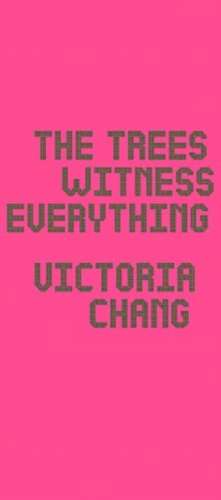
The Trees Witness Everything
Autor Victoria Changen Limba Engleză Paperback – 9 iun 2022
- Chang¿s most recent book, Obit,was one of the most celebrated poetry books of 2020
- Obit won the 2020 Pen/Voelcker Award and Los Angeles Times Book Prize for Poetry, was named a New York Times Notable Book, and was longlisted for the National Book Award
- Obit and this new book, The Trees Witness Everythingare related in that Chang was writing both simultaneously.
- Chang books have been named to the New York Times Notable Books List twice.
- Central themes are nature and human activity
- Inspired by the work of W.S. Merwin
Preț: 91.13 lei
Puncte Express: 137
Carte disponibilă
Livrare economică 14-28 noiembrie
Livrare express 03-07 noiembrie pentru 25.25 lei
Livrare prin curier în România Termenul estimat este afișat lângă disponibilitate.
Transport gratuit de la 400.00 lei Plată online sau ramburs, în funcție de opțiunile comenzii.
Retur gratuit în 14 zile Comandă securizată și suport în română.
Specificații
ISBN-13: 9781556596322
ISBN-10: 1556596324
Pagini: 144
Dimensiuni: 104 x 229 x 12 mm
Greutate: 0.16 kg
Editura: Copper Canyon Press,U.S.
ISBN-10: 1556596324
Pagini: 144
Dimensiuni: 104 x 229 x 12 mm
Greutate: 0.16 kg
Editura: Copper Canyon Press,U.S.
Notă biografică
Born in Detroit, Michigan to Taiwanese immigrants, Victoria Chang was educated at the University of Michigan, Harvard University, and Stanford Business School and holds an MFA in poetry from Warren Wilson. She is the author of six books of poetry, including Obit, which was named a "New York Times 100 Notable Books of 2020" and included on Time Magazine's "100 Must-Read Books of 2020." She lives in Southern California with her family and serves as the Program Chair of Antioch's Low-Residency MFA Program.
Descriere
Descriere de la o altă ediție sau format:
A NEW YORKER BEST BOOK OF 2022
'Impeccable, precise poems, sometimes shocking and strange, but always startling' Irish Times
A lover of strict form, best-selling poet Victoria Chang turns to compact Japanese waka, powerfully innovating on tradition while continuing her pursuit of one of life's hardest questions: how to let go.
In The Trees Witness Everything, Victoria Chang reinvigorates language by way of concentration, using constraint to illuminate and free the wild interior. Largely composed in various Japanese syllabic forms called 'wakas,' each poem is shaped by pattern and count. This highly original work innovates inside the lineage of great poets including W.S. Merwin, whose poem titles are repurposed as frames and mirrors for the text, stitching past and present in complex dialogue. Chang depicts the smooth, melancholic isolation of the mind while reaching outward to name - with reverence, economy and whimsy - the ache of wanting, the hawk and its shadow, our human urge to hide the minute beneath the light.
A NEW YORKER BEST BOOK OF 2022
'Impeccable, precise poems, sometimes shocking and strange, but always startling' Irish Times
A lover of strict form, best-selling poet Victoria Chang turns to compact Japanese waka, powerfully innovating on tradition while continuing her pursuit of one of life's hardest questions: how to let go.
In The Trees Witness Everything, Victoria Chang reinvigorates language by way of concentration, using constraint to illuminate and free the wild interior. Largely composed in various Japanese syllabic forms called 'wakas,' each poem is shaped by pattern and count. This highly original work innovates inside the lineage of great poets including W.S. Merwin, whose poem titles are repurposed as frames and mirrors for the text, stitching past and present in complex dialogue. Chang depicts the smooth, melancholic isolation of the mind while reaching outward to name - with reverence, economy and whimsy - the ache of wanting, the hawk and its shadow, our human urge to hide the minute beneath the light.
Recenzii
Turning
My mother is dead.
The lemons still turn yellow,
the trout still stare emptily,
desire is still free.
We still love many people,
eat peaches as if kissing.
A lover of strict form, best-selling poet Victoria Chang turns to compact Japanese waka, powerfully innovating on tradition while continuing her pursuit of one of life's hardest questions: how to let go.
In The Trees Witness Everything, Victoria Chang reinvigorates language by way of concentration, using constraint to illuminate and free the wild interior. Largely composed in various Japanese syllabic forms called 'wakas,' each poem is shaped by pattern and count. This highly original work innovates inside the lineage of great poets including W.S. Merwin, whose poem titles are repurposed as frames and mirrors for the text, stitching past and present in complex dialogue. Chang depicts the smooth, melancholic isolation of the mind while reaching outward to name ? with reverence, economy and whimsy ? the ache of wanting, the hawk and its shadow, our human urge to hide the minute beneath the light.
In this brilliant new collection, Chang continues her exploration of memory and mourning. These are impeccable, precise poems, sometimes shocking and strange, but always startling in their ability to excise an utterance from the depths of grief and longing that is both painful and reverent . . . Chang's crystalline, controlled poems seem etched from deep experience, and move hauntingly between the living and the dead . . . their economy lends them both a sharp detail and a hallucinatory potential, traversing a staggering progress of thought and image across a small number of lines
In this collection, the constraints of the waka, a Japanese syllabic form, yield highly compressed, surreal meditations on time, desire, and the movements of the mind itself. Chang's poems . . . document a practice of sustained observation and imagination.
Elegant and reflective . . . For those who are grieving and those who have grieved, Chang offers beautiful insights, and a path toward healing
Some of the most dazzling evocations of the natural world I've encountered
Sad, elegiac and intensely vivid
My mother is dead.
The lemons still turn yellow,
the trout still stare emptily,
desire is still free.
We still love many people,
eat peaches as if kissing.
A lover of strict form, best-selling poet Victoria Chang turns to compact Japanese waka, powerfully innovating on tradition while continuing her pursuit of one of life's hardest questions: how to let go.
In The Trees Witness Everything, Victoria Chang reinvigorates language by way of concentration, using constraint to illuminate and free the wild interior. Largely composed in various Japanese syllabic forms called 'wakas,' each poem is shaped by pattern and count. This highly original work innovates inside the lineage of great poets including W.S. Merwin, whose poem titles are repurposed as frames and mirrors for the text, stitching past and present in complex dialogue. Chang depicts the smooth, melancholic isolation of the mind while reaching outward to name ? with reverence, economy and whimsy ? the ache of wanting, the hawk and its shadow, our human urge to hide the minute beneath the light.
In this brilliant new collection, Chang continues her exploration of memory and mourning. These are impeccable, precise poems, sometimes shocking and strange, but always startling in their ability to excise an utterance from the depths of grief and longing that is both painful and reverent . . . Chang's crystalline, controlled poems seem etched from deep experience, and move hauntingly between the living and the dead . . . their economy lends them both a sharp detail and a hallucinatory potential, traversing a staggering progress of thought and image across a small number of lines
In this collection, the constraints of the waka, a Japanese syllabic form, yield highly compressed, surreal meditations on time, desire, and the movements of the mind itself. Chang's poems . . . document a practice of sustained observation and imagination.
Elegant and reflective . . . For those who are grieving and those who have grieved, Chang offers beautiful insights, and a path toward healing
Some of the most dazzling evocations of the natural world I've encountered
Sad, elegiac and intensely vivid