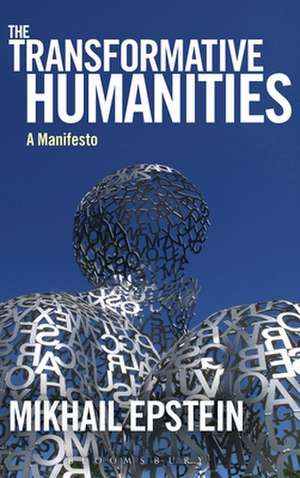
The Transformative Humanities: A Manifesto
Editat de Professor Igor E. Klyukanov Autor Professor Mikhail Epsteinen Limba Engleză Hardback – 15 noi 2012
Prin volumul The Transformative Humanities, observăm o deschidere interdisciplinară ambițioasă, în care teoria literară și filosofia converg cu antropologia, semiotica și studiile tehnologice. Putem afirma că Mikhail Epstein nu se mulțumește doar cu o analiză retrospectivă a culturii, ci propune un manifest pentru o „umanistică constructivă”. Reținem premisa conform căreia, dacă științele naturii au ca extensie practică tehnologia, iar cele sociale politica, disciplinele umaniste necesită propriul lor braț transformator pentru a modela viitorul intelectual al societății.
Cititorii familiarizați cu Towards a New Enlightenment – The Case for Future-Oriented Humanities de Markus Gabriel vor aprecia modul în care Mikhail Epstein duce mai departe discuția despre rolul valorilor umaniste în gestionarea crizelor contemporane, oferind însă un aparat terminologic mult mai specific pentru „disciplinele dezirabile”. Structura cărții reflectă o progresie logică de la reconfigurarea vocabularului cultural (trecerea de la „post-” la „proto-”) către o examinare critică a condiției umane în era post-umană. Partea a doua, „Humans and Texts”, introduce concepte inovatoare precum „semiurgia” (trecerea de la analiza la sinteza limbajului), în timp ce secțiunea dedicată relației om-mașină explorează traumele informaționale și evoluția speciei.
Merită menționat că acest volum reușește să integreze moștenirea gândirii lui Mikhail Bakhtin în contextul provocărilor secolului XXI. Stilul este academic, dens, dar programatic, transformând speculația filosofică într-o metodologie de lucru pentru cercetătorii care doresc să depășească stadiul de observatori pasivi ai fenomenelor culturale.
Preț: 901.62 lei
Preț vechi: 1192.86 lei
-24%
Carte tipărită la comandă
Livrare economică 27 noiembrie-11 decembrie
Specificații
ISBN-10: 1441100466
Pagini: 344
Dimensiuni: 155 x 231 x 30 mm
Greutate: 0.66 kg
Ediția:New.
Editura: Bloomsbury Publishing
Colecția Bloomsbury Academic
Locul publicării:New York, United States
V-ar putea interesa
-
 Barthes: A Very Short IntroductionJonathan Culler-20%Preț: 57.32 lei71.23 lei
 -
 -28%Preț: 440.18 lei613.56 lei
 -
 Rhetoric of Romanticism (Paper)P De ManPreț: 287.89 lei
 -
 Modern Literary Theory: A ReaderPatricia Waugh-22%Preț: 296.21 lei377.86 lei
 -
 Preț: 469.94 lei
 -
 Critical Theory and Practice: A CoursebookKeith GreenPreț: 395.76 lei
 -
 -15%Preț: 518.31 lei609.78 lei
 -
 -15%Preț: 485.98 lei571.74 lei
 -
 Fredric JamesonAdam RobertsPreț: 273.18 lei
 -
 RealismPam MorrisPreț: 213.36 lei
 -
 Maurice BlanchotUllrich HaasePreț: 287.46 lei
 -
 IronyClaire ColebrookPreț: 217.01 lei
 -
 Preț: 139.74 lei
 -
 The Location of CultureHomi K. BhabhaPreț: 231.79 lei
 -
 The Post-Colonial Critic: Interviews, Strategies, DialoguesGayatri Chakravorty SpivakPreț: 446.93 lei
 -
 The Death of the CriticDr Ronan McDonald-41%Preț: 72.16 lei122.13 lei
 -
 Debating the CanonL. MorrisseyPreț: 404.31 lei
 -
 Literary Criticism in the 21st Century: Theory RenaissanceVincent B. Leitch-17%Preț: 205.33 lei247.25 lei
 -
 How to Read and WhyHarold BloomPreț: 92.57 lei
De ce să citești această carte
Recomandăm această carte cercetătorilor și studenților din domeniul literaturii și filosofiei care caută o alternativă la discursul critic tradițional. Cititorul câștigă o perspectivă nouă asupra modului în care disciplinele umaniste pot influența activ dezvoltarea tehnologică și socială. Este un instrument teoretic esențial pentru oricine dorește să înțeleagă cum se pot sintetiza noi forme de cultură și limbaj într-o lume dominată de algoritmi și inteligență artificială.
Descriere
In his famous classification of the sciences, Francis Bacon not only catalogued those branches of knowledge that already existed in his time, but also anticipated the new disciplines he believed would emerge in the future: the "desirable sciences." In this open access publication, Mikhail Epstein echoes, in part, Bacon's vision and outlines the "desirable" disciplines and methodologies that may emerge in the humanities in response to the new realities of the twenty-first century. Are the humanities a purely scholarly field, or should they have some active, constructive supplement? We know that technology serves as the practical extension of the natural sciences, and politics as the extension of the social sciences. Both technology and politics are designed to transform what their respective disciplines study objectively.
The Transformative Humanities: A Manifesto addresses the question: Is there any activity in the humanities that would correspond to the transformative status of technology and politics? It argues that we need a practical branch of the humanities which functions similarly to technology and politics, but is specific to the cultural domain.
The ebook editions of this book are available open access under a CC BY-NC-ND 4.0 license on bloomsburycollections.com.
Cuprins
Foreword, by Caryl Emerson (Princeton University)
Introduction
Part One. An Open Future
Chapter 1. From Post- to Proto-: Toward a New Prefix in Cultural Vocabulary
Chapter 2. Chronocide: A Prologue to the Resurrection of Time
Chapter 3. Mikhail Bakhtin and the Future of the Humanities
Part Two. Humans and Texts
Chapter 4. Reconfigurations of Textuality
Chapter 5. " ". Ecophilogy: Text and its Environment
Chapter 6. Semiurgy: From Language Analysis to Language Synthesis
Chapter 7. Scriptorics: An Introduction to the Anthropology and Personology of Writing
Part Three. Humans and Machines
Chapter 8. The Fate of the Human in the Posthuman Age
Chapter 9. The Art of World-Making and the New Vocation for Metaphysics
Chapter 10. Information Trauma and the Evolution of the Human Species
Chapter 11. Horrology: The Study of Civilization in Fear of Itself
Part Four. Humans and Humans
Chapter 12. Universics: From Relativism to Critical Universality
Chapter 13. Micronics: The Study of Small Things
Chapter 14. From Body to Self: What Is It Like To Be What You Are?
Chapter 15. Differential Ethics: From the Golden Rule to the Diamond Rule
Part Five. The Future of Wisdom. Creative Theory
Chapter 16. What Is 'The Interesting?'
Chapter 17. Philosophy's Return to Wisdom
Chapter 18. Logos and Sophia: Sophian Disciplines
Chapter 19. The Philosophy of the Possible and the Possibilities of Philosophy
Chapter 20. The Mass of Knowledge and the Energy of Thinking In Place of a Conclusion: A New Introduction to Future Thinking
Glossary
References
Index
Recenzii
Mikhail Epstein's The Transformative Humanities is a critical manifesto for our times. The humanities, denigrated, underfunded, abandoned, and increasingly seen as irrelevant, are here rethought and reordered. Not a claim for a more economically viable or culturally more relevant form of the humanities; not an argument that states we need the humanities to make better citizens or more humane professionals, Epstein looks at the core of the humanities and sees its vitality and strength undiminished beneath layers of disciplinary morbidity and administrative pandering. A book that ALL humanists need to read to understand the problems and the advantages of the humanities in the 21st century.
An unforeseen boon of the 1989-91 revolutions in the Soviet bloc has been the re-invigoration of Western intellectual life. Eastern European thinkers encountered with fresh eyes, and much unease, the theories and attitudes that arose in a Paris-dominated West from the heyday of Sartre to that of Badiou. Among the most significant and startling contributions since '89 have come to us from Mikhail Epstein, who's been setting thought experiments in motion since the time of Perestroika. Emerging from the Soviet bubble to take the measure of postmodernism, the first questions that Epstein posed were: Why post-? Why not proto-? His concern ever since has been to redirect humanists from self-pity toward 'inventorship.' 'Perhaps,' as he writes in The Transformative Humanities, 'twenty-first century society, and conceivably even academe itself, are turning away from the humanities because in the twentieth century, and especially in the second half, the humanities turned away from humans?' The task he has set himself is no less than to invent concepts, reinvent attitudes, and engineer a technics that will render the humanities human at last.
It is widely recognized that we are in the midst of a crisis in how universities are organized, the ends they serve, and the place they hold in national life. The humanities are at the epicenter of changes now taking place. Mikhail Epstein is uniquely qualified to grasp the complex nature of the current dilemma, and more importantly, to provide a blueprint for the future that is both visionary and realistic. He is a thinker/activist who was tried in the crucible of late Soviet social, economic, and institutional chaos. He now brings the skills he developed in that historic moment of change to bear on our own. In an age in which a tsunami of sheer data threatens to overwhelm our capacity to make sense of it, Epstein's revolutionary project demonstrates how wisdom can triumph over brute information. His manifesto is one of the best informed, and most compelling arguments I know for education that is still centered on how to be human.
The Transformative Humanities will be, for many scholars, a jump-start to critical inquiry across literary studies and philosophy alike.