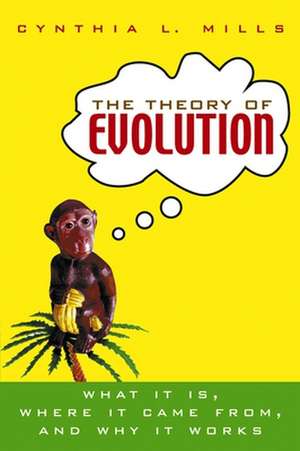
The Theory of Evolution: What It Is, Where It Came From, and Why It Works
Autor Cynthia L. Millsen Limba Engleză Hardback – 31 mar 2004
This important new book by award-winning science writer Cynthia Mills clearly explains one of the most crucial, and most misunderstood, concepts of modern science-the theory of evolution. After examining Darwin, his precursors, and how the theory of evolution developed, Mills answers key questions, including: How successful is the theory at explaining the natural world, and what does it fail to explain? What are some of the competing ideas and theories about the origin of the species? How will the theory of evolution likely hold up over time, as our understanding of genetics grows?
Cynthia L. Mills (Portland, OR) is an award-winning science writer and veterinarian. Her article ""Breeding and Discontents,"" originally published in The Sciences, was selected for The Best American Science and Nature Writing 2001, guest-edited by E. O. Wilson. Also in the same series: The Big Bang Theory (0-471-39452-1) by Karen C. Fox
Preț: 153.90 lei
27.22€ • 32.21$ • 23.73£
Carte disponibilă
Livrare economică 13-27 martie
Specificații
ISBN-10: 1620457946
Pagini: 228
Dimensiuni: 152 x 229 x 16 mm
Greutate: 0.5 kg
Editura: Wiley
Textul de pe ultima copertă
A lightning rod for more than a century, the subject of evolution continues to be a highly volatile one. Just as Charles Darwin's remarkable announcement generated a venomous response, here in the twenty-first century the theory of evolution is still frequently greeted with alarm, ridicule, and denial. Yet, it has managed to persevere, taking on a life of its own and holding steadfast against attack.
This important new book by award-winning science writer Cynthia Mills clearly explains one of the most crucial-and most misunderstood-explanatory theories of modern science. She examines how the theory arose, how it ""evolved,"" and why it is successful at explaining how life is perpetuated, in all its varied forms. Taking a historical approach, Mills begins with Enlightenment-era explanations for the origins of life, introducing the early scientists and philosophers who had the greatest influence on Darwin's thinking. She then examines Darwin's seminal work and later elaborations, answering key questions such as: How successful is the theory at explaining the natural world? What are some of the competing ideas and theories about the origin of the species? How has the theory withstood critics in greater number and of greater passion than any other scientific concept?How will the theory likely hold up over time and address new challenges as our understanding of genetics and biology grows?Where does the theory fail?