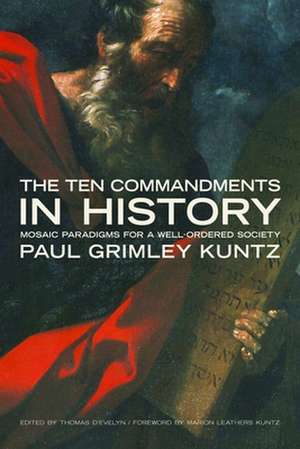
The Ten Commandments in History: Emory University Studies in Law and Religion (EUSLR)
Autor Paul Grimley Kuntz Editat de Thomas D'Evelynen Limba Engleză Paperback – 2004
Din seria Emory University Studies in Law and Religion (EUSLR)
-
 Preț: 266.32 lei
 -
 Preț: 246.06 lei
 -
 Preț: 147.17 lei
 -
 Preț: 258.93 lei
 -
 Preț: 187.36 lei
 -
 Preț: 220.76 lei
 -
 Preț: 250.37 lei
 -
 Preț: 158.32 lei
 -
 Preț: 271.25 lei
 -
 Preț: 145.99 lei
 -
 Preț: 179.56 lei
 -
 Preț: 236.06 lei
 -
 Preț: 257.62 lei
 -
 Preț: 276.40 lei
 -
 Preț: 297.79 lei
 -
 Preț: 193.61 lei
 -
 Preț: 222.87 lei
 - 8%
 Preț: 407.58 lei
 - 8%
 Preț: 434.28 lei
 -
 Preț: 245.48 lei
Preț: 156.22 lei
Puncte Express: 234
Carte tipărită la comandă
Livrare economică 20 noiembrie-04 decembrie
Livrare prin curier în România Termenul estimat este afișat lângă disponibilitate.
Transport gratuit de la 400.00 lei Plată online sau ramburs, în funcție de opțiunile comenzii.
Retur gratuit în 14 zile Comandă securizată și suport în română.
Specificații
ISBN-13: 9780802826602
ISBN-10: 0802826601
Pagini: 244
Dimensiuni: 152 x 229 x 15 mm
Greutate: 0.4 kg
Editura: EERDMANS
Colecția Emory University Studies in Law and Religion (EUSLR)
Seria Emory University Studies in Law and Religion (EUSLR)
Locul publicării:United States
ISBN-10: 0802826601
Pagini: 244
Dimensiuni: 152 x 229 x 15 mm
Greutate: 0.4 kg
Editura: EERDMANS
Colecția Emory University Studies in Law and Religion (EUSLR)
Seria Emory University Studies in Law and Religion (EUSLR)
Locul publicării:United States
V-ar putea interesa
-
 God in the Age of Science?: A Critique of Religious ReasonHerman Philipse-15%Preț: 177.14 lei209.43 lei
 -
 Oxford Studies in Philosophy of Religion Volume 5Jonathan Kvanvig-14%Preț: 291.29 lei338.35 lei
 -
 The Fall and HypertimeHud Hudson-29%Preț: 503.47 lei704.96 lei
 -
 -21%Preț: 382.99 lei484.05 lei
 -
 Religious Faith and Intellectual VirtueLaura Frances Callahan-31%Preț: 664.49 lei962.27 lei
 -
 Rationality and Religious CommitmentRobert Audi-14%Preț: 280.16 lei323.89 lei
 -
 Destiny and Deliberation: Essays in Philosophical TheologyJonathan L. Kvanvig-13%Preț: 293.25 lei337.42 lei
 -
 -31%Preț: 962.40 lei1400.82 lei
 -
 Belief without Borders: Inside the Minds of the Spiritual but not ReligiousLinda A. Mercadante-15%Preț: 435.49 lei512.34 lei
 -
 WorldviewDavid K. NauglePreț: 231.36 lei
 -
 How (Not) to Be SecularJames K. A. SmithPreț: 108.60 lei
 -
 Souls ExistRichard SchainPreț: 81.96 lei
 -
 A2 Philosophy Revision Guide for EdexcelBrian PoxonPreț: 131.45 lei
 -
 As Philosophy Revision Guide for Aqa (Unit D)Brian PoxonPreț: 69.94 lei
 -
 A2 Philosophy Revision Guide for OCRBrian PoxonPreț: 131.55 lei
 -
 A Manual for Creating AtheistsPeter BoghossianPreț: 168.46 lei
Textul de pe ultima copertă
Foreword by Marion Leathers Kuntz
Paul Grimley Kuntz was a deeply religious man who not only found religious profundity in the Decalogue but also was convinced that it offers the most reasonable paradigm for a well-ordered society. Decrying the loss of the true meaning of the Decalogue in modern times, Kuntz spent the last decade of his life preparing this book, his magnum opus, on the Decalogue. In his research and writing he left no stone unturned, considering the Decalogue and the history of its use from every conceivable angle.
In "The Ten Commandments in History" Kuntz passionately argues that the Ten Commandments are universal principles of social order that have to be applied in concrete circumstances in order for their meaning to be fully understood. In a nearly seamless discourse about the tradition of the Ten Commandments, Kuntz engages the thought of more than twenty philosophers from antiquity to modernity, showing how great minds adapted the Decalogue to the needs of their particular age. Among the figures treated in the book are Philo, Aquinas, Wycliffe, Luther, Calvin, Hobbes, Locke, Edwards, Kant, Jefferson, Montaigne, Pascal, Hegel, and Nietzsche. By demonstrating the crucial role of the Decalogue in the history of ideas, Kuntz hoped that readers would find a new reverence for the Ten Commandments and once again value their place in civil society.
In "The Ten Commandments in History" Kuntz passionately argues that the Ten Commandments are universal principles of social order that have to be applied in concrete circumstances in order for their meaning to be fully understood. In a nearly seamless discourse about the tradition of the Ten Commandments, Kuntz engages the thought of more than twenty philosophers from antiquity to modernity, showing how great minds adapted the Decalogue to the needs of their particular age. Among the figures treated in the book are Philo, Aquinas, Wycliffe, Luther, Calvin, Hobbes, Locke, Edwards, Kant, Jefferson, Montaigne, Pascal, Hegel, and Nietzsche. By demonstrating the crucial role of the Decalogue in the history of ideas, Kuntz hoped that readers would find a new reverence for the Ten Commandments and once again value their place in civil society.