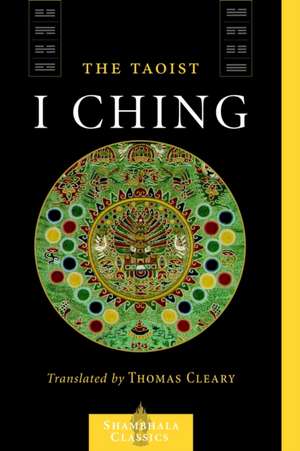
The Taoist I Ching
Autor Liu I-Ming Traducere de Thomas Clearyen Limba Engleză Paperback – iul 2005
Această ediție în format paperback reprezintă o monografie esențială pentru studiul filozofiei orientale, oferind o perspectivă taoistă riguroasă asupra uneia dintre cele mai vechi scrieri chinezești. Volumul, publicat de Shambhala, nu se rezumă la o simplă redare a textului divinatoriu, ci integrează comentariul amplu redactat de Liu I-Ming în anul 1796. Ne-a atras atenția modul în care autorul, un adept al Școlii Realității Complete, reușește să demistifice limbajul ezoteric al celor 64 de hexagrame, transformându-le într-un ghid practic pentru auto-realizare în viața cotidiană. Structura cărții este binară: prima parte conține textul propriu-zis al The Taoist I Ching cu notele lui Liu I-ming, în timp ce a doua parte explorează secțiunile atribuite școlii confucianiste, cunoscute sub numele de „Imagini Generale” și „Hexagrame Mixte”. Găsim în această lucrare o punte neașteptată între tradiție și modernitate, deoarece comentariul utilizează terminologii din psihologie, istorie și sociologie pentru a explica mecanismele schimbării. Ca alternativă la ediția I Ching (Translated with Annotations by James Legge) pentru cursurile de filozofie chineză, volumul de față are avantajul unei perspective pur taoiste, spre deosebire de interpretările mai rigide, de factură academică sau strict confucianistă ale lui Legge. În contextul operei sale, această lucrare completează viziunea expusă în Awakening to the Tao, unde Liu I-Ming folosea eseuri meditative scurte; aici, el aplică aceleași principii de înțelepciune asupra structurii complexe a oracolului, oferind o metodă sistematică de cultivare spirituală.
Preț: 156.81 lei
Preț vechi: 221.31 lei
-29%
Carte disponibilă
Livrare economică 14-21 noiembrie
Specificații
ISBN-10: 1590302605
Pagini: 338
Dimensiuni: 153 x 231 x 24 mm
Greutate: 0.48 kg
Editura: Shambhala
Locul publicării:United States
V-ar putea interesa
-
 Tao Te ChingDavid VillanoPreț: 62.85 lei
 -
 Preț: 64.40 lei
 -
 Entry Into the InconceivableThomas ClearyPreț: 186.56 lei
 -
 Preț: 82.51 lei
 -
 Tao the Way of GodWaysun LiaoPreț: 125.89 lei
 -
 Preț: 216.28 lei
 -
 The Uddhava GitaSwami Ambikananda SaraswatiPreț: 92.50 lei
 -
 Buddhist YogaThomas ClearyPreț: 107.56 lei
 -
 The Tao of OrganizationCheng YiPreț: 145.92 lei
 -
 Preț: 102.36 lei
 -
 The Human ElementThomas ClearyPreț: 105.24 lei
 -
 Preț: 89.18 lei
 -
 Taoist MeditationThomas Cleary-20%Preț: 112.42 lei141.19 lei
 -
 Preț: 129.87 lei
 -
 Zen Letters: Teachings of YuanwuJ.C. ClearyPreț: 94.38 lei
 -
 The Taoist Classics (Volume 3)Thomas ClearyPreț: 284.32 lei
 -
 Holding Yin, Embracing YangEva WongPreț: 137.95 lei
 -
 Graceful ExitsSushila Blackman-37%Preț: 80.24 lei127.56 lei
 -
 Preț: 110.64 lei
 -
 TaoismEva WongPreț: 140.56 lei
De ce să citești această carte
Recomandăm această lucrare cititorilor interesați de filozofia aplicată și istoria religiilor. Spre deosebire de manualele de divinație simpliste, această ediție oferă instrumentele intelectuale necesare pentru a înțelege dinamica schimbării prin prisma tradiției taoiste. Cititorul câștigă acces la o metodă de auto-analiză psihologică și etică, fundamentată pe comentariile unui maestru autentic, făcând textul relevant atât pentru studiu academic, cât și pentru dezvoltare personală.
Despre autor
Liu I-Ming (1734–1821) a fost un important adept și reformator al Școlii Realității Complete (Quanzhen) din cadrul taoismului. Erudit format în spiritul budismului și confucianismului, el și-a dedicat viața explicării textelor alchimice și filozofice complexe pentru publicul larg. Opera sa se distinge prin efortul de a elimina superstițiile acumulate în jurul textelor clasice, punând accent pe transformarea interioară. Traducătorul Thomas Cleary, recunoscut pentru expertiza sa în textele asiatice, redă fidel vocea lui Liu, făcând accesibilă înțelepciunea sa pentru spațiul cultural occidental.
Notă biografică
Thomas Cleary holds a PhD in East Asian Languages and Civilizations from Harvard University and a JD from the University of California, Berkeley, Boalt Hall School of Law. He is the translator of over fifty volumes of Buddhist, Taoist, Confucian, and Islamic texts from Sanskrit, Chinese, Japanese, Pali, and Arabic. A resident of Oakland, California, he passed away in June 2021.
Descriere scurtă
This first part of the present volume is the text of the I Ching proper—the sixty-four hexagrams plus sayings on the hexagrams and their lines—with the commentary composed by Liu I-ming, a Taoist adept, in 1796. The second part is Liu I-ming's commentary on the two sections added to the I Ching by earlier commentators, believed to be members of the original Confucian school; these two sections are known as the Overall Images and the Mixed Hexagrams. In total, the book illuminates the Taoist inner teachings as practiced in the School of Complete Reality.
Well versed in Buddhism and Confucianism as well as Taoism, Liu I-ming intended his work to be read as a guide to comprehensive self-realization while living an ordinary life in the world. In his attempt to lift the veil of mystery from the esoteric language of the I Ching, he employs the terminology of psychology, sociology, history, myth, and religion. This commentary on the I Ching stands as a major contribution to the elucidation of Chinese spiritual genius.