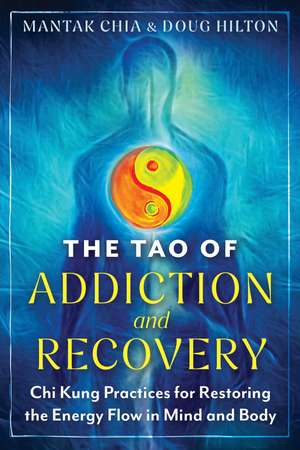
The Tao of Addiction and Recovery: Chi Kung Practices for Restoring the Energy Flow in Mind and Body
Autor Mantak Chia, Doug Hiltonen Limba Engleză Paperback – 2026
• Systematically explains the nature and development of addictions, the process of recovery, and how the Tao Te Ching can provide guidance
• Provides easy-to-perform Chi Kung practices to aid with recovery, specifically for challenges that don’t respond to mainstream treatment
• Describes Taoist Emotional Recycling to heal stuck emotions about the past and address the urges and attitudes that often cause relapse
This book explores addiction and recovery from a Taoist viewpoint, offering a path to healing rooted in ancient Chi Kung practices and principles from the Tao Te Ching.
Emphasizing the eternal balance of yin and yang, the authors show that addiction clogs up the body’s “yin centers,” hindering one’s ability to process energy effectively and propagating a pattern of stuck behaviors. The authors provide a systematic approach that has been refined over 5,000 years of easy-to-perform Chi Kung exercises that help rebalance the body, identify the root causes and traumas that fuel addiction, and address the attitudes and urges that cause relapse.
Through these holistic organ- and body-centered practices, readers can develop healthy sleeping patterns, eliminate brain fog, reduce joint pain, and develop willpower. Readers are also guided in Taoist Emotional Recycling to heal stuck emotions about the past and transform negative energy into positive energy to ensure recovery and return to a state of wholeness.
Preț: 107.74 lei
Preț vechi: 149.06 lei
-28% Precomandă
Puncte Express: 162
Preț estimativ în valută:
19.07€ • 22.23$ • 16.74£
19.07€ • 22.23$ • 16.74£
Carte nepublicată încă
Doresc să fiu notificat când acest titlu va fi disponibil:
Se trimite...
Preluare comenzi: 021 569.72.76
Specificații
ISBN-13: 9798888502815
Pagini: 272
Ilustrații: Full-color throughout
Dimensiuni: 152 x 229 x 15 mm
Greutate: 0.58 kg
Ediția:2nd Edition, New Edition
Editura: Inner Traditions/Bear & Company
Colecția Destiny Books
Pagini: 272
Ilustrații: Full-color throughout
Dimensiuni: 152 x 229 x 15 mm
Greutate: 0.58 kg
Ediția:2nd Edition, New Edition
Editura: Inner Traditions/Bear & Company
Colecția Destiny Books
Notă biografică
Mantak Chia founded the Healing Tao System in North America in 1979 and developed it worldwide as European Tao Yoga and Universal Healing Tao. The author of more than 60 books, he has taught and certified tens of thousands of students and instructors and tours the United States, Europe, Asia, and Australia annually, giving workshops and lectures.
Doug Hilton has been a counselor for more than 30 years with extensive experience in trauma, addictions, and couples and family issues. A certified Universal Healing Tao instructor, he has been integrating Chi Kung into his counseling practice for more than 20 years.
Doug Hilton has been a counselor for more than 30 years with extensive experience in trauma, addictions, and couples and family issues. A certified Universal Healing Tao instructor, he has been integrating Chi Kung into his counseling practice for more than 20 years.
Extras
Chapter One
Addiction and Recovery from a Taoist Perspective
Imagine that this happens to you: You come home accompanied by a friend. You are surprised that some of your family members and other friends are already there waiting for you. One of them asks you to sit down with them in the circle they have made. Each of them takes a turn reading something they wrote. You are instructed that you are not allowed to respond until all of them have read what they have written. Each of their prepared statements expresses care and concern about your behavior. They are suggesting that you have an addiction. A lot of tears are shed, and the emotion in the room is thick.
This feels like an ambush and a betrayal to you. How could they do this? you ask yourself. You’re thinking, They’re judging me and attacking me. This is unfair. I can stop whenever I want. I just like doing it. It’s not a problem. I have great willpower. I can control myself. I can do whatever I want, it’s my life. I know lots of people who do it more than me. They just don’t understand . . . They seem dead serious, though, threatening to stop helping you or even associating with you if you don’t stop. How do you respond? What’s the best way to handle this? If you get mad or defensive, then you may lose them. Maybe it’s better to just play along, you think.
ADDICTION DEFINED
What is addiction, anyway? It can be considered from different perspectives. The 12-Step community views it from a disease perspective. Gabor Maté, physician and addiction expert, has raised awareness of the value of viewing addiction as a trauma response. Psychologist Bruce Alexander has described addiction as the result of a chronic lack of connection in life. In his book The Biology of Belief, cell biologist and best-selling author Bruce Lipton describes how beliefs can be passed down through the generations, hence it seems possible that some of the beliefs that make people more vulnerable to trying or relying on addictive activities or substances could be the result of a predisposition that stems from the beliefs of previous generations. Other experts focus on the obsessive and compulsive aspects of addiction, while still others emphasize that addiction operates like a chronic condition such as diabetes or high blood pressure.
In our first book on addiction, EMDR and the Universal Healing Tao: An Energy Approach to Overcoming Emotional Trauma, Master Chia and Doug Hilton suggest that it is useful to view addiction as a response to adopting an overly yang lifestyle, which emphasizes and values extreme and aggressive tendencies, without enough of a yin approach to life to balance it out with gentleness, compassion, and letting go of what is not within our control. Examples of yang tendencies might be moving too quickly, relentlessly driving toward a desired goal without much consideration given to the process that it might take to reach it, and expending energy to reach the goal without taking adequate time to rest. Without referring to it in terms of yang or yin, the 12-Step community has long recognized that tendency and the need for a lifestyle change. They often use the term “Easy Does It” in their meetings. This is an important direction not just for people who have addictions; it also points to the change that is possible and indeed needed at the level of family, culture, and society if we wish to address the subtle and unconscious motivations behind addictive behavior. Effective prevention strategies need to address this, and not just give out information about the dangers of addiction.
In that first book we used Taoist concepts to point out the paradoxical nature of change and how adopting an overly yang lifestyle can lead to problems that lead to addictions. Being successful in life is often associated with ideas like being a go-getter, someone who “takes the bull by the horns” and “makes things happen.” Putting effort into life is necessary to get results, of course, but too much aggression can lead to frustration and resentment—disturbed emotional states that are some of the building blocks for what can lead a person to turn to an addictive substance or activity in order to cope. In that book we suggested that the survival mechanisms that allow us to deny overwhelming circumstances so we can cope, forget our pain, and simply adapt may also be the mechanisms that can lead to addictive behavior. Addiction seems to exploit these human tendencies, leading us to gravitate to something unhealthy without realizing it.
As Gabor Maté and others have pointed out, trauma and the pileup of many unresolved feelings can also, consciously or unconsciously, push a person to find a powerful way to medicate those feelings. Being active in an addiction means that the normal way of processing emotions is not being allowed to function, so experiences that you would normally process and let go of become more difficult to resolve. As a result, the stuffed emotions pile up. And as more and more emotions get repressed, the need to self-medicate grows.
When people have experiences that shake their faith in themselves or whatever belief systems they have adopted, they become more vulnerable to addiction. If a sense of inner peace is not cultivated, then it will be only a matter of time before the person starts searching for substitutes for that peace.
Examining addiction from an energetic perspective, it becomes clear that the undigested emotions resulting from an addictive lifestyle will, like a clogged carburetor, block the energy flow in the channels and create an urgent need for the person to find something that can relieve them from their pain, even if only temporarily. The internal weight of those clogged emotions and the energy it takes to numb those painful emotions as much as possible drains a lot of energy. Addictive substances and activities may provide temporary relief, but they eventually plug up the internal channels even more, with toxic consequences as a result. If the internal processing system remains blocked for a long time and the “solutions” to address it are primarily addictive ones, new patterns that connect the problem feelings to addictive solutions become more solid over time. Since we are built to survive and to be internally consistent, eventually the internal core programming becomes permanently changed to accept the addictive solutions as necessary and required for proper functioning. Addiction prevention and recovery, from a Taoist perspective, involves keeping the energy channels open and clear or reopening and clearing them out again if there is a need to do so, so that the person can feel like they have space to deal with their life circumstances without having to resort to drastic measures to cope along the way.
THE CONSEQUENCES OF ADDICTION
The effects of addiction are many and varied. The virtues, or higher qualities, of the vital yin organs (the heart, the spleen, the lungs, the kidneys, the sexual organs, and the liver), which store physical, emotional, mental, and spiritual energy, become obscured by the buildup of toxicity. This translates into the addict looking and becoming older than their relative age would indicate, as their responses to life situations become more reactive and negative. As the energy channels that are connected to those yin organs become increasingly blocked over time with an overload of toxic energy, the result is chronic physical pain and a lack of well-being on all levels. The body’s systems cry out for relief from the physical and emotional pain and demand that the substances or activities to which the person is addicted be provided. As a result, despite knowing better, people end up going back to their addictions in an attempt to give themselves relief from their symptoms.
When someone is actively engaged in feeding their addiction, they are not thinking as clearly and rationally as they would under normal circumstances. Their higher cognitive functions in the cerebral cortex are essentially hijacked and taken for a joyride. Addictions are progressive. They get worse the more the person feeds them, and it becomes harder and harder to stop. The yin organs then produce a variety of negative emotional states that lead to a personality of addiction that is named “Slick” in 12-Step meetings. This refers to the predictable combination of undesirable tendencies in addicts such as lying, manipulating, self-centeredness, and being impatient and demanding.*
Which approach to treating addiction is the correct one? All of them are correct to a certain extent, and none of them completely capture the mysterious nature of the problem enough to completely cure it. They all have value in terms of guiding treatment, and there are a few things they all agree on. They all recognize that addiction is not a problem of losers or a weak character. It is also generally accepted that addiction is not something that a person wants. All approaches agree that there is no way to know if someone will cross the line into addiction. It is also universally accepted that recovery from addiction is difficult and complicated. Consistent with Taoism, the focus of this book is not to attempt to draw lines of distinction to include some approaches and definitions and exclude others. The purpose is to instead take what is valuable from each perspective, blend it with the right ingredients from ancient knowledge, and integrate the different approaches so that an effective treatment can be created. It is difficult to imagine how a treatment approach of any kind could teach people how to embrace the reality of their lives and create positive outcomes if the approach is somehow based in judgment or an attitude of superiority.
Addiction and Recovery from a Taoist Perspective
Imagine that this happens to you: You come home accompanied by a friend. You are surprised that some of your family members and other friends are already there waiting for you. One of them asks you to sit down with them in the circle they have made. Each of them takes a turn reading something they wrote. You are instructed that you are not allowed to respond until all of them have read what they have written. Each of their prepared statements expresses care and concern about your behavior. They are suggesting that you have an addiction. A lot of tears are shed, and the emotion in the room is thick.
This feels like an ambush and a betrayal to you. How could they do this? you ask yourself. You’re thinking, They’re judging me and attacking me. This is unfair. I can stop whenever I want. I just like doing it. It’s not a problem. I have great willpower. I can control myself. I can do whatever I want, it’s my life. I know lots of people who do it more than me. They just don’t understand . . . They seem dead serious, though, threatening to stop helping you or even associating with you if you don’t stop. How do you respond? What’s the best way to handle this? If you get mad or defensive, then you may lose them. Maybe it’s better to just play along, you think.
ADDICTION DEFINED
What is addiction, anyway? It can be considered from different perspectives. The 12-Step community views it from a disease perspective. Gabor Maté, physician and addiction expert, has raised awareness of the value of viewing addiction as a trauma response. Psychologist Bruce Alexander has described addiction as the result of a chronic lack of connection in life. In his book The Biology of Belief, cell biologist and best-selling author Bruce Lipton describes how beliefs can be passed down through the generations, hence it seems possible that some of the beliefs that make people more vulnerable to trying or relying on addictive activities or substances could be the result of a predisposition that stems from the beliefs of previous generations. Other experts focus on the obsessive and compulsive aspects of addiction, while still others emphasize that addiction operates like a chronic condition such as diabetes or high blood pressure.
In our first book on addiction, EMDR and the Universal Healing Tao: An Energy Approach to Overcoming Emotional Trauma, Master Chia and Doug Hilton suggest that it is useful to view addiction as a response to adopting an overly yang lifestyle, which emphasizes and values extreme and aggressive tendencies, without enough of a yin approach to life to balance it out with gentleness, compassion, and letting go of what is not within our control. Examples of yang tendencies might be moving too quickly, relentlessly driving toward a desired goal without much consideration given to the process that it might take to reach it, and expending energy to reach the goal without taking adequate time to rest. Without referring to it in terms of yang or yin, the 12-Step community has long recognized that tendency and the need for a lifestyle change. They often use the term “Easy Does It” in their meetings. This is an important direction not just for people who have addictions; it also points to the change that is possible and indeed needed at the level of family, culture, and society if we wish to address the subtle and unconscious motivations behind addictive behavior. Effective prevention strategies need to address this, and not just give out information about the dangers of addiction.
In that first book we used Taoist concepts to point out the paradoxical nature of change and how adopting an overly yang lifestyle can lead to problems that lead to addictions. Being successful in life is often associated with ideas like being a go-getter, someone who “takes the bull by the horns” and “makes things happen.” Putting effort into life is necessary to get results, of course, but too much aggression can lead to frustration and resentment—disturbed emotional states that are some of the building blocks for what can lead a person to turn to an addictive substance or activity in order to cope. In that book we suggested that the survival mechanisms that allow us to deny overwhelming circumstances so we can cope, forget our pain, and simply adapt may also be the mechanisms that can lead to addictive behavior. Addiction seems to exploit these human tendencies, leading us to gravitate to something unhealthy without realizing it.
As Gabor Maté and others have pointed out, trauma and the pileup of many unresolved feelings can also, consciously or unconsciously, push a person to find a powerful way to medicate those feelings. Being active in an addiction means that the normal way of processing emotions is not being allowed to function, so experiences that you would normally process and let go of become more difficult to resolve. As a result, the stuffed emotions pile up. And as more and more emotions get repressed, the need to self-medicate grows.
When people have experiences that shake their faith in themselves or whatever belief systems they have adopted, they become more vulnerable to addiction. If a sense of inner peace is not cultivated, then it will be only a matter of time before the person starts searching for substitutes for that peace.
Examining addiction from an energetic perspective, it becomes clear that the undigested emotions resulting from an addictive lifestyle will, like a clogged carburetor, block the energy flow in the channels and create an urgent need for the person to find something that can relieve them from their pain, even if only temporarily. The internal weight of those clogged emotions and the energy it takes to numb those painful emotions as much as possible drains a lot of energy. Addictive substances and activities may provide temporary relief, but they eventually plug up the internal channels even more, with toxic consequences as a result. If the internal processing system remains blocked for a long time and the “solutions” to address it are primarily addictive ones, new patterns that connect the problem feelings to addictive solutions become more solid over time. Since we are built to survive and to be internally consistent, eventually the internal core programming becomes permanently changed to accept the addictive solutions as necessary and required for proper functioning. Addiction prevention and recovery, from a Taoist perspective, involves keeping the energy channels open and clear or reopening and clearing them out again if there is a need to do so, so that the person can feel like they have space to deal with their life circumstances without having to resort to drastic measures to cope along the way.
THE CONSEQUENCES OF ADDICTION
The effects of addiction are many and varied. The virtues, or higher qualities, of the vital yin organs (the heart, the spleen, the lungs, the kidneys, the sexual organs, and the liver), which store physical, emotional, mental, and spiritual energy, become obscured by the buildup of toxicity. This translates into the addict looking and becoming older than their relative age would indicate, as their responses to life situations become more reactive and negative. As the energy channels that are connected to those yin organs become increasingly blocked over time with an overload of toxic energy, the result is chronic physical pain and a lack of well-being on all levels. The body’s systems cry out for relief from the physical and emotional pain and demand that the substances or activities to which the person is addicted be provided. As a result, despite knowing better, people end up going back to their addictions in an attempt to give themselves relief from their symptoms.
When someone is actively engaged in feeding their addiction, they are not thinking as clearly and rationally as they would under normal circumstances. Their higher cognitive functions in the cerebral cortex are essentially hijacked and taken for a joyride. Addictions are progressive. They get worse the more the person feeds them, and it becomes harder and harder to stop. The yin organs then produce a variety of negative emotional states that lead to a personality of addiction that is named “Slick” in 12-Step meetings. This refers to the predictable combination of undesirable tendencies in addicts such as lying, manipulating, self-centeredness, and being impatient and demanding.*
Which approach to treating addiction is the correct one? All of them are correct to a certain extent, and none of them completely capture the mysterious nature of the problem enough to completely cure it. They all have value in terms of guiding treatment, and there are a few things they all agree on. They all recognize that addiction is not a problem of losers or a weak character. It is also generally accepted that addiction is not something that a person wants. All approaches agree that there is no way to know if someone will cross the line into addiction. It is also universally accepted that recovery from addiction is difficult and complicated. Consistent with Taoism, the focus of this book is not to attempt to draw lines of distinction to include some approaches and definitions and exclude others. The purpose is to instead take what is valuable from each perspective, blend it with the right ingredients from ancient knowledge, and integrate the different approaches so that an effective treatment can be created. It is difficult to imagine how a treatment approach of any kind could teach people how to embrace the reality of their lives and create positive outcomes if the approach is somehow based in judgment or an attitude of superiority.
Cuprins
Acknowledgments
Putting The Tao of Addiction and Recovery into Practice
1 • Addiction and Recovery from a Taoist Perspective
2 • What Is Recovery?
3 • The Chi Kung Approach
4 • Yin and Yang and the Concept of Balance
5 • Getting Started with Chi Kung Practice
6 • Practices for Detoxification and Unwinding the Body
7 • Practices for Self-Confidence
8 • Practices for Transforming Toxic Patterns
9 • Practices for a Full and Restful Sleep
10 • Practices for Releasing Trauma
Appendix: More Recovery Resources
Other Relevant Books by Mantak Chia
About the Authors
The Universal Healing Tao System
and Training Center
Index
Putting The Tao of Addiction and Recovery into Practice
1 • Addiction and Recovery from a Taoist Perspective
2 • What Is Recovery?
3 • The Chi Kung Approach
4 • Yin and Yang and the Concept of Balance
5 • Getting Started with Chi Kung Practice
6 • Practices for Detoxification and Unwinding the Body
7 • Practices for Self-Confidence
8 • Practices for Transforming Toxic Patterns
9 • Practices for a Full and Restful Sleep
10 • Practices for Releasing Trauma
Appendix: More Recovery Resources
Other Relevant Books by Mantak Chia
About the Authors
The Universal Healing Tao System
and Training Center
Index
Recenzii
“The Tao of Addiction and Recovery is a profound guide to getting to the roots of addictive behavior in order to restore balance and harmony through Chi Kung, breathwork, diet, and lifestyle practices. This will help readers to release negative patterns, traumas, and damaging practices to reclaim and build one’s inner energy without harmful substances.”
“In this book, you will discover easy-to-follow Chi Kung practices to aid your recovery, as the authors systematically explain the nature and development of addictions, the process of recovery, and how the Tao Te Ching can provide guidance. In this book the authors also show readers how to heal sick and stuck emotions by addressing the urges and attitudes that often cause relapse.”
“In this book, you will discover easy-to-follow Chi Kung practices to aid your recovery, as the authors systematically explain the nature and development of addictions, the process of recovery, and how the Tao Te Ching can provide guidance. In this book the authors also show readers how to heal sick and stuck emotions by addressing the urges and attitudes that often cause relapse.”
Descriere
A Taoist guide to recovering from addiction