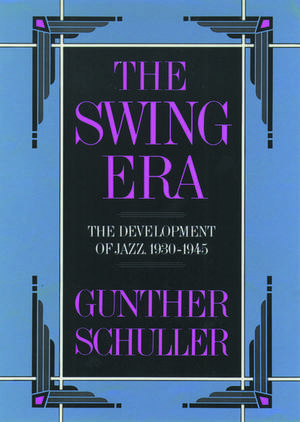
The Swing Era: The Development of Jazz, 1930-1945: The History of Jazz
Autor Gunther Schulleren Limba Engleză Hardback – 13 iul 1989
Preț: 544.67 lei
Preț vechi: 745.40 lei
-27%
Puncte Express: 817
Carte tipărită la comandă
Livrare economică 13-18 noiembrie
Livrare prin curier în România Termenul estimat este afișat lângă disponibilitate.
Transport gratuit pentru acest produs Plată online sau ramburs, în funcție de opțiunile comenzii.
Retur gratuit în 14 zile Comandă securizată și suport în română.
Specificații
ISBN-13: 9780195043129
ISBN-10: 019504312X
Pagini: 944
Ilustrații: music examples
Dimensiuni: 164 x 248 x 49 mm
Greutate: 1.49 kg
Editura: OUP OXFORD
Colecția OUP Oxford
Seria The History of Jazz
Locul publicării:Oxford, United Kingdom
ISBN-10: 019504312X
Pagini: 944
Ilustrații: music examples
Dimensiuni: 164 x 248 x 49 mm
Greutate: 1.49 kg
Editura: OUP OXFORD
Colecția OUP Oxford
Seria The History of Jazz
Locul publicării:Oxford, United Kingdom
V-ar putea interesa
-
 Herbie Hancock: PossibilitiesHerbie HancockPreț: 104.88 lei
 -
 Spirits Rejoice!: Jazz and American ReligionJason Bivins-20%Preț: 271.27 lei337.05 lei
 -
 Visions of Jazz: The First CenturyGary Giddins-14%Preț: 206.35 lei238.66 lei
 -
 -16%Preț: 214.71 lei257.06 lei
 -
 Louis Armstrong's Hot Five and Hot Seven RecordingsBrian Harker-17%Preț: 204.37 lei246.73 lei
 -
 Horn TechniqueGunther Schuller-29%Preț: 347.66 lei488.77 lei
 -
 Victory through Harmony: The BBC and Popular Music in World War IIChristina L. Baade-11%Preț: 338.29 lei380.95 lei
 -
 -17%Preț: 177.30 lei213.31 lei
 -
 Louis Armstrong, Master of ModernismThomas BrothersPreț: 267.38 lei
 -
 Charles Lloyd: A Wild, Blatant TruthJosef Woodard-17%Preț: 135.53 lei163.45 lei
Recenzii
'This is jazz criticism of a quality rarely encountered and, probably, the outstanding work of its kind on the music of the swing era.'Ray Comiskey, Irish Times
'this is not a book to be digested at one sitting; instead readers will prefer to come back again and again to absorb the various monographs on soloists, big bands and small groups. There is more than enough to keep us busy until the arrival of Volume Three.'Clive Davis, The Times
'a suitably Promethean study, densely packed with musical examples and expansively judgmental on the pros and cons of a generation of players ... his insistence on getting to the core of the music, on identifying the original virtues of the jazz musician's art, is something to be prized, especially in this depth'Richard Cook, Sunday Times
'The Swing Era is a work of love first and foremost ... I can't think of any writing that could have made me happier these past few weeks.'William D. Routt, LaTrobe University, Sunday Herald (Melbourne)
'its value to jazz and big band fan is immeasurable'Peter Hepple, Stage & Television Today
'a magisterial achievement, equally engrossing for musicologists, enthusiasts or the just plain curious ... Throughout, Schuller ... speaks with serene authority.'S. Frederick Starr, The Washington Post
'the presentation of the text is excellent and the written style lucid and easy to follow'Frank Murphy, International Journal of Music Education
'the second volume of his projected trilogy, is an even more impressive achievement - the long wait has been worthwhile'Daily Telegraph
'Reading it is like listening to one of those hugely learned men with the gift of the gab, like Bronowski or A.J.P. Taylor, talking about his favourite subject. Every observation is backed by evidence, every generalisation judiciously qualified, every side-issue detailed in a footnote, but it is all done without a trace of pomposity. The real enjoyment in reading The Swing Era, as in reading Johnson's Lives of the Poets, comes from being taught more about something you love by an erudite, courteous and generous mind.'Dave Gelly, Jazz, Issue 12
'While the length of this work might arouse the suspicion of obsessive exhaustiveness, individual treatments of bands and soloists are admirably concise: it is the commitment to range of coverage that gives this book its volume.'David Ayers, University of Kent, Journal of American Studies, 27 (1993)
'this is not a book to be digested at one sitting; instead readers will prefer to come back again and again to absorb the various monographs on soloists, big bands and small groups. There is more than enough to keep us busy until the arrival of Volume Three.'Clive Davis, The Times
'a suitably Promethean study, densely packed with musical examples and expansively judgmental on the pros and cons of a generation of players ... his insistence on getting to the core of the music, on identifying the original virtues of the jazz musician's art, is something to be prized, especially in this depth'Richard Cook, Sunday Times
'The Swing Era is a work of love first and foremost ... I can't think of any writing that could have made me happier these past few weeks.'William D. Routt, LaTrobe University, Sunday Herald (Melbourne)
'its value to jazz and big band fan is immeasurable'Peter Hepple, Stage & Television Today
'a magisterial achievement, equally engrossing for musicologists, enthusiasts or the just plain curious ... Throughout, Schuller ... speaks with serene authority.'S. Frederick Starr, The Washington Post
'the presentation of the text is excellent and the written style lucid and easy to follow'Frank Murphy, International Journal of Music Education
'the second volume of his projected trilogy, is an even more impressive achievement - the long wait has been worthwhile'Daily Telegraph
'Reading it is like listening to one of those hugely learned men with the gift of the gab, like Bronowski or A.J.P. Taylor, talking about his favourite subject. Every observation is backed by evidence, every generalisation judiciously qualified, every side-issue detailed in a footnote, but it is all done without a trace of pomposity. The real enjoyment in reading The Swing Era, as in reading Johnson's Lives of the Poets, comes from being taught more about something you love by an erudite, courteous and generous mind.'Dave Gelly, Jazz, Issue 12
'While the length of this work might arouse the suspicion of obsessive exhaustiveness, individual treatments of bands and soloists are admirably concise: it is the commitment to range of coverage that gives this book its volume.'David Ayers, University of Kent, Journal of American Studies, 27 (1993)
Notă biografică
Prominent American composer, horn-player, and writer on music.