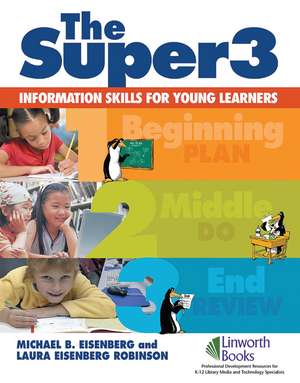
The Super3: Information Skills for Young Learners: Big6 Information Literacy Skills
Autor Robert E. Berkowitz, Michael B. Eisenberg, Laura Eisenberg Robinsonen Limba Engleză Paperback – 30 aug 2007
Use The Super3, a spin off from the widely used Big6, to help students in grades PreK-2 develop crucial problem-solving skills. Learn how to break down the problem-solving process so that younger students get it and remember it. Discover a process model for children to learn and use in order to be successful with the various tasks they undertake. The Super3 helps younger students recognize what they are doing so they can label and talk about their research. Provides an easy transition into the Big6. Ready-to-use worksheets include explanations for daily implementation of the Super3 into the classroom. Mike Eisenberg and Laura Eisenberg Robinson have adapted the widely used Big6 research approach for students in grades PreK-2. The Super3 uses the three simple steps: Plan, Do, Review.
Preț: 244.24 lei
Preț vechi: 330.61 lei
-26%
Puncte Express: 366
Carte tipărită la comandă
Livrare economică 26 noiembrie-10 decembrie
Livrare prin curier în România Termenul estimat este afișat lângă disponibilitate.
Transport gratuit de la 400.00 lei Plată online sau ramburs, în funcție de opțiunile comenzii.
Retur gratuit în 14 zile Comandă securizată și suport în română.
Specificații
ISBN-13: 9781586832865
ISBN-10: 1586832867
Pagini: 112
Ilustrații: black & white line drawings
Dimensiuni: 216 x 279 x 8 mm
Greutate: 0.34 kg
Editura: Bloomsbury Publishing
Colecția Linworth
Seria Big6 Information Literacy Skills
Locul publicării:New York, United States
ISBN-10: 1586832867
Pagini: 112
Ilustrații: black & white line drawings
Dimensiuni: 216 x 279 x 8 mm
Greutate: 0.34 kg
Editura: Bloomsbury Publishing
Colecția Linworth
Seria Big6 Information Literacy Skills
Locul publicării:New York, United States
V-ar putea interesa
-
 -17%Preț: 306.14 lei366.91 lei
 -
 Helping with Homework: A Parent's Guide to Information Problem-SolvingMichael B. Eisenberg-26%Preț: 205.05 lei277.60 lei
 -
 Teaching Information & Technology Skills: The Big6 in Elementary SchoolsMichael B. Eisenberg-25%Preț: 257.60 lei341.67 lei
 -
 -31%Preț: 290.34 lei422.83 lei
 -
 Preț: 512.86 lei
 -
 Starting, Strengthening and Managing Institutional RepositoriesJonathan A. Nabe-20%Preț: 570.25 lei712.81 lei
 -
 Teaching Information & Technology Skills: The Big6 in Secondary SchoolsMichael B. Eisenberg-36%Preț: 241.13 lei377.28 lei
 -
 Big6 Collection: Best of the Big6 eNewsletter, Volume IIMichael B. Eisenberg-34%Preț: 251.05 lei382.61 lei
 -
 The Big6 Workshop Handbook: Implementation and ImpactMichael B. Eisenberg-23%Preț: 287.02 lei374.38 lei
 -
 Information Literacy: Essential Skills for the Information AgeMichael B. Eisenberg-16%Preț: 341.44 lei405.77 lei
 -
 -20%Preț: 607.37 lei759.21 lei
 -
 Information Systems EngineeringPaul Johannesson-20%Preț: 608.02 lei760.03 lei
 -
 Service Science and Logistics InformaticsZongwei Luo-20%Preț: 1086.46 lei1358.07 lei
 -
 -20%Preț: 2459.53 lei3074.41 lei
 -
 The Oracle Universal Content Management HandbookDmitri Khanine-20%Preț: 349.81 lei437.25 lei
 -
 -20%Preț: 986.83 lei1233.54 lei
 -
 -20%Preț: 321.35 lei401.68 lei
 -
 String Processing and Information RetrievalFabio Crestani-20%Preț: 339.73 lei424.66 lei
 -
 Smart Sensing and ContextPaul Havinga-20%Preț: 321.36 lei401.70 lei
 -
 -20%Preț: 324.35 lei405.44 lei
 -
 -20%Preț: 983.37 lei1229.21 lei
 -
 Digital Libraries: Achievements, Challenges and OpportunitiesShigeo Sugimoto-20%Preț: 336.09 lei420.11 lei
 -
 Anti-Spam MeasuresGuido Schryen-20%Preț: 346.69 lei433.36 lei
 -
 eSourcing Capability Model for Service Providers (eSCM-SP)Elaine B. Hyder-20%Preț: 591.29 lei739.10 lei
Recenzii
Super3: Information Skills for Young Learners outlines the process of research from beginning to middle to end but for younger students than those who would use the Big6. The authors, father and daughter, are well versed in the process having written about the Big6 for older students, and presented the information at conferences and workshops. Here they take on the younger students who are just beginning to use libraries, books and other materials to gather information for research projects. Clearly the steps are the same: plan, do, and review. This framework, though seemingly quite simplistic, is the crux of research no matter the grade level, even graduate students follow these steps. Teachers are given support materials, some not so great song lyrics to help students remember what to do, plenty of ideas. The authors include a chart showing how the Big3 compares with the Big6 which makes it easy to understand terminology. From overview to worksheets and examples, classroom teachers and libraries who teach research skills (don't we all?) will find this a valuable addition to their professional libraries.