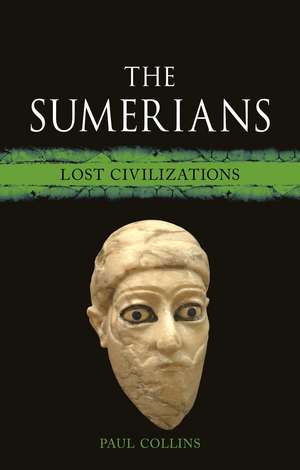
The Sumerians: Lost Civilizations: Lost Civilizations
Autor Paul Collinsen Limba Engleză Hardback – 22 mar 2021
The Sumerians are widely believed to have created the world’s earliest civilization on the fertile floodplains of southern Iraq from about 3500 to 2000 BCE. They have been credited with the invention of nothing less than cities, writing, and the wheel, and therefore hold an ancient mirror to our own urban, literate world. But is this picture correct? Paul Collins reveals how the idea of a Sumerian people was assembled from the archaeological and textual evidence uncovered in Iraq and Syria over the last one hundred fifty years. Reconstructed through the biases of those who unearthed them, the Sumerians were never simply lost and found, but reinvented a number of times, both in antiquity and in the more recent past.
Din seria Lost Civilizations
- 11%
 Preț: 130.62 lei
 - 15%
 Preț: 92.02 lei
 -
 Preț: 109.27 lei
 - 11%
 Preț: 130.08 lei
 - 13%
 Preț: 124.95 lei
 -
 Preț: 128.52 lei
 -
 Preț: 147.93 lei
 -
 Preț: 91.31 lei
 - 13%
 Preț: 125.25 lei
 -
 Preț: 128.02 lei
 - 14%
 Preț: 93.37 lei
 - 13%
 Preț: 94.61 lei
 -
 Preț: 131.67 lei
 -
 Preț: 108.46 lei
 -
 Preț: 110.39 lei
 -
 Preț: 148.64 lei
 -
 Preț: 131.80 lei
 -
 Preț: 132.53 lei
 -
 Preț: 130.21 lei
Preț: 129.64 lei
Puncte Express: 194
Carte disponibilă
Livrare economică 16-23 noiembrie
Livrare prin curier în România Termenul estimat este afișat lângă disponibilitate.
Transport gratuit de la 400.00 lei Plată online sau ramburs, în funcție de opțiunile comenzii.
Retur gratuit în 14 zile Comandă securizată și suport în română.
Specificații
ISBN-13: 9781789144154
ISBN-10: 1789144159
Pagini: 208
Ilustrații: 40 color plates, 20 halftones
Dimensiuni: 140 x 216 x 20 mm
Greutate: 0.54 kg
Editura: REAKTION BOOKS
Colecția Reaktion Books
Seria Lost Civilizations
ISBN-10: 1789144159
Pagini: 208
Ilustrații: 40 color plates, 20 halftones
Dimensiuni: 140 x 216 x 20 mm
Greutate: 0.54 kg
Editura: REAKTION BOOKS
Colecția Reaktion Books
Seria Lost Civilizations
V-ar putea interesa
Notă biografică
Paul Collins is the Jaleh Hearn Curator for Ancient Near East at the Ashmolean Museum, University of Oxford, specializing in the art and archaeology of Mesopotamia and Iran. He is the author of Assyrian Palace Sculptures and Mountains and Lowlands: Ancient Iran and Mesopotamia.
Recenzii
“[A] stimulating new book. . . . The Sumerians, for all their doubtful status as a formal society, have a remarkable list of achievements to their credit. Besides being the world’s earliest attested civilization in the fourth millennium BCE, they invented cuneiform—the world’s earliest writing—and the sexagesimal system of mathematics. Their cities, such as Uruk and Ur, were the headquarters of the world’s earliest city-states, with bureaucracies, legal codes, divisions of labor, and a money economy. . . . A civilization made vivid by Collins’s clear and expert text.”
"In this fascinating monograph, Collins provides a thought-provoking study of the Sumerians as representing the most ancient of all civilizations. Instead of presenting a traditional descriptive account, Collins explores how archaeological and textual sources were used over the past 150 years to construct multiple and often-conflicting notions of the ancient land called Sumer and the people who became known as the Sumerians. . . . Well-written, well-illustrated, and well-documented, this volume will be of great interest to both scholars and students. . . . Highly recommended."
"This book makes a vital and thought-provoking contribution to the study of the ancient Middle East, and is written in such a way that readers beyond those working in the field will also find it accessible."
"A highly readable, fully authoritative account of all aspects of the ways of life of the Sumerians, one of the most important peoples of the ancient world. Collins also covers the issue of the discovery and rediscovery of the Sumerians very effectively, bringing to life not just the Sumerians themselves but also the early travelers and antiquarians who first engaged with them. The book, too, is superbly illustrated."