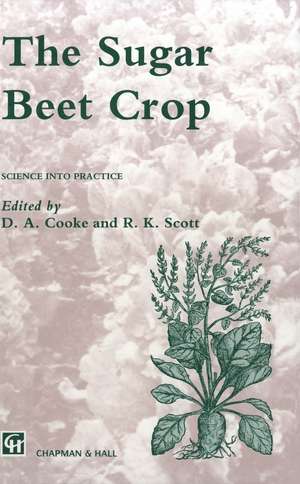
The Sugar Beet Crop: World Crop Series
Autor D.A. Cooke, J.E. Scotten Limba Engleză Paperback – 28 sep 2011


Preț: 926.05 lei
Preț vechi: 1129.33 lei
-18%
Puncte Express: 1389
Carte tipărită la comandă
Livrare economică 03-17 decembrie
Livrare prin curier în România Termenul estimat este afișat lângă disponibilitate.
Transport gratuit pentru acest produs Plată online sau ramburs, în funcție de opțiunile comenzii.
Retur gratuit în 14 zile Comandă securizată și suport în română.
Specificații
ISBN-13: 9789401066549
ISBN-10: 940106654X
Pagini: 700
Ilustrații: 704 p.
Dimensiuni: 155 x 235 x 37 mm
Greutate: 0.96 kg
Ediția:Softcover reprint of the original 1st ed. 1993
Editura: SPRINGER NETHERLANDS
Colecția Springer
Seria World Crop Series
Locul publicării:Dordrecht, Netherlands
ISBN-10: 940106654X
Pagini: 700
Ilustrații: 704 p.
Dimensiuni: 155 x 235 x 37 mm
Greutate: 0.96 kg
Ediția:Softcover reprint of the original 1st ed. 1993
Editura: SPRINGER NETHERLANDS
Colecția Springer
Seria World Crop Series
Locul publicării:Dordrecht, Netherlands
V-ar putea interesa
-
 Ecology of the Shortgrass Steppe: A Long-Term PerspectiveW. K. Lauenroth-31%Preț: 684.47 lei987.93 lei
 -
 Anatomy of the Monocotyledons Volume X: OrchidaceaeWilliam Louis Stern-33%Preț: 1143.69 lei1699.34 lei
 -
 Plants and MicroclimateHamlyn G. Jones-11%Preț: 477.02 lei535.99 lei
 -
 Reaching for the SunJohn KingPreț: 374.78 lei
 -
 Terrestrial Photosynthesis in a Changing EnvironmentJaume Flexas-5%Preț: 1106.98 lei1165.24 lei
 -
 Physiological Plant EcologyWalter Larcher-18%Preț: 771.23 lei940.53 lei
 -
 Mutation Breeding in Chickpea:Imran Kozgar-15%Preț: 532.41 lei626.37 lei
Public țintă
ResearchCuprins
1 History of the crop.- 1.1 Origins of beet growing.- 1.2 Evolution of cultivated Beta species.- 1.3 Achard and the first beet sugar factory.- 1.4 The early history of sugar-beet breeding.- 1.5 Development of the beet sugar industry in the nineteenth century.- 1.6 Improvements in growing techniques and expansion of sugar-beet cultivation in the twentieth century.- 1.7 Sugar beet in retrospect and prospect.- 1.8 Historical time-table.- References.- 2 Biology and physiology of the sugar-beet plant.- 2.1 Introduction.- 2.2 Crop establishment and vegetative growth.- 2.3 Production and distribution of assimilates.- 2.4 Reproductive growth 60 References.- 3 Genetics and breeding.- 3.1 Introduction.- 3.2 Objectives of sugar-beet breeding.- 3.3 Characters subjected to selection.- 3.4 The inheritance of specific characters.- 3.5 Allopolyploidy in sugar-beet breeding.- 3.6 Selection methods.- 3.7 Synthetic varieties in sugar beet.- 3.8 Background to hybrid breeding in sugar beet.- 3.9 Hybrid breeding methods and development of hybrid varieties.- 3.10 Breeding for specific characters.- 3.11 Impact of new technologies on sugar-beet breeding.- References.- 4 Seed production and quality.- 4.1 Introduction.- 4.2 Seed production — indirect (steckling transplant) method.- 4.3 Seed production — direct (overwintering) method.- 4.4 Seed production — harvest.- 4.5 Seed quality.- 4.6 Seed law requirements.- References.- 5 Soil management and crop establishment.- 5.1 Obj ectives of tillage.- 5.2 Primary tillage.- 5.3 Secondary tillage, sowing and post-sowing tillage.- 5.4 Mechanical weed control.- 5.5 Soil compaction.- 5.6 Subsoil loosening.- 5.7 Protection against wind erosion.- 5.8 Reduced tillage.- References.- 6 Crop physiology and agronomy.- 6.1 Introduction.- 6.2 The physiology ofcrop growth.- 6.3 Analysing agronomy in physiological terms.- 6.4 Analysing the effects of weeds andyirus yellows in physiological terms.- 6.5 The application of physiological principles to the future development of the industry.- References.- 7 Nutrition.- 7.1 Introduction.- 7.2 Nitrogen.- 7.3 Phosphorus and sulphur.- 7.4 Potassium and sodium.- 7.5 Calcium and magnesium.- 7.6 Micronutrients.- References.- 8 Water use and irrigation.- 8.1 Introduction.- 8.2 Sugar-beet plants and water.- 8.3 Water use.- 8.4 Water use and crop growth.- 8.5 Responses to irrigation.- 8.6 Irrigation practice.- References.- 9 Rhizomania.- 9.1 Introduction.- 9.2 Symptoms and damage.- 9.3 Causal agents.- 9.4 Factors affecting disease development.- 9.5 Spread of the disease.- 9.6 Control.- 9.7 Conclusions.- References.- 10 Diseases.- 10.1 Introduction.- 10.2 Major virus diseases.- 10.3 Virus diseases of minor or unknown importance.- 10.4 Major fungal diseases.- 10.5 Minor or localised fungal diseases.- 10.6 Diseases caused by bacteria and bacteria-like organisms.- References.- 11 Pests.- 11.1 Introduction.- 11.2 Effects of pests on plant growth and crop yield.- 11.3 Distribution, biology, and pathogenicity of the major pests.- 11.4 Minimising yield losses caused by pests.- References.- 12 Weeds and weed control.- 12.1 Introduction.- 12.2 Weeds.- 12.3 Weed competition and the effect of time of removal.- 12.4 Weed control.- 12.5 Weed control outside the sugar-beet crop.- 12.6 Herbicide resistance.- 12.7 Herbicide soil residues.- 12.8 Summary and future prospects.- References.- 13 Opportunities for manipulation of growth and development.- 13.1 The rationale for growth regulation.- 13.2 Chemical regulation of growth and development.- 13.3 A molecular biological approach to regulation of growth anddevelopment.- 13.4 Conclusions.- References.- 14 Storage.- 14.1 Introduction.- 14.2 Amount of losses.- 14.3 Causes of losses.- 14.4 Reducing storage losses.- References.- 15 Root quality and processing.- 15.1 Introduction.- 15.2 Historical overview of technical quality.- 15.3 Concepts of good beet quality.- 15.4 Quality parameters.- 15.5 Factors influencing quality.- 15.6 Evolution of beet quality.- 15.7 Concluding remarks.- References.- 16 By-products.- 16.1 Introduction.- 16.2 Sugar-beet tops.- 16.3 Sugar-beet pulp.- 16.4 Sugar-beet molasses.- 16.5 Molassed sugar-beet pulp (feed).- 16.6 Beet vinasse.- 16.7 Concluding remarks.- References.
Recenzii
The book clearly presents a very comprehensive account of the crop. The book clearly provides a broad and considered outline of this major crop...it should be available widely in the libraries of colleges, universities and research institutes wherever crop science is studied - Journal of Agricultural Science