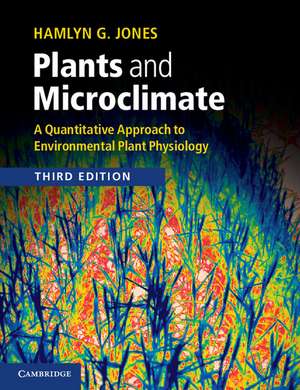
Plants and Microclimate
Autor Hamlyn G. Jonesen Limba Engleză Paperback – 30 noi 2017
În cadrul programelor de studiu dedicate fiziologiei vegetale și ecologiei, Plants and Microclimate ocupă o poziție centrală ca text fundamental pentru înțelegerea interacțiunilor biofizice dintre plante și mediul lor aerian. Suntem de părere că această a treia ediție, publicată de Cambridge University Press, reușește să transforme aspectele numerice complexe în concepte accesibile, menținând în același timp rigoarea matematică necesară cercetării avansate. Remarcăm o actualizare semnificativă a aparatului bibliografic, unde peste 50% din surse sunt noi, reflectând progresele rapide din domeniu. Structura volumului este organizată logic pentru a ghida cititorul de la principiile fizice de bază, precum radiația și transferul de căldură, către procesele fiziologice vitale: relațiile hidrice, stomatele, fotosinteza și respirația. Finalul lucrării face tranziția către aplicații practice, analizând stresul abiotic și îmbunătățirea randamentului culturilor agricole. Comparabil cu Plant-Atmosphere Relationships de J. Grace în ceea ce privește precizia științifică, volumul de față se distinge printr-o abordare mult mai extinsă, integrând date de teledetecție și resurse online care nu erau disponibile în lucrările anterioare. În contextul operei sale, Hamlyn G. Jones rafinează aici temele explorate în Plants under Stress, făcând pasul de la analiza descriptivă a factorilor de stres către un model predictiv, cantitativ. Putem afirma că elementul distinctiv al acestei ediții este modul în care autorul corelează noile descoperiri din genetica moleculară cu răspunsurile plantei la scară macroscopică, oferind o viziune holistică asupra modului în care vegetația răspunde schimbărilor climatice și poluanților.
Preț: 466.68 lei
Preț vechi: 524.35 lei
-11%
Carte tipărită la comandă
Livrare economică 26 noiembrie-10 decembrie
Specificații
ISBN-10: 0521279593
Pagini: 426
Ilustrații: 170 b/w illus.
Dimensiuni: 189 x 246 x 23 mm
Greutate: 0.82 kg
Ediția:Revizuită
Editura: Cambridge University Press
Locul publicării:Cambridge, United Kingdom
V-ar putea interesa
-
 Design and Analysis of Ecological ExperimentsSamuel M. Scheiner-31%Preț: 662.78 lei961.23 lei
 -
 The Biology of Temporary WatersD. Dudley Williams-22%Preț: 528.29 lei679.94 lei
 -
 The Biology and Conservation of Wild FelidsDavid MacDonald-29%Preț: 561.75 lei794.03 lei
 -
 -30%Preț: 675.82 lei969.14 lei
 -
 Plant Biotechnology: The genetic manipulation of plantsAdrian Slater-22%Preț: 407.23 lei520.58 lei
 -
 Methods in Comparative Plant Population EcologyDavid Gibson-21%Preț: 483.35 lei612.26 lei
 -
 Youth in a Suspect SocietyH. GirouxPreț: 308.77 lei
 -
 Apocalyptic Faith and Political ViolenceJ. RinehartPreț: 399.17 lei
 -
 The Ideology of TyrannyG. Preparata-15%Preț: 481.71 lei566.71 lei
 -
 Monetary EconomicsSteven DurlaufPreț: 395.75 lei
 -
 Preț: 385.66 lei
 -
 Hollywood's ExploitedRichard van HeertumPreț: 300.02 lei
 -
 Gender and Jewish HistoryMarion A. KaplanPreț: 236.74 lei
 -
 Service ManagementBart Van Looy-15%Preț: 677.70 lei797.29 lei
 -
 Preț: 113.92 lei
 -
 Preț: 370.65 lei
 -
 Anatomy of a Financial CrisisM. JarsulicPreț: 368.58 lei
 -
 State Power and DemocracyA. KolinPreț: 398.19 lei
 -
 Social Representations and IdentityG. Moloney-15%Preț: 637.96 lei750.55 lei
 -
 The Progression of the American PresidencyJ. Twombly-53%Preț: 183.52 lei389.18 lei
 -
 Lenin, Religion, and TheologyR. Boer-15%Preț: 645.34 lei759.23 lei
 -
 Economics and EthicsA. Dutt-15%Preț: 642.01 lei755.31 lei
 -
 Bats of Britain, Europe and Northwest AfricaChristian Dietz-51%Preț: 352.66 lei723.68 lei
 -
 The SAGE Dictionary of Leisure StudiesTony BlackshawPreț: 438.68 lei
 -
 The Victorian CityJudith Flanders-26%Preț: 90.66 lei122.85 lei
 -
 Plant EcologyErnst-Detlef Schulze-18%Preț: 772.15 lei941.65 lei
De ce să citești această carte
Recomandăm această carte studenților și cercetătorilor care au nevoie de o bază teoretică solidă și cuantificabilă în fiziologia mediului. Cititorul câștigă o înțelegere profundă a mecanismelor prin care plantele gestionează resursele de apă și lumină, fiind un instrument indispensabil pentru cei care lucrează în agricultură de precizie, silvicultură sau monitorizarea ecosistemelor prin tehnologii moderne de teledetecție.
Despre autor
Hamlyn G. Jones este profesor emerit de ecologie vegetală la Universitatea din Dundee. Cariera sa s-a concentrat pe utilizarea modelelor matematice și a abordărilor experimentale pentru a descifra adaptabilitatea plantelor la medii specifice. Expertiza sa în toleranța la stresul de mediu este recunoscută internațional, fiind un pionier în aplicarea metodelor cantitative pentru a explica interacțiunile dintre biosferă și atmosferă. Lucrările sale sunt fundamentale pentru înțelegerea modului în care factorii abiotici influențează supraviețuirea și productivitatea speciilor vegetale.
Descriere scurtă
Cuprins
Recenzii
'I have strongly recommended the previous editions to all my students in plant physiology or applied crop management and will continue to do so with this excellent new edition. Hamlyn Jones provides an excellent combination of experimental experience with the mathematical and physical bases of plant physiology and environmental physics. This true systems approach to understanding plant responses to the environment is precisely what is needed as we address complex issues such as climate change. This is a book that should be read by any scientist attempting to understand and affect plant responses to the environment at the whole plant and crop level, but especially at the molecular level. The combination of clear conceptual explanations, and many well-chosen figures and tables, along with their mathematical basis is particularly helpful to those with different learning styles and goals.' Alan N. Lakso, Cornell University
'This book's continued emphasis on using primary quantitative data to illustrate plant behaviour and function maintains its authoritative position as the core text for environmental plant physiology. This third edition sees the scope of the book expanding upwards and outwards with a new section on remote sensing, and inwards to cover the emerging 'omics', whilst always retaining its focus on the whole plant. I have lost four copies of the second edition to light-fingered students over the years - convincing evidence of its irresistible value. I firmly expect this third edition to be equally desirable!' Mark Rayment, Bangor University