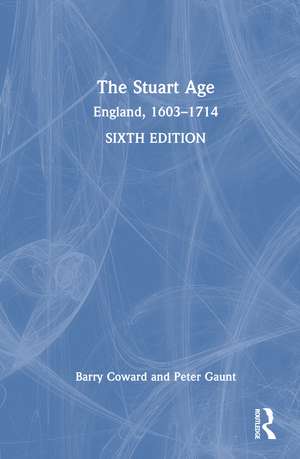
The Stuart Age: England, 1603–1714
Autor Barry Coward, Peter Gaunten Limba Engleză Hardback – 14 ian 2027
The sixth edition has been thoroughly revised and updated by Peter Gaunt to reflect new work and changing trends in research on the Stuart age. It expands on key areas, including the early Stuart social and economic contexts; recent work on gender, printing and print culture and the public sphere; key military events and debates surrounding the English Civil War and its causes, outcomes and consequences; England’s colonies and colonial expansion, foreign policy and wars and engagement with Continental Europe. While focusing on England, it also provides strong coverage of developments in Scotland and Ireland, and it also explores the position of Wales and the Welsh.
The Stuart Age is a long-standing favourite of lecturers and students of early modern English and British history, and this new edition is essential reading for those interested in or studying the Stuart period.
Preț: 1125.92 lei
Preț vechi: 1484.56 lei
-24% Precomandă
Puncte Express: 1689
Carte nepublicată încă
Livrare prin curier în România Precomanda se expediază când titlul devine disponibil.
Transport gratuit pentru acest produs Plată online sau ramburs, în funcție de opțiunile comenzii.
Retur gratuit în 14 zile Comandă securizată și suport în română.
Doresc să fiu notificat când acest titlu va fi disponibil:
Se trimite...
Specificații
ISBN-13: 9781032432311
ISBN-10: 1032432314
Pagini: 750
Ilustrații: 62
Dimensiuni: 156 x 234 mm
Greutate: 0.45 kg
Ediția:6
Editura: Taylor & Francis
Colecția Routledge
Locul publicării:Oxford, United Kingdom
ISBN-10: 1032432314
Pagini: 750
Ilustrații: 62
Dimensiuni: 156 x 234 mm
Greutate: 0.45 kg
Ediția:6
Editura: Taylor & Francis
Colecția Routledge
Locul publicării:Oxford, United Kingdom
V-ar putea interesa
-
 Oliver CromwellBarry CowardPreț: 464.16 lei
 -
 -18%Preț: 1057.86 lei1290.08 lei
 -
 The English Civil Wars 1642–1651Peter Gaunt-44%Preț: 60.14 lei107.94 lei
Public țintă
UndergraduateCuprins
List of maps, tables, genealogical tables and figures
Preface to the sixth edition
Explanatory notes and abbreviations
PART 1 Early Stuart England
Introduction
1. The economy of early Stuart England
2. The society of early Stuart England
3. The physical and mental horizons of the early Stuarts
4. The constitutional and political structures in early Stuart England: politics from above and from below
PART 2 The reigns of the Early Stuarts, 1603–1640
Introduction
5. The survival of the old system, 1603–1621
6. The collapse of the old system, 1621–1640
PART 3 The English Revolution, 1640–1660
Introduction
7. The making of the English Revolution, 1640–1649
8. The search for a new settlement, 1649–1660
PART 4 The reigns of Charles II and James II, 1660–1688
Introduction
9. The shortcomings of ‘the Restoration Settlement’, 1660–1674
10. Catholicism, crown and kingdom, 1674–1688
PART 5 The reigns of the Later Stuarts
Introduction
11. The reign of William III, 1689–1702, and of Mary II, to 1694
12. The reign of Queen Anne, 1702–1714
PART 6 Later Stuart England
Introduction
13. Later Stuart England: change and continuity at home
14. Later Stuart England: engagement with the wider world
Bibliography
Appendix: Timeline
Glossary of terms and concepts
Index
Preface to the sixth edition
Explanatory notes and abbreviations
PART 1 Early Stuart England
Introduction
1. The economy of early Stuart England
2. The society of early Stuart England
3. The physical and mental horizons of the early Stuarts
4. The constitutional and political structures in early Stuart England: politics from above and from below
PART 2 The reigns of the Early Stuarts, 1603–1640
Introduction
5. The survival of the old system, 1603–1621
6. The collapse of the old system, 1621–1640
PART 3 The English Revolution, 1640–1660
Introduction
7. The making of the English Revolution, 1640–1649
8. The search for a new settlement, 1649–1660
PART 4 The reigns of Charles II and James II, 1660–1688
Introduction
9. The shortcomings of ‘the Restoration Settlement’, 1660–1674
10. Catholicism, crown and kingdom, 1674–1688
PART 5 The reigns of the Later Stuarts
Introduction
11. The reign of William III, 1689–1702, and of Mary II, to 1694
12. The reign of Queen Anne, 1702–1714
PART 6 Later Stuart England
Introduction
13. Later Stuart England: change and continuity at home
14. Later Stuart England: engagement with the wider world
Bibliography
Appendix: Timeline
Glossary of terms and concepts
Index
Recenzii
Praise for Fifth Edition
The Stuart Age enjoys a hard-won reputation as one of the best introductions to the 'British Isles' during an era of civil war and revolution. This updated edition, containing much that is new, makes the volume still more indispensable to students and teachers alike.
Dr David Ceri Jones, Aberystwyth University, UK
The late Barry Coward’s The Stuart Age, 1603–1714 has long been regarded as the best single-volume introduction to the history of seventeenth-century England. This revised fifth edition elegantly updates Coward’s work for the post-Cameron generation. The book is prefaced with an excellent new introduction by Peter Gaunt, which surveys the dizzying quantity of new writing on the subject which has appeared since the fourth edition was published, in 2012, and incisively summarises the current state of the field. Gaunt’s deep knowledge of all aspects of seventeenth-century English life makes him the ideal scholar to refresh and rejuvenate Coward’s original text – and his work has ensured that, in its latest incarnation, The Stuart Age will continue to be required reading for all who teach and study this most fascinating of historical periods.
Mark Stoyle, University of Southampton, UK
The Stuart Age enjoys a hard-won reputation as one of the best introductions to the 'British Isles' during an era of civil war and revolution. This updated edition, containing much that is new, makes the volume still more indispensable to students and teachers alike.
Dr David Ceri Jones, Aberystwyth University, UK
The late Barry Coward’s The Stuart Age, 1603–1714 has long been regarded as the best single-volume introduction to the history of seventeenth-century England. This revised fifth edition elegantly updates Coward’s work for the post-Cameron generation. The book is prefaced with an excellent new introduction by Peter Gaunt, which surveys the dizzying quantity of new writing on the subject which has appeared since the fourth edition was published, in 2012, and incisively summarises the current state of the field. Gaunt’s deep knowledge of all aspects of seventeenth-century English life makes him the ideal scholar to refresh and rejuvenate Coward’s original text – and his work has ensured that, in its latest incarnation, The Stuart Age will continue to be required reading for all who teach and study this most fascinating of historical periods.
Mark Stoyle, University of Southampton, UK
Notă biografică
Barry Coward was Reader in History at Birkbeck College, University of London. His publications include Oliver Cromwell (2000) and The Cromwellian Protectorate (2002).
Peter Gaunt is Emeritus Professor of Early Modern History at the University of Chester and a current Vice President and past Chairman and past President of The Cromwell Association. His previous publications include studies of the civil wars of the 1640s in English, Welsh and British contexts, of Oliver Cromwell and of Protectoral central government. With Barry Coward, he is the author of English Historical Documents, 1603–1660 (2010), and with Roger Lockyer, of the most recent edition of Tudor and Stuart Britain, 1485–1714 (2019).
Peter Gaunt is Emeritus Professor of Early Modern History at the University of Chester and a current Vice President and past Chairman and past President of The Cromwell Association. His previous publications include studies of the civil wars of the 1640s in English, Welsh and British contexts, of Oliver Cromwell and of Protectoral central government. With Barry Coward, he is the author of English Historical Documents, 1603–1660 (2010), and with Roger Lockyer, of the most recent edition of Tudor and Stuart Britain, 1485–1714 (2019).
Descriere
The Stuart Age provides an introduction to the Elizabethan system of government in the early Stuart decades; the causes of the English civil war; the English Revolution; the aims and achievements of Oliver Cromwell; the continuation of religious passion in the politics of Restoration England; and the impact of the Glorious Revolution.