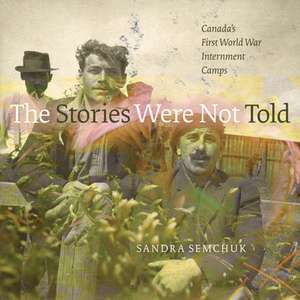
The Stories Were Not Told: Canada’s First World War Internment Camps
Autor Sandra Semchuken Limba Engleză Paperback – 11 dec 2018
Preț: 215.36 lei
Preț vechi: 256.85 lei
-16%
Puncte Express: 323
Preț estimativ în valută:
38.07€ • 45.08$ • 33.16£
38.07€ • 45.08$ • 33.16£
Carte disponibilă
Livrare economică 12-26 martie
Specificații
ISBN-13: 9781772123784
ISBN-10: 1772123781
Pagini: 352
Dimensiuni: 229 x 229 x 18 mm
Greutate: 0.94 kg
Editura: University of Alberta Press
Colecția University of Alberta Press
Locul publicării:Edmonton, Canada
ISBN-10: 1772123781
Pagini: 352
Dimensiuni: 229 x 229 x 18 mm
Greutate: 0.94 kg
Editura: University of Alberta Press
Colecția University of Alberta Press
Locul publicării:Edmonton, Canada
V-ar putea interesa
-
 -8%Preț: 488.67 lei531.16 lei
 -
 Preț: 232.05 lei
 -
 Hearts of Freedom: Stories of Southeast Asian RefugeesPeter DuschinskyPreț: 250.90 lei
 -
 When The Emperor Was DivineJulie Otsuka-28%Preț: 53.35 lei74.41 lei
 -
 No Free Man: Canada, the Great War, and the Enemy Alien ExperienceBohdan S. KordanPreț: 347.30 lei
 -
 Preț: 217.92 lei
 -
 Civilian Internment in CanadaRhonda L HintherPreț: 197.39 lei
 -
 All of Baba's ChildrenMyrna KostashPreț: 95.74 lei
 -
 -18%Preț: 138.34 lei168.21 leiNou
 -
 Soviet InternmentMaria Cristina Galmarini-11%Preț: 121.19 lei135.50 lei
 -
 -27%Preț: 76.16 lei103.95 lei
 -
 Preț: 130.71 lei
 -
 -18%Preț: 185.51 lei225.07 lei
 -
 My Family the EnemyKaren McCombie-27%Preț: 40.10 lei55.02 lei
 -
 CaptivesThe National ArchivesPreț: 124.36 lei
 -
 A Shadow of MyselfPeter FlammPreț: 102.31 lei
 -
 -15%Preț: 222.31 lei260.64 lei
 -
 Bread and WarFelicity SpectorPreț: 137.33 lei
Comentariile autorului
Full colour throughout, 154 photographs, foreword, notes, bibliography, index
Cuprins
1 Learning from the PastThe War Measures ActEnemy AliensFamilies in Danger2 Standing Where the Internees Stood3 Stories from Internees and DescendantsMary BayrakJerry BayrakPhilip Yasnowskyj, excerpt from “Internment”Nikola Sakaliuk, “WWI Internment Account of a Ukrainian at Fort Henry,” an interview by Lubomyr Y. LuciukFerdinand Zieroth, as told by grandson David ZierothWasyl Bobyk, as told by son Albert BobykEmile Litowski, as told by niece Christine WitiukVasyl Doskoch, as told by daughter Anne SadelainStefa (Mielniczuk) Pawliw, as told by granddaughter Kim PawliwPetro Witrowicz, as told by granddaughter Valdine CiwkoAnonymous, as told by a grandsonUncle’s Story, as told by nephew Andrew AntoniukYurko Forchuk, as told by son Marshall ForchukYuri Babjek and his brothers, John, Bill, and Theodore,as told by grandson Nick TopolnyskiMikhail Danyluk, as told by granddaughter Florence McKieFrederick, Hilda, and Fred Jr. Kohse, as told by son and brother Gerald KohseMetro Olynyk, as told by son Fred OlynykMaksym Boyko, as told by son Otto and daughter-in-law Kathleen BoykoWilliam Sharun, as told by son Lawrence SharunHarry Levitsky, as told by step-granddaughter Donna Korchinski4 Spirit Lake Photographs5 Engaging Memory WorkA Loss of IdentityThey Were KidsAuthorities Can’t Control MemoryTelling the Story as ResistanceHumiliationThese Are the Last Flowers I Will See in My LifeHealingResilienceThe Doors Open
Recenzii
"To dwell in this book's pages is to experience dismay, sadness and sobering revelation. Finally though, a century later, internment stories are being told, making our nation's history more authentic."
"The book is a melding of Semchuk’s personal journey, visual art, narrative, and recall.... The Stories Were Not Told is an intriguing composition, stimulating thought and offering an artistic integrative approach to history and culture.... This grounding of the human experience through a variety of approaches reveals more than history per se." [Full review at https://ormsbyreview.com/2020/05/13/823-regular-hinther-mochoruk-semchuk-black-internment/]
"[The author] underscores the linkage between the past and the present and the potential implications of not doing the individual and collective “memory work” that forces us to confront our personal and national histories in a meaningful and respectful fashion. It is a powerful invocation—and one we should heed."
"The book is a melding of Semchuk’s personal journey, visual art, narrative, and recall.... The Stories Were Not Told is an intriguing composition, stimulating thought and offering an artistic integrative approach to history and culture.... This grounding of the human experience through a variety of approaches reveals more than history per se." [Full review at https://ormsbyreview.com/2020/05/13/823-regular-hinther-mochoruk-semchuk-black-internment/]
"[The author] underscores the linkage between the past and the present and the potential implications of not doing the individual and collective “memory work” that forces us to confront our personal and national histories in a meaningful and respectful fashion. It is a powerful invocation—and one we should heed."