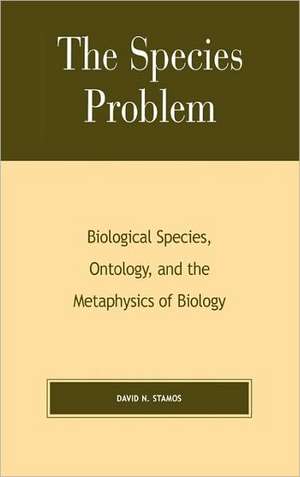
The Species Problem
Autor David N. Stamosen Limba Engleză Hardback – 16 mar 2003
| Toate formatele și edițiile | Preț | Express |
|---|---|---|
| Paperback (1) | 366.38 lei 6-8 săpt. | |
| Bloomsbury Publishing – 9 feb 2004 | 366.38 lei 6-8 săpt. | |
| Hardback (1) | 800.64 lei 6-8 săpt. | |
| Rowman & Littlefield – 16 mar 2003 | 800.64 lei 6-8 săpt. |
Preț: 800.64 lei
Preț vechi: 1096.77 lei
-27%
Puncte Express: 1201
Preț estimativ în valută:
141.79€ • 165.59$ • 123.17£
141.79€ • 165.59$ • 123.17£
Carte tipărită la comandă
Livrare economică 21 februarie-07 martie
Preluare comenzi: 021 569.72.76
Specificații
ISBN-13: 9780739105030
ISBN-10: 0739105035
Pagini: 390
Dimensiuni: 163 x 236 x 34 mm
Greutate: 0.86 kg
Ediția:New.
Editura: Rowman & Littlefield
ISBN-10: 0739105035
Pagini: 390
Dimensiuni: 163 x 236 x 34 mm
Greutate: 0.86 kg
Ediția:New.
Editura: Rowman & Littlefield
V-ar putea interesa
-
 The Aesthetic Mind: Philosophy and PsychologyElisabeth Schellekens-18%Preț: 337.84 lei412.18 lei
 -
 Emotion and ValueSabine Roeser-34%Preț: 518.89 lei782.28 lei
 -
 -27%Preț: 123.09 lei168.10 lei
 -
 -12%Preț: 164.59 lei188.06 lei
Notă biografică
Descriere scurtă
Cuprins
Part 1 Introduction
Chapter 2 The Species Problem and the Problem of Universals
Chapter 3 Ontology and Criteria of Reality
Chapter 4 Preliminary Assumptions and Concepts
Chapter 5 Abstract of the Book
Part 6 Species Nominalism
Chapter 7 Preliminary Considerations
Chapter 8 Occam and Locke
Chapter 9 Buffon, Lamarck, and Darwin
Chapter 10 Modern Nominalists in Biology
Part 11 Species as Classes
Chapter 12 Plato, Aristotle, and Linnaeus
Chapter 13 Species as Elementary Classes
Chapter 14 Species as Cluster Classes
Chapter 15 Species as Ecological Niches
Chapter 16 Problems with Species as Classes
Part 17 Species as Individuals
Chapter 18 Precursors from Hegel to Mayr
Chapter 19 Ghiselin, Hull, et al.
Chapter 20 Punctuated Equilibria
Chapter 21 Problems with Species as Individuals
Chapter 22 Species as Sets, Clades, and Lineages
Part 23 Species as Relations
Chapter 24 The Origin of an Idea
Chapter 25 Species as Biosimilarity Complexes
Chapter 26 Problems with Species as Relations
Chapter 27 Concluding Remarks
Chapter 2 The Species Problem and the Problem of Universals
Chapter 3 Ontology and Criteria of Reality
Chapter 4 Preliminary Assumptions and Concepts
Chapter 5 Abstract of the Book
Part 6 Species Nominalism
Chapter 7 Preliminary Considerations
Chapter 8 Occam and Locke
Chapter 9 Buffon, Lamarck, and Darwin
Chapter 10 Modern Nominalists in Biology
Part 11 Species as Classes
Chapter 12 Plato, Aristotle, and Linnaeus
Chapter 13 Species as Elementary Classes
Chapter 14 Species as Cluster Classes
Chapter 15 Species as Ecological Niches
Chapter 16 Problems with Species as Classes
Part 17 Species as Individuals
Chapter 18 Precursors from Hegel to Mayr
Chapter 19 Ghiselin, Hull, et al.
Chapter 20 Punctuated Equilibria
Chapter 21 Problems with Species as Individuals
Chapter 22 Species as Sets, Clades, and Lineages
Part 23 Species as Relations
Chapter 24 The Origin of an Idea
Chapter 25 Species as Biosimilarity Complexes
Chapter 26 Problems with Species as Relations
Chapter 27 Concluding Remarks
Recenzii
Stamos provides a thorough introduction to the debate over the ontological status of species. He offers the innovative suggestion that species are neither classes nor individuals, but relations. Stamos's approach is a fresh alternative to the standard, well-worn positions.
This is an important book on an important topic. David Stamos deals with one of the hardest issues in the philosophy of biology, the 'species problem,' showing philosophical sensitivity and scientific understanding. It will be essential reading for all further work on the topic, and is a real joy to read in its own right.
...I recommend this book as a handy reference for a wide range of views on the species question...
Stamos' study deserves high praise. It is the most comprehensive survey of the literature on the question of "species" - how to define the term, how to classify it among other biological terms, how it was historically used and misused, how it relates to other questions of ontology (what there is) and epistemology (what do we know and how we get to know it), and how it is bound with serious philosophical questions about Universals (do they exist?, are they nothing but a collection of Individuals?) and Essentialism (does something have certain characteristics that are essential or secondary to its very nature and existence?), to name just two categories. The book is well organized, clearly written, broadly researched, and meticulously referenced.as such, this book should become a standard reference to anyone interested in biology form theoretical and practical perspectives alike.
Stamos has brought together in one substantial volume almost everything one would ever want to know about how biologists and philosophers of biology have understood the word 'species.' More than that, he has shown what makes understanding this word crucial for biological explanation and scientific ontology. His book honors the close connection between analytical metaphysics and biological theorizing.
This is an important book on an important topic. David Stamos deals with one of the hardest issues in the philosophy of biology, the 'species problem,' showing philosophical sensitivity and scientific understanding. It will be essential reading for all further work on the topic, and is a real joy to read in its own right.
...I recommend this book as a handy reference for a wide range of views on the species question...
Stamos' study deserves high praise. It is the most comprehensive survey of the literature on the question of "species" - how to define the term, how to classify it among other biological terms, how it was historically used and misused, how it relates to other questions of ontology (what there is) and epistemology (what do we know and how we get to know it), and how it is bound with serious philosophical questions about Universals (do they exist?, are they nothing but a collection of Individuals?) and Essentialism (does something have certain characteristics that are essential or secondary to its very nature and existence?), to name just two categories. The book is well organized, clearly written, broadly researched, and meticulously referenced.as such, this book should become a standard reference to anyone interested in biology form theoretical and practical perspectives alike.
Stamos has brought together in one substantial volume almost everything one would ever want to know about how biologists and philosophers of biology have understood the word 'species.' More than that, he has shown what makes understanding this word crucial for biological explanation and scientific ontology. His book honors the close connection between analytical metaphysics and biological theorizing.