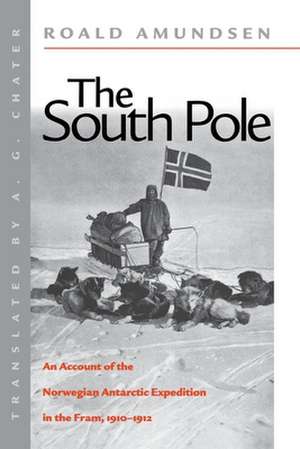
The South Pole
Autor Roald Amundsen Traducere de A G Chateren Limba Engleză Paperback – apr 2001
"Roald Amundsen planted the Norwegian flag on the South Pole on December 14, 1911: a full month before Robert Falcon Scott arrived on the same spot. Amundsen's 'The South Pole' is less well-known than his rival's, in part because he is less of a literary stylist, but also, perhaps, because he survived the journey. His book is a riveting first-hand account of a truly professional expedition; Amundsen's heroism is understated, but it is heroism nonetheless."
--"The Times of London," 23 June 2001
At the beginning of the twentieth century, the South Pole was the most coveted prize in the fiercely nationalistic modern age of exploration. In the spring of 1911 two separate expeditions left their respective camps in Antarctica in a desperate bid to achieve the glory of being first to reach the South Pole: a British party, led by Captain R. F. Scott, and a Norwegian one under Captain Roald Amundsen. The South Pole, Amundsen's first-hand account of the expedition, is a fascinating and highly readable history of the tenacity and perseverance of the age.
"The last of the Vikings," Roald Engebreth Gravning Amundsen was a powerfully built man of over six feet in height, born into a family of merchant sea captains in 1872. In 1903 he navigated the Northwest Passage in a 70-foot fishing boat. Soon afterwards he learned that Ernest Shackleton was setting out on an attempt to reach the South Pole. Shackleton abandoned his quest a mere 97 miles short of the Pole, but Amundsen began preparing his own expedition. Although this was the age of the amateur explorer, Amundsen was a professional: he left little to chance, apprenticed with Inuits, and obsessed over every detail.
On October 18, 1911 Amundsen's party set out from the Bay of Whales, on Antarctica's Ross Ice Shelf, for their final drive toward the pole. His British counterpart, Robert Falcon Scott, dependent on Siberian ponies rather than on dogs, began his trip three weeks later. While Scott clung fast to the British rule of "No skis, no dogs," Amundsen understood that both were vital to survival. Aided by exceptionally cooperative weather conditions, Amundsen's men passed the point where Shackleton was forced to turn back on December 7, and at approximately 3pm on December 14, 1911, Roald Amundsen raised the flag of Norway at the South Pole, one month before Scott's party would arrive.
A polar masterpiece of history and adventure, The South Pole is the stunning first-hand account of one of the greatest success stories in the annals of exploration. Most skillfully Amundsen constructs the expedition's character through its personalitiesthe cast of veteran explorers, scientists, and crewproviding insight not only into Amundsen's philosophy of exploration, but into the classical age of polar explorers."
Preț: 311.68 lei
Puncte Express: 468
Carte tipărită la comandă
Livrare economică 09-23 iunie
Specificații
ISBN-13: 9780814706985
ISBN-10: 0814706983
Pagini: 896
Dimensiuni: 138 x 215 x 52 mm
Greutate: 1.18 kg
Editura: NEW YORK UNIVERSITY PRESS
ISBN-10: 0814706983
Pagini: 896
Dimensiuni: 138 x 215 x 52 mm
Greutate: 1.18 kg
Editura: NEW YORK UNIVERSITY PRESS
V-ar putea interesa
-
 The Worst Journey in the WorldApsley Cherry-Garrard-17%Preț: 87.56 lei106.09 lei
 -
 The Last ExpeditionR. F. Scott-19%Preț: 73.65 lei90.61 lei
 -
 Journals: Captain Scott's Last ExpeditionRobert Falcon Scott-16%Preț: 53.86 lei64.46 lei
 -
 The North PoleErling KaggePreț: 152.48 lei
 -
 The Last VikingStephen R. BownPreț: 128.98 lei
 -
 Victim of the AuroraThomas Keneally-28%Preț: 48.65 lei67.93 lei
 -
 Scott And Amundsen: The Last Place on EarthRoland Huntford-27%Preț: 86.41 lei117.73 lei
 -
 The Last Place on EarthRoland HuntfordPreț: 126.53 lei
 -
 -25%Preț: 136.83 lei182.77 lei
 -
 Scott of the Antarctic's Deadly Race to the South PoleJohn Micklos Jr.Preț: 54.12 lei
 -
 SouthErnest Henry ShackletonPreț: 75.66 lei
 -
 South: The last Antarctic expedition of Shackleton and the EnduranceSir Ernest Shackleton-25%Preț: 51.76 lei69.35 lei
 -
 Famous Firsts: First Man to the South PoleBen Hubbard-37%Preț: 64.95 lei102.82 lei
 -
 -19%Preț: 56.63 lei69.70 lei
 -
 ShackletonMichael SmithPreț: 55.17 lei
 -
 South!Ernest Henry Shackleton-10%Preț: 63.24 lei70.63 lei
 -
 Amundsen's WayJoanna Grochowicz-35%Preț: 42.17 lei64.67 lei
 -
 Roald Amundsen's Sled DogsMary R. Tahan-15%Preț: 469.71 lei552.60 lei
 -
 The Return of the South Pole Sled DogsMary R. TahanPreț: 257.76 lei
Cuprins
The first account; Introduction; 1. The history of the South Pole; 2. Plan and preparations; 3. On the way to the south; 4. From Madeira to the barrier; 5. On the barrier; 6. Depot journeys; 7. Preparing for winter; 8. A day at Framheim; 9. The end of the winter.
Descriere
Descriere de la o altă ediție sau format:
The 1912 English translation of the two-volume illustrated account of how Roald Amundsen's Norwegian team reached the South Pole first.
The 1912 English translation of the two-volume illustrated account of how Roald Amundsen's Norwegian team reached the South Pole first.