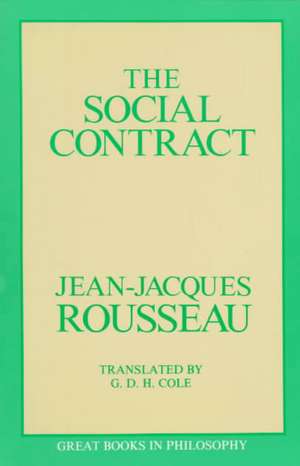
The Social Contract
Autor Jean-Jacques Rousseauen Limba Engleză Paperback – mar 1988
What is the content of human nature and how does it compel mankind to come together to create a civil society? What form does this society take? What benefits does it offer its citizens, and what must each individual sacrifice to reap its rewards? How does sovereign power manifest itself, and what consequences follow for those who choose not to abide by the "general will"? Does Rousseau's political theory set forth a blueprint for democracyone that results in equality, universal suffrage, and popular sovereigntyor is it a recipe for central state totalitarianism? These are just a few of the complex questions that will confront readers of The Social Contract.
Whatever their intent or iltimate result, Jean-Jacques Rousseau's views on the state and man's relationship to it have culminated in one of the most powerful and compelling pieces of political philosophy ever written.
| Toate formatele și edițiile | Preț | Express |
|---|---|---|
| Paperback (9) | 39.90 lei 3-5 săpt. | +16.29 lei 6-10 zile |
| Penguin Books – 2 sep 2004 | 42.70 lei 23-34 zile | +16.29 lei 6-10 zile |
| Arcturus Publishing – 15 iul 2017 | 47.74 lei 3-5 săpt. | +5.70 lei 6-10 zile |
| Penguin Publishing Group – 30 iun 1968 | 57.33 lei 3-5 săpt. | +24.85 lei 6-10 zile |
| Penguin Publishing Group – 30 mai 2006 | 59.56 lei 3-5 săpt. | |
| e-artnow – 15 apr 2019 | 39.90 lei 3-5 săpt. | |
| CREATESPACE – | 40.15 lei 3-5 săpt. | |
| Lulu.Com – 7 sep 2018 | 61.72 lei 6-8 săpt. | |
| CreateSpace Independent Publishing Platform – | 66.60 lei 3-5 săpt. | |
| Globe Pequot Publishing Group Inc – mar 1988 | 81.42 lei 3-5 săpt. | |
| Hardback (3) | 61.85 lei 3-5 săpt. | +8.100 lei 6-10 zile |
| Arcturus Publishing – mar 2025 | 61.85 lei 3-5 săpt. | +8.100 lei 6-10 zile |
| Arcturus Publishing – apr 2025 | 67.63 lei 3-5 săpt. | |
| Synergy International of the Americas, Ltd – 15 iul 2007 | 260.41 lei 6-8 săpt. |
Preț: 81.42 lei
Puncte Express: 122
Preț estimativ în valută:
14.40€ • 16.51$ • 12.45£
14.40€ • 16.51$ • 12.45£
Carte disponibilă
Livrare economică 08-22 aprilie
Specificații
ISBN-13: 9780879754440
ISBN-10: 0879754443
Pagini: 138
Dimensiuni: 141 x 216 x 10 mm
Greutate: 0.2 kg
Editura: Globe Pequot Publishing Group Inc
ISBN-10: 0879754443
Pagini: 138
Dimensiuni: 141 x 216 x 10 mm
Greutate: 0.2 kg
Editura: Globe Pequot Publishing Group Inc
V-ar putea interesa
-
 On the Shortness of LifeLucius Annaeus Seneca-22%Preț: 42.02 lei53.76 lei
 -
 Confessions of a SinnerSaint Augustine-22%Preț: 42.20 lei53.88 lei
 -
 On FriendshipMichel De Montaigne-22%Preț: 42.34 lei53.95 lei
 -
 On the Pleasure of HatingWilliam Hazlitt-22%Preț: 42.24 lei53.88 lei
 -
 The Communist ManifestoFriedrich Engels-21%Preț: 42.34 lei53.93 lei
 -
 On the Suffering of the WorldArthur Schopenhauer-31%Preț: 37.31 lei53.98 lei
 -
 On Art and LifeJohn Ruskin-22%Preț: 42.00 lei53.75 lei
 -
 On Natural SelectionCharles Darwin-22%Preț: 41.94 lei53.80 lei
 -
 Why I am So WiseFriedrich Nietzsche-22%Preț: 41.79 lei53.61 lei
 -
 Why I WriteGeorge Orwell-22%Preț: 42.16 lei53.85 lei
 -
 The First Ten BooksConfucius-22%Preț: 41.60 lei53.50 lei
 -
 The Art of WarSun Tzu-22%Preț: 42.00 lei53.75 lei
 -
 Fear and TremblingSøren Kierkegaard-21%Preț: 42.59 lei54.11 lei
 -
 On SuicideDavid Hume-22%Preț: 42.24 lei53.87 lei
 -
 Conspicuous ConsumptionThorstein Veblen-30%Preț: 38.36 lei54.68 lei
 -
 Books v. CigarettesGeorge OrwellPreț: 53.99 lei
 -
 The Fastidious AssassinsAlbert CamusPreț: 53.91 lei
 -
 The Sickness Unto DeathSøren Kierkegaard-21%Preț: 42.83 lei54.26 lei
 -
 The Lamp of MemoryJohn RuskinPreț: 53.99 lei
 -
 Useful Work v. Useless ToilWilliam MorrisPreț: 53.75 lei
 -
 Days of ReadingMarcel ProustPreț: 53.75 lei
 -
 The Future of an IllusionSigmund FreudPreț: 53.68 lei
 -
 An Answer to the Question: 'What is Enlightenment?'Immanuel Kant-21%Preț: 42.47 lei54.02 lei
 -
 Why Look at Animals?John BergerPreț: 53.78 lei
 -
 The Moral Essays (Operette Morali)LeopardiPreț: 273.75 lei
 -
 PassionsGiacomo LeopardiPreț: 481.86 lei
 -
 Dogs of God: Columbus, the Inquisition, and the Defeat of the MoorsJr. Reston, JamesPreț: 114.66 lei
 -
 Moral FablesGiacomo LeopardiPreț: 69.29 lei
Descriere
Descriere de la o altă ediție sau format:
This volume brings together three of Rousseau's most important political writings--The Social Contract and The First Discourse (Discourse on the Sciences and Arts) and The Second Discourse (Discourse on the Origin and Foundations of Inequality)--and presents essays by major scholars that shed light on these texts.
This volume brings together three of Rousseau's most important political writings--The Social Contract and The First Discourse (Discourse on the Sciences and Arts) and The Second Discourse (Discourse on the Origin and Foundations of Inequality)--and presents essays by major scholars that shed light on these texts.
Notă biografică
Jean-Jacques Rousseau (1712-78) the French political philosopher and educationalist, is the author of A Discourse on Inequality, and Emile.
Maurice Cranston was Professor of Political Science at the London School of Economics and wrote and published widely on Rousseau, including two volumes of biography.
Maurice Cranston was Professor of Political Science at the London School of Economics and wrote and published widely on Rousseau, including two volumes of biography.
Cuprins
The Social Contract Translator's acknowledgments
Introduction
Foreword
Book I
Book II
Book III
Book IV
Introduction
Foreword
Book I
Book II
Book III
Book IV