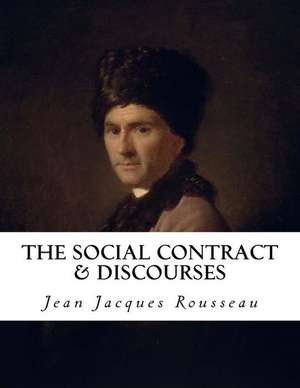
The Social Contract & Discourses
Autor Jean Jacques Rousseau Editat de Ernest Rhys Traducere de G. D. H. Coleen Limba Engleză Paperback
Preț: 72.93 lei
Puncte Express: 109
Carte disponibilă
Livrare economică 16-30 noiembrie
Livrare prin curier în România Termenul estimat este afișat lângă disponibilitate.
Transport gratuit de la 400.00 lei Plată online sau ramburs, în funcție de opțiunile comenzii.
Retur gratuit în 14 zile Comandă securizată și suport în română.
Specificații
ISBN-13: 9781533648532
ISBN-10: 1533648530
Pagini: 154
Dimensiuni: 216 x 280 x 8 mm
Greutate: 0.37 kg
ISBN-10: 1533648530
Pagini: 154
Dimensiuni: 216 x 280 x 8 mm
Greutate: 0.37 kg
Notă biografică
Jean-Jacques Rousseau (28 June 1712 - 2 July 1778) was a Genevan philosopher, writer and composer. His political philosophy influenced the progress of the Enlightenment throughout Europe, as well as aspects of the French Revolution and the development of modern political, economic and educational thought. His Discourse on Inequality and The Social Contract are cornerstones in modern political and social thought. Rousseau's sentimental novel Julie, or the New Heloise (1761) was important to the development of preromanticism and romanticism in fiction.[2][3] His Emile, or On Education (1762) is an educational treatise on the place of the individual in society. Rousseau's autobiographical writings-the posthumously published Confessions (composed in 1769), which initiated the modern autobiography, and the unfinished Reveries of a Solitary Walker (composed 1776-1778)-exemplified the late-18th-century "Age of Sensibility", and featured an increased focus on subjectivity and introspection that later characterized modern writing. Rousseau befriended fellow philosophy writer Denis Diderot in 1742, and would later write about Diderot's romantic troubles in his Confessions. During the period of the French Revolution, Rousseau was the most popular of the philosophers among members of the Jacobin Club. He was interred as a national hero in the Panthéon in Paris, in 1794, 16 years after his death. Rousseau was born in Geneva, which was at the time a city-state and a Protestant associate of the Swiss Confederacy. Since 1536, Geneva had been a Huguenot republic and the seat of Calvinism. Five generations before Rousseau, his ancestor Didier, a bookseller who may have published Protestant tracts, had escaped persecution from French Catholics by fleeing to Geneva in 1549, where he became a wine merchant