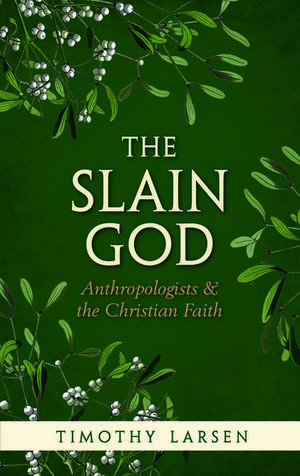
The Slain God: Anthropologists and the Christian Faith
Autor Timothy Larsenen Limba Engleză Hardback – 28 aug 2014
Preț: 354.00 lei
Preț vechi: 397.76 lei
-11%
Puncte Express: 531
Carte tipărită la comandă
Livrare economică 29 octombrie-04 noiembrie
Livrare prin curier în România Termenul estimat este afișat lângă disponibilitate.
Transport gratuit de la 400.00 lei Plată online sau ramburs, în funcție de opțiunile comenzii.
Retur gratuit în 14 zile Comandă securizată și suport în română.
Specificații
ISBN-13: 9780199657872
ISBN-10: 0199657874
Pagini: 266
Dimensiuni: 148 x 222 x 23 mm
Greutate: 0.46 kg
Editura: OUP OXFORD
Colecția OUP Oxford
Locul publicării:Oxford, United Kingdom
ISBN-10: 0199657874
Pagini: 266
Dimensiuni: 148 x 222 x 23 mm
Greutate: 0.46 kg
Editura: OUP OXFORD
Colecția OUP Oxford
Locul publicării:Oxford, United Kingdom
V-ar putea interesa
-
 The Hastening that Waits: Karl Barth's EthicsNigel Biggar-29%Preț: 389.67 lei545.95 lei
 -
 Christianity and Liberal SocietyRobert Song-11%Preț: 508.49 lei571.34 lei
 -
 -31%Preț: 931.61 lei1355.01 lei
 -
 Canon and Criterion in Christian Theology: From the Fathers to FeminismWilliam J. Abraham-31%Preț: 630.07 lei911.49 lei
 -
 Crisis of Doubt: Honest Faith in Nineteenth-Century EnglandTimothy Larsen-11%Preț: 353.78 lei398.19 lei
 -
 Life in the Flesh: An Anti-Gnostic Spiritual PhilosophyAdam G. Cooper-31%Preț: 724.87 lei1053.19 lei
 -
 -25%Preț: 405.12 lei540.63 lei
 -
 -14%Preț: 298.25 lei347.26 lei
 -
 A People of One Book: The Bible and the VictoriansTimothy Larsen-17%Preț: 283.41 lei339.94 lei
 -
 Good God: The Theistic Foundations of MoralityDavid Baggett-13%Preț: 302.85 lei347.00 lei
 -
 SatanHenry Ansgar KellyPreț: 224.32 lei
 -
 An Introduction to ChristianityLinda WoodheadPreț: 332.62 lei
 -
 God, Freedom, and EvilAlvin PlantingaPreț: 87.66 lei
 -
 Losing Our VirtueDavid F WellsPreț: 147.82 lei
 -
 The Ethical Thought of Hans Urs von BalthasarChristopher SteckPreț: 223.17 lei
 -
 Bernard of ClairvauxDennis TamburelloPreț: 109.99 lei
 -
 -43%Preț: 94.38 lei165.92 lei
 -
 Preț: 62.60 lei
Recenzii
This is a startling book. Many anthropologists do not realize how deeply religious many of the great anthropologists of religion have been. The Slain God raises the question of how faith shapes what the anthropologist sees, and it will change the way the reader thinks about the answer.
Larsen's book is beautifully written and based on the most patient scrutiny of every scrap of evidence. It provides an authoritative account of some of anthropology's most influential practitioners.
Larsen shines a bright sidelight on the history of social anthropology and of it treatment of Christianity
Larsen tells the story beautifully in his narrative biographical style.
As in his earlier work, Larsen disrupts a teleological vision of religion condemned to disappear before the forces of progress and modernity. He is to be congratulated for challenging this narrative head-on and confronting what amounts to anti-religious bias in the human sciences.
This well-written and finely research book ... should be widely discussed in a variety of circles concerned with anthropology, religious studies, theology and the history of religion
a welcome contribution to the history of anthropology ... Larsen's narrative and sharp observations skilfully weave together authors' biographical experiences with their theoretical and ethnographic findings ... I hope this book will break for good certain unspoken taboos in the discipline that one cannot be at the same time a serious anthropologist and a practising 'believer'.
One of the many virtues of Larsen's study is its revealing of the 'all too human' character of the scholarship by the anthropologists he examines.
Readers interested in continuing debates over faith, science and secularism will find much of value in this very important book. The further you get into the book, the more astonished you are that no predecessor has written such a full-length study of this critically important topic.
Witty, penetrating, following the evidence where it leads, this book is a great delight.
Larsen has broken new ground in an area that was overgrown with the weeds of anecdote and myth. The subject has the quality of an 'elephant in the room' among both Christians and anthropologists, each of whom seem to feel that the other has nothing to offer. Quite the contrary, Larsen has demonstrated that the two are uneasy siblings, some believers and some skeptics, but siblings nonetheless.
Larsen's book is clearly and delightfully written. It is, he says, the first book-length study of the subject, and it is as welcome as it is overdue
In his latest book, The Slain God , Timothy Larsen provides a compelling account of the complex relationship between anthropology and the Christian faith . . . His is the first book-length study of the relationship between anthropology and Christianity and as such is of interest to anyone who wishes to understand this relationship better. The book is also particularly timely in view of the recent resurgence of interest in these issues in the anthropology of Christianity.
This book will be greeted as something of a bombshell amongst anthropologists of religion...a highly original book that should be with us for a long time to come.
Larsen provides a most satisfying study ... Beautifully written and carrying lightly an immense amount of historical and literary research well placed in the extensive footnotes to each chapter, one is impressed with the fullness of Larsens explorations ... By bringing so many strands together in a remarkably complete documentation of all sources, Larsens work stands as difficult to refute by those intoxicated with the fable that anthropology is of its nature secular, that all religion is illogical and beyond analytical remit, save to destroy it and that faith is incompatible with the good works of the discipline.
Larsen's book is beautifully written and based on the most patient scrutiny of every scrap of evidence. It provides an authoritative account of some of anthropology's most influential practitioners.
Larsen shines a bright sidelight on the history of social anthropology and of it treatment of Christianity
Larsen tells the story beautifully in his narrative biographical style.
As in his earlier work, Larsen disrupts a teleological vision of religion condemned to disappear before the forces of progress and modernity. He is to be congratulated for challenging this narrative head-on and confronting what amounts to anti-religious bias in the human sciences.
This well-written and finely research book ... should be widely discussed in a variety of circles concerned with anthropology, religious studies, theology and the history of religion
a welcome contribution to the history of anthropology ... Larsen's narrative and sharp observations skilfully weave together authors' biographical experiences with their theoretical and ethnographic findings ... I hope this book will break for good certain unspoken taboos in the discipline that one cannot be at the same time a serious anthropologist and a practising 'believer'.
One of the many virtues of Larsen's study is its revealing of the 'all too human' character of the scholarship by the anthropologists he examines.
Readers interested in continuing debates over faith, science and secularism will find much of value in this very important book. The further you get into the book, the more astonished you are that no predecessor has written such a full-length study of this critically important topic.
Witty, penetrating, following the evidence where it leads, this book is a great delight.
Larsen has broken new ground in an area that was overgrown with the weeds of anecdote and myth. The subject has the quality of an 'elephant in the room' among both Christians and anthropologists, each of whom seem to feel that the other has nothing to offer. Quite the contrary, Larsen has demonstrated that the two are uneasy siblings, some believers and some skeptics, but siblings nonetheless.
Larsen's book is clearly and delightfully written. It is, he says, the first book-length study of the subject, and it is as welcome as it is overdue
In his latest book, The Slain God , Timothy Larsen provides a compelling account of the complex relationship between anthropology and the Christian faith . . . His is the first book-length study of the relationship between anthropology and Christianity and as such is of interest to anyone who wishes to understand this relationship better. The book is also particularly timely in view of the recent resurgence of interest in these issues in the anthropology of Christianity.
This book will be greeted as something of a bombshell amongst anthropologists of religion...a highly original book that should be with us for a long time to come.
Larsen provides a most satisfying study ... Beautifully written and carrying lightly an immense amount of historical and literary research well placed in the extensive footnotes to each chapter, one is impressed with the fullness of Larsens explorations ... By bringing so many strands together in a remarkably complete documentation of all sources, Larsens work stands as difficult to refute by those intoxicated with the fable that anthropology is of its nature secular, that all religion is illogical and beyond analytical remit, save to destroy it and that faith is incompatible with the good works of the discipline.
Notă biografică
Timothy Larsen is McManis Professor of Christian Thought, Wheaton College, Wheaton, Illinois. He is a Fellow of both the Royal Historical Society and the Royal Anthropological Institute. He has been a Visiting Fellow, Trinity College, Cambridge, and some of the research for this volume was undertaken while a Visiting Fellow, All Souls College, Oxford. His previous monographs published by Oxford University Press are Crisis of Doubt: Honest Faith in Nineteenth-Century England and A People of One Book: The Bible and the Victorians.